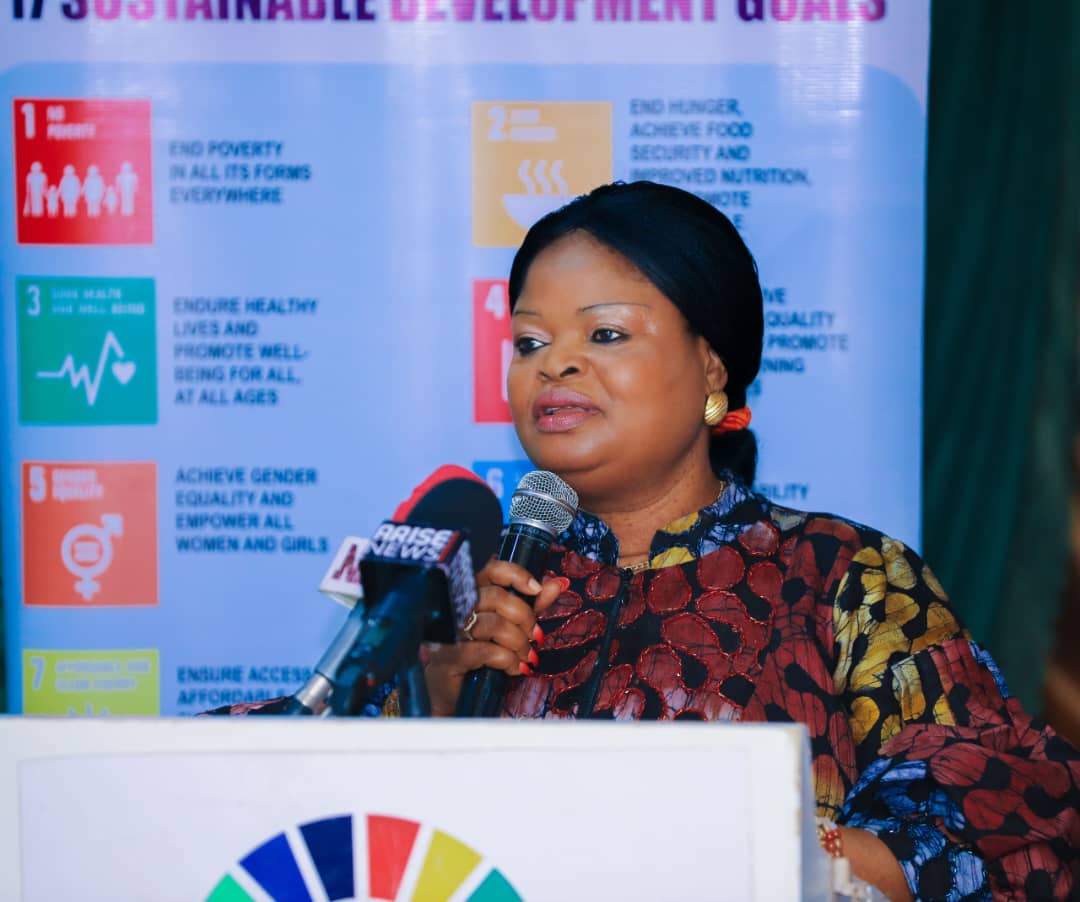
—As Orelope-Adefulire calls on states to deliver measurable progress on SDGs
By Johnbosco Agbakwuru
ABUJA — WITH less than five years left until the 2030 deadline, Princess Adejoke Orelope-Adefulire, Senior Special Assistant to the President on Sustainable Development Goals (SDGs), has urged states and stakeholders across Nigeria to move beyond commitments and deliver measurable results.
She emphasized that Nigeria’s success hinges on urgent action at all levels—subnational, governmental, and societal.
Speaking at a one-day Roundtable Dialogue with State SDGs Focal Persons in Abuja, Orelope-Adefulire stressed that the last five years demand greater coordination, innovation, and strong ownership at the state level if Nigeria is to meet its SDG targets.
She highlighted the crucial role of state focal persons in linking national policies with grassroots realities, calling for full mainstreaming of the SDGs into state budgets and development plans.
The presidential aide in a statement by Desmond Utomwen, her Special Assistant on Media, Publicity and Strategic Communication, was quoted as saying: “Our discussions must be honest, bold, and action-oriented. We must shift from commitment to results. The SDGs concern real people, real communities, and real change.”
She also warned that sustainable development cannot be achieved without sustainable financing, urging states to reduce reliance on external aid.
Orelope-Adefulire revealed that 17 states have yet to domesticate and integrate the SDGs into their governance frameworks—a major barrier to national progress.
“This is a national agenda, not just a federal or state government initiative. Achieving the SDGs depends on all tiers of government working together,” she affirmed.
While 20 states have aligned their plans with SDG targets and indicators, the rest must act swiftly to ensure their budgets reflect national priorities.
“When you spend 10 Naira, we want to know what portion goes to addressing poverty, hunger, education, healthcare, or job creation at the grassroots,” she added.
She urged development efforts to be driven from the bottom up, with states and local governments ensuring that increased federal allocations translate to visible community benefits.
Stress was placed on the need for states to mobilize domestic resources and reduce dependence on foreign aid.
“It is no longer enough to wait on external support. We must look inward, leverage what we have, and use resources efficiently,” Orelope-Adefulire stated.
The Abuja dialogue brought together SDG focal persons nationwide to share experiences, strengthen data systems, and forge partnerships designed to leave no one behind.
At the event, Julius Okunbor, Edo State’s Director-General for SDGs, described the dialogue as “an eye-opener,” noting that Edo’s SDG activities have been revitalized and are accelerating implementation.
“Many assume there is abundant donor funding in SDG coffers, but the truth is, we need to work with what we have, minimize leakages, and manage budgets prudently,” Okunbor said.
Similarly, Kenechukwu Nwosu, Special Adviser to Abia State Governor on Basic and Secondary Education, shared how integrating SDGs across sectors such as infrastructure, health, agriculture, and sanitation is driving tangible progress in Abia.
“We have strong partnerships with municipal governments and local leaders. Social mobilization and grassroots engagement are critical to our success,” Nwosu said, adding that financial discipline allows the state to meet counterpart funding obligations without taking loans.
In conclusion, Orelope-Adefulire urged participants to rise to the challenge and make the dialogue a turning point in Nigeria’s collective efforts to achieve the SDGs.
“The SDGs are not abstract goals; they are about real people and real change. Every state must play its part. For the 17 states yet to domesticate the goals, the time to act is now,” she stressed.
With 2030 fast approaching, it is clear that Nigeria’s sustainable development future will depend as much on the actions taken in state capitals, local governments, and communities as on federal policies.
Disclaimer
Comments expressed here do not reflect the opinions of Vanguard newspapers or any employee thereof.