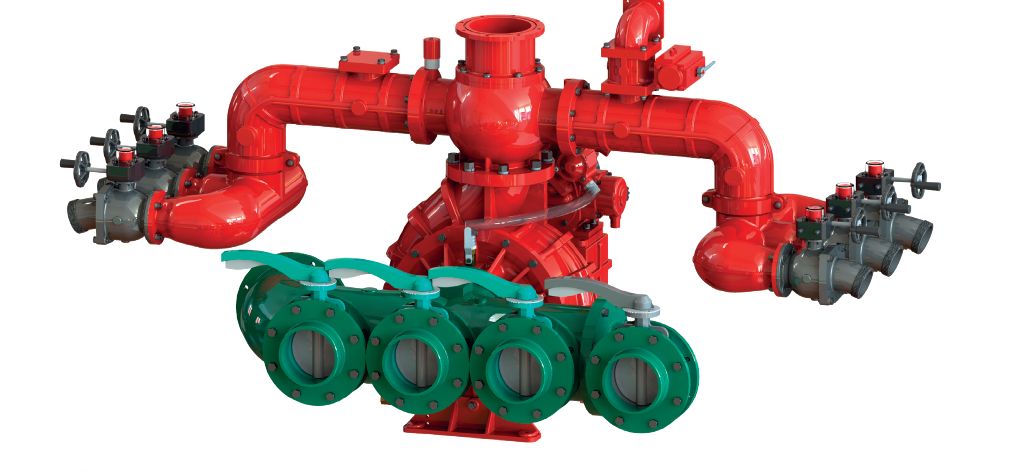
When responding to urban fires, industrial fires, airport emergencies, or forest rescues, selecting the right fire truck and fire pump is crucial. The fire pump is the core component of a fire truck, determining the vehicle’s efficiency and stability during firefighting operations.
This article provides a comprehensive guide on choosing a fire pump and highlights the advantages and applications of YONGAN fire truck water pumps.
1. Identify Your Firefighting Needs — Standard Pressure or High Pressure?
- Standard Pressure Fire Pump (CB Series): High flow rates, suitable for large-area water supply, such as municipal water systems, industrial plants, airports, and petrochemical firefighting.
- High Pressure Fire Pump (CB40 Series): High pressure, ideal for high-rise building firefighting, long-distance water projection, or high-pressure fine mist operations.
YONGAN products cover both CB Series standard pressure pumps and CB40 Series high-pressure pumps, meeting a wide range of firefighting requirements.
2. Understand Model Naming to Avoid Selection Mistakes
YONGAN fire pump model naming is clear and straightforward:
- CB = Standard Pressure Pump, CB40 = High Pressure Pump
- Numbers indicate rated flow or model code
Examples:
- CB10/20: Standard pressure pump, flow 1200 L/min
- CB10/30: Standard pressure pump, flow 1800 L/min
- CB40/7: High-pressure pump, 4.0 MPa, flow 420 L/min
- CB40.10/7.50: Combination pump, standard + high pressure
Understanding the model lets you quickly determine pump performance, avoiding wrong selection.
3. Compare Performance — Flow Rate and Pressure
- CB Series standard pressure pumps: Maximum flow up to 180 L/s
- CB40/7 high-pressure pump: Pressure 4.0 MPa, flow 420 L/min
High flow and stable pressure allow rapid water supply while reducing recoil for firefighters using hoses.
4. Consider Durability and Maintenance Costs
- Material Selection: YONGAN fire truck pumps are available in lightweight alloys, bronze, or duplex stainless steel, ensuring long-term reliability even in seawater or chemical environments.
- Maintenance and Lifespan: Equipped with maintenance-free mechanical seals, reducing routine maintenance frequency and costs.
5. Choose the Right Model Based on Scenario
- Small Fire Trucks: Recommended CB10/20, CB10/30 series; flows of 1200 L/min and 1800 L/min, lightweight design saves space.
- High-Pressure Operations: Recommended CB40/7 high-pressure pump; 4.0 MPa, 420 L/min, compatible with high-pressure spray guns and reels for rapid deployment.
- Versatile Needs: Recommended CB40.10/7.50 combination pump, integrating standard and high pressure for complex operations.
- Large Industrial & Airport Fire Trucks: Recommended CB10/180, CB20/40, flow up to 180 L/s, designed for large-scale firefighting scenarios.
6. Advantages of Choosing YONGAN
- Drive Method: PTO rear-drive system, high transmission efficiency, compact structure.
- Noise Control: Spiral pump casing + rubber damping pads reduce operational noise.
- Water Hammer Resistance: Smooth performance curve minimizes water hammer impact, prolonging pump and pipeline life.
Conclusion
When selecting a fire truck and fire pump, consider operation scenarios, flow rate, pressure, material, and drive method. With high flow output, stable performance, corrosion-resistant materials, and low maintenance costs, YONGAN fire truck water pumps (CB Series and CB40 Series) are ideal for municipal, industrial, airport, and forest fire trucks.
Disclaimer
Comments expressed here do not reflect the opinions of Vanguard newspapers or any employee thereof.