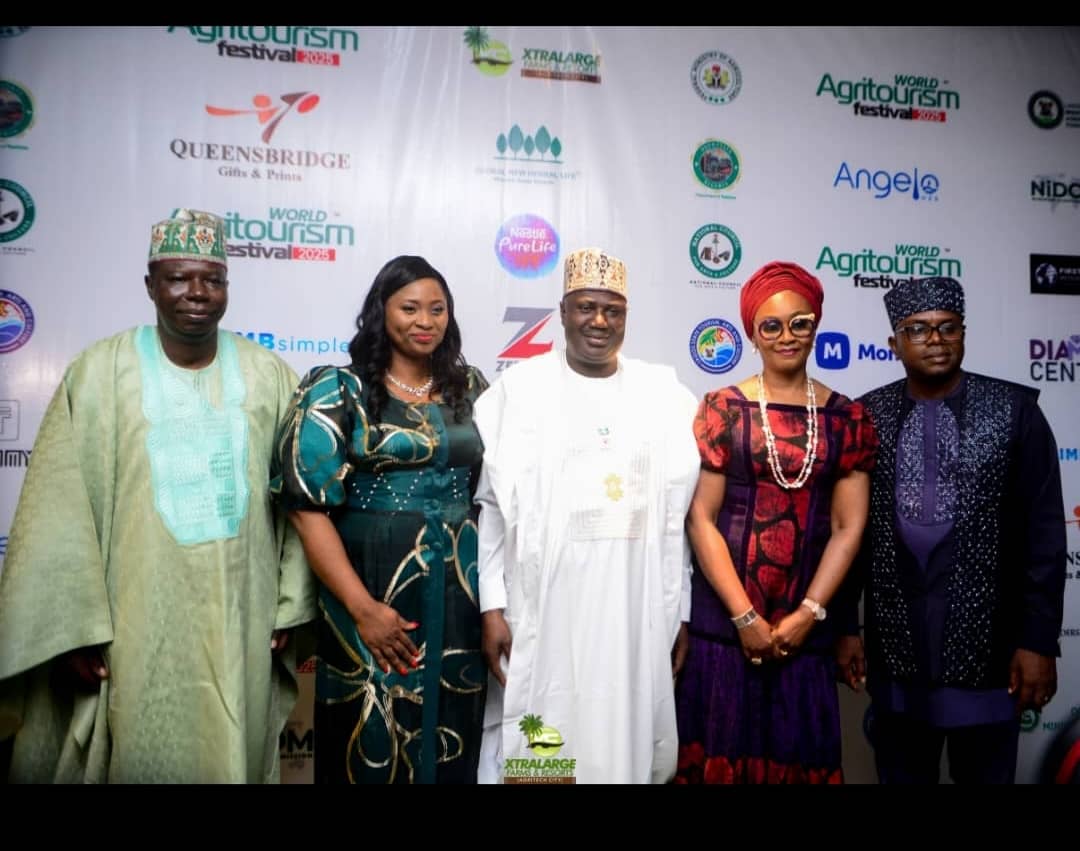
Managing Director, Xtra Large Farms Dr. Moji Davis, Minister of State for agriculture and food security Senator, Aliyu Sabi Abdullahi, First lady Ogun state, Dr Mrs Bamidele Abiodun, CEO Xtra Large Farms Dr. Seyi Davis
By Esther Onyegbula
The Honourable Minister of State for Agriculture and Food Security, Senator Aliyu Sabi Abdullahi, described the World Agritourism Festival 2025 organised by Xtralarge farms and resorts as a “pioneering initiative” that aligns with President Bola Ahmed Tinubu’s Renewed Hope Agenda, which prioritizes agricultural transformation as a core pillar of economic diversification.
Speaking at the event, Senator Abdullahi said: “We must consume what we produce and produce what we eat. Agriculture must become smarter, more inclusive, and resilient. Events like this are critical to building a prosperous agro-based economy powered by innovation and tourism.”
The minister lauded the organizers, Xtralarge Farms and Resorts, for leading the charge, and accepted his recognition as National Agritourism Patron of the Year on behalf of Nigeria’s resilient farmers, particularly women and youth, who are redefining the sector’s potential.
He further called for the immediate establishment of a national technical committee to develop a comprehensive agritourism policy. The proposed committee would include the Federal Ministries of Agriculture, Culture and Creative Economy, and other relevant agencies and stakeholders, with the aim of creating a unified national strategy for agritourism growth.
Highlighting Nigeria’s vast agricultural landscape, estimated at 300 million hectares, with only 34 million currently under cultivation, Senator Abdullahi emphasized the untapped potential of rural areas, not only for food production but also for tourism and education.
“Agritourism is more than farm visits. It includes festivals, eco-tours, educational programs, and farm stays. Countries like Italy, the U.S., Malaysia, and South Africa are already leveraging this hybrid model to stimulate rural development and tourism. Nigeria must do the same.”
He cited the recent launch of over 11,000 agricultural tools by President Tinubu as evidence of the federal government’s commitment to modernizing the sector and making it attractive to the next generation.
“Agriculture is no longer about hoes and back-breaking labour,” the minister said. “It’s about digital tools, export-ready products, tourism integration, and youth innovation.”
Reiterating that transformation cannot happen in isolation, Senator Abdullahi called on stakeholders, from rural farmers to government ministries, to forge lasting collaborations.
“The Ministry of Agriculture and Food Security is ready to provide the leadership needed to build a national agritourism ecosystem. The time to act is now.”
Underscoring the crucial role of women in the sector, First Lady of Ogun State, Dr. (Mrs.) Bamidele Abiodun, stated that over half of Nigeria’s smallholder farmers are women.
Highlighting the gender disparities in land ownership and finance access as major constraints to food security, Dr. Abiodun said: “Empowering women farmers is not just a moral imperative but a strategic economic decision. That’s why initiatives like the Renewed Hope Agricultural Support Scheme, led by First Lady Senator Oluremi Tinubu, are essential. In Ogun State, we’re supporting women to transition into commercial agriculture.”
She also pointed to Ogun State’s proximity to Lagos, Africa’s largest food consumption hub, as an opportunity to scale agro-processing, create jobs, and reduce food costs.
Challenging stakeholders to move beyond outdated farming methods and embrace value addition through agritourism, the CEO of Xtralarge Farms and Resorts, Dr. Seyi Davids, said: “If we continue farming like our grandfathers, our children will abandon the land. Agriculture embodies culture, tourism, innovation, and technology. That’s why we created this festival to present agriculture as a complete lifestyle and economic powerhouse.”
Emphasizing value chain improvement, Dr. Davids cited examples of how raw materials like cocoa are transformed into high-value products abroad. He noted that Xtralarge now produces 21 agriculturally based products, demonstrating what is possible when innovation meets enterprise.
According to him: “The future of agriculture is fusion, fusion with tech, tourism, and culture. Agritourism is how we show the world what our land is truly worth.”
The festival also spotlighted Nigeria’s expanding international agricultural footprint, with references to recent bilateral agreements with Qatar and Brazil aimed at infrastructure development, technology transfer, and capacity building. These partnerships, officials noted, signal global confidence in Nigeria’s readiness to feed itself, and contribute to global food systems.
The World Agritourism Festival 2025 marks a significant step in Nigeria’s bid to reclaim agriculture as not just a means of survival, but as a cultural and economic asset of global relevance. With strong political backing, grassroots participation, and private sector leadership, the country is poised to lead Africa’s next agricultural revolution, one rooted not only in soil, but in vision.
Disclaimer
Comments expressed here do not reflect the opinions of Vanguard newspapers or any employee thereof.