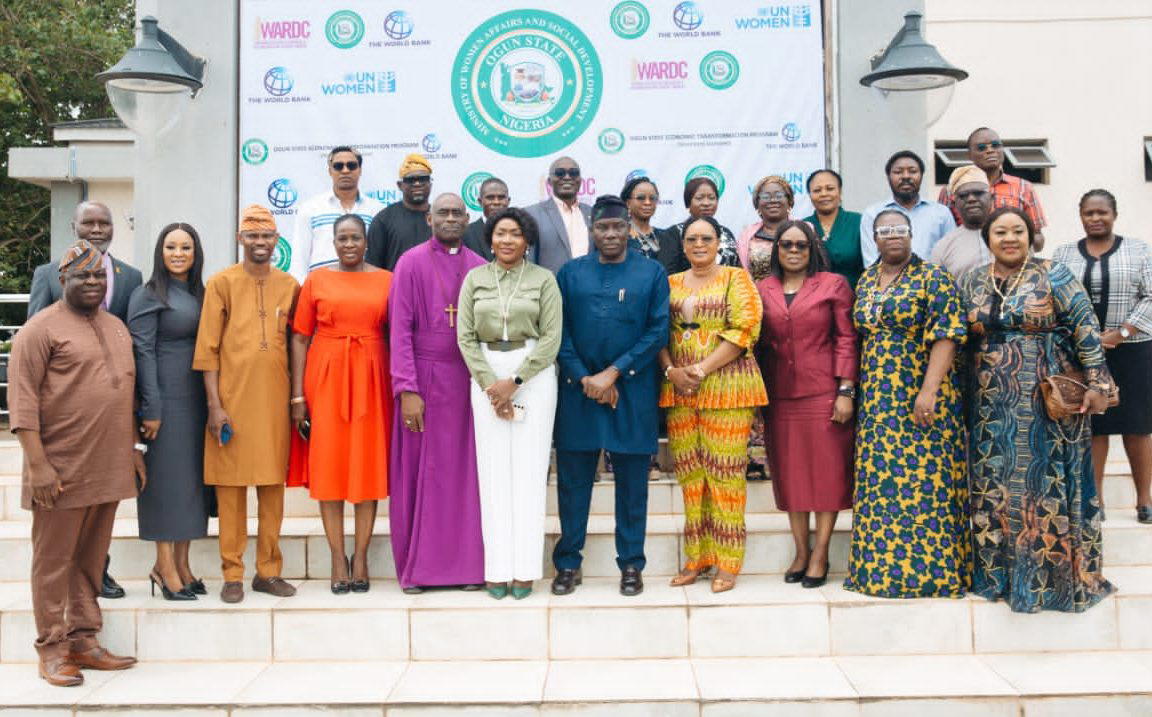
The Commissioner for Women Affairs and Social Development, Hon. Adijat Motunrayo Adeleye (m) in a group photograph with other stakeholders after the Legislative Dialogue held on Gender Based Violence
…holds parliamentary dialogue on DEI Commission, others
By James Ogunnaike, Abeokuta
The Ogun State Economic Transformation Project (OGSTEP) has organized a one-day workshop for journalists and media managers on the appropriate reporting of Gender Based Violence and child sexual abuses in the State.
The workshop, which was part of efforts in tackling Gender Based Violence and child sexual abuses in the State, was held in Abeokuta, the Ogun State capital, was in collaboration with the Ministry of Women Affairs and Social Development and sponsored by the World Bank.
Speaking at the workshop with the theme, “Strengthening GBV Response Through Collaboration, Learning and Safeguarding Standards”, the OGSTEP Gender Specialist, Mrs. Ewajesu Fasina, disclosed that the training was put together to expose journalists to rudiment of covering and reporting cases of GBV, particularly when the persons affected are minors.
She added that GBV cases are on the rise, hence, the media as the watchdog of the society must do more to report and inform the society about the menace which has led to deaths, permanent physical injuries and psychological trauma on the survivors.
The OGSTEP Gender Specialist observed that the media as a stakeholder like health workers, security agencies and communities, have pivotal roles to play in the combat against GBV.
She added that a similar workshop had earlier been organized by the OGSTEP for the personnel of the Nigeria Police, Nigeria Security and Civil Defence Corps (NSCDC), Amotekun Corps, health workers and Community Development Associations.
Mrs Fasina revealed that according to the available records from the Federal Ministry of Women Affairs and Social Development, 28% of Nigerian women aged between 25 and 29 have experienced some form of physical violence at age 15.
She noted that cases of GBV were underreported because many survivors refused to present themselves due to stigmatization and name-calling by the community and law enforcement agents, noting that GBV is more complex than it has been reported by the media.
She pointed out that journalists and media practitioners have the power to see all the angles of GBV cases, hence they must cover the angles including health, security, and legal, emphasizing that “without journalists, we cannot win the battle”.
Mrs Fasina posited that journalists should focus more on the Violence Against Persons (Prohibition) Act and the Child Rights Act to back up their reports.
“Journalists have the power to ensure justice with the power of the pen or the power of the keyboard. Journalists have the opportunity to cover all angles – the health, the security and the legal aspects of every story. Without the media and journalists, we cannot win the battle as you remain the only group of people with the bird’s-eye view”, she stated.
In his presentation, a legal practitioner, Damola Lapite, who spoke on the topic ‘Legal Framework for GBV Response: Reporting, Persecution and Survivors’ Rights’, emphasised the need for confidentiality and consent to avoid traumatising survivors.
He said that journalists must always have in mind the importance of maintaining confidentiality and obtaining consent from survivors before reporting on GBV cases.
“The Federal Government is working hard towards eradicating GBV, however, more needs to be done to address the issue effectively. The government’s efforts are commendable, but the enormity of the problem demands more comprehensive solutions”, he submitted.
Meanwhile, World Bank through OGSTEP, Ministry of Women Affairs and WARDC held a Parliamentary Dialogue on the Diversity, Equity and Inclusivity Commission, Framework for Responsible and Inclusive Land-Intensive Agriculture (FRILIA) Bill and Gender Mainstreaming Frameworks for the Ogun State House of Assembly members.
In her remarks at the event held at the MITROS Residence in Abeokuta, the Ogun State Commissioner for Women Affairs and Social Development, Hon. Motunrayo Adijat Adeleye, explained that the dialogue was to advance legislative action on equity, social inclusion, gender-responsive governance, and community rights in the state.
In a communique issued at the end of the dialogue attended by critical stakeholders, government officials, civil society organizations, gender and human rights advocates, development partners, academics, security agencies, youth and women groups, religious and traditional institutions, persons with disabilities and media representatives, the House of Assembly assured that it will take a legislative action that will prioritize the passage of DEI Commission Bill and review the FRILIA draft bill for legislative adoption.
The stakeholders also advocated for institutional strengthening, budgetary support and continued engagement, to implement the provisions of the bills when enacted.
Disclaimer
Comments expressed here do not reflect the opinions of Vanguard newspapers or any employee thereof.