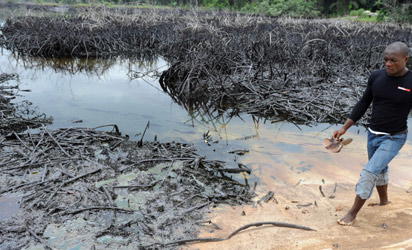
OIl spill
…Insists on Justice for Saro-Wiwa, Others
By Daniel Abia, P/Harcourt
The Movement for the Survival of the Ogoni People (MOSOP) has dismissed claims that resuming oil production in Ogoniland will create jobs, calling such assertions deceptive and misleading.
MOSOP asserted that, rather than benefiting the Ogoni people, oil resumption would only serve to enrich the 37 states of Nigeria, while the host communities would continue to suffer neglect and environmental degradation.
In a statement, MOSOP described the narrative of job creation through oil resumption as a “divide and conquer strategy” aimed at distracting from the real issues affecting Ogoni people.
Speaking on the issue, Fegalo Nsuke, President of MOSOP, urged all stakeholders—especially the oil industry—to be honest and transparent about the situation in Ogoniland.
Nsuke emphasized that before any discussion on oil resumption, the legacy issues stemming from decades of conflict must first be addressed. These include:
The wrongful execution of nine Ogoni activists, including Ken Saro-Wiwa, in 1995.
An investigation into the controversial deaths of four prominent Ogoni leaders in May 1994.
Justice for the estimated 4,000 Ogoni people killed by the Nigerian military during the struggle for environmental and social justice.
Nsuke also questioned the job creation claims, arguing that Shell Petroleum Development Company (SPDC) operated in Ogoniland for 30 years without significantly improving the lives of the people.
“Shell operated in Ogoni for three decades and could not create jobs. Nothing has changed in their operations, so how will jobs suddenly be created now if the interests of Ogoni people are not first considered?”
Nsuke further stressed that the real issue is not just oil production but how revenues from oil are utilized. He argued that oil extracted from Ogoniland is simply transported to export terminals, with the revenue deposited into the federal account, from which Ogoni communities receive no direct allocation.
“Once the pipelines are laid, oil is simply pumped out to the export terminal. The revenue goes into a federation account, and Ogoni receives no special allocation. Our people will only be left with menial jobs like security and cleaning services.”
MOSOP maintained that real job creation will only come through investment in Ogoni development, not from oil resumption alone.
Nsuke insisted that Ogoni development must be a priority in any oil-related discussions. He argued that other Nigerian cities, such as Lagos, Abuja, Calabar, and Kano, were developed using revenues from oil-producing regions, and Ogoni must receive similar treatment.
“Cities like Lagos and Abuja were not built from the income of security men and cleaners in oilfields. They were developed with allocations from Ogoni oil revenues. It is only fair that Ogoni receives the same treatment.”
MOSOP has proposed that oil companies commit at least 20% of their profits to Ogoni development—a resolution adopted at the Ogoni Congress held on November 30, 2024.
“MOSOP stands firmly by the resolution of the Ogoni Congress, which demands that 20% of oil profits be dedicated to Ogoni development. This is the only way to ensure justice and a sustainable resolution to the Ogoni struggle.”
MOSOP reaffirmed its commitment to securing justice, economic fairness, and environmental protection for the Ogoni people, vowing to resist any attempt to force oil resumption without addressing these core issues.
Disclaimer
Comments expressed here do not reflect the opinions of Vanguard newspapers or any employee thereof.