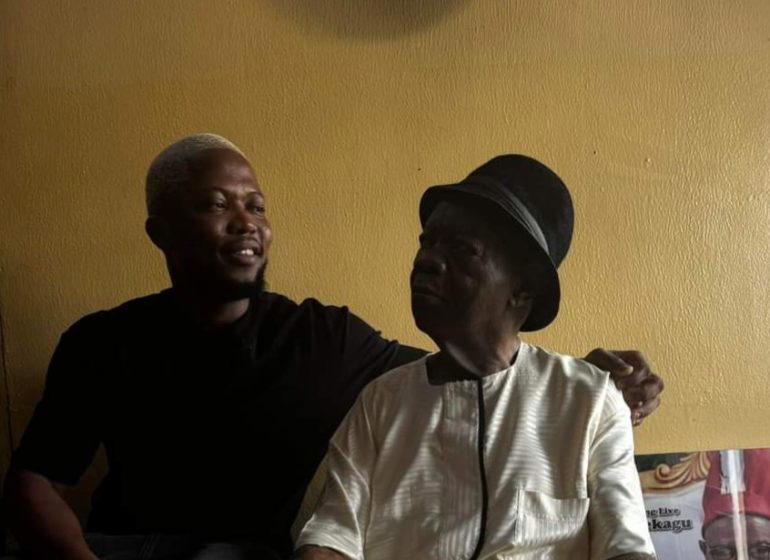
By Osa Mbonu-Amadi, Arts Editor
In Titanic, the 1997 American epic romantic disaster film, Jack, the fine artist on the commoners’ deck, gave the billionaires aboard the Titanic something to chew over when he told them he prefers to wake up every morning and go out not knowing who he would meet.
He was indirectly mocking the strict lives of the billionaires who see everyone in their lives by appointment. Jack was Rose’s secret lover on The Titanic.
It was Rose that invited him to a ball on the first-class deck where he met the billionaires and fell into a conversation with them.
Alongside other disruptive changes, the social media has brought a lifestyle in which we wake up every morning and go out without knowing who and what to meet. “Anything can happen anytime on the social media,” says Brain Jotter, the popular content creator whose content brought the resurgence of Gentleman Mike Ejeagha’s 41-year-old song titled “Gwo Gwo Gwo Ngwo”. The folk highlife song tells a story of how the tortoise deceived the elephant, rode on it, and used it to pay the dowry of its bride.
Who is Brain Jotter, and what did he do?
Imo State of Nigeria-born Chukwuebuka Emmanuel Amuzie, popularly known as Brain Jotter is a Nigerian comedian, skit maker, content creator and Nollywood actor, famous for his comic dance and videos on TikTok and Instagram. Brain Jotter has over 9.1million followers on Facebook (now Meta) and more than 5 million followers on Instagram. “BE HAPPY!! LIFE IS SHORT,” is his slogan on Facebook, while on Instagram he announces: “GOD FIRST, I AM NOT ON TWITTER.”
Brain Jotter kickstarted a dance step to Gentleman Mike Ejeagha’s song. The dance moves became a challenge, with many people creating different versions of it on different social media platforms.
A few weeks ago, the skit become Brain Jotter’s most viewed video on Instagram, amassing a staggering 29.1 million views and over 30,000 comments on Instagram. It also got 19.6 million views with over 23,000 comments on TikTok. The statistics is far more than that today, and the dance and music are still spreading across the world.
A US-based content creator and media personality, Radiogad, claimed that Brain Jotter had already made about N400 million from the skit. But Brain Jotter denied the claim that he made any profit from Mike Ejeagha’s music, saying that all proceeds from the music go to the musician and his record label.
However, it is possible to make that amount of money from the skit, considering the viewership. But it is inaccurate to say the money was made from the music itself. What Brain Jotter’s skit has done rather was to attract millions of streaming for Ejeagha’s song, thereby making more money for the aged folklore highlife musician.
What is happening on the social media has introduced Gentleman Mike Ejeagha’s music to a new audience and interred his legacy as a pioneer of Nigerian folklore music. There are two core takeaways from the event:
The power of social media
We are yet to fully comprehend the extent to which the social media revolution has changed our lives for good. By democratizing access to media, with 5.07 billion social media subscribers, representing 62.6 per cent of the world’s population (as of April 2024), the social media has acquired the power to turn anyone into a superstar overnight; conversely, it can also bring anyone down overnight from any height! With the social media, the creative space has expanded by quantum leaps, especially for young people, and has continued to expand.
Promotion popularises culture
Mike Ejeagha’s songs are steeped in folk Igbo highlife. Highlife music, which is an important cultural product of Nigeria and Africa, especially of the Igbos, is regarded as old school music that is no longer in vogue. But look at what the social media has done to a 41-year-old folk highlife song in less than one week. This lays credence to the theory by cultural studies scholars in media studies that promotion popularises culture.
Every positive culture has huge commercial potentials; it only requires promotion. Western cultural products are popular and profitable because of media promotions. Fortunately for African countries with poor access to global traditional media, the social media has bridged the gap. On the social media, life is unpredictable – anything can happen.
One misconception haboured by many young people today who knew nothing about Mike Ejeagha is that he was an obscure musician during his days. That may be true by the standards of the age of internet and the social media. But Mike Ejeagha was not obscure during his days, especially among Igbos. One of such youths, with Facebook name, Kay Voice, made a post on Facebook and asked a questions: “Why was this man not popular while he was still active in music until now?”
One Barnabas Okafor, in a comment, answered Jay Voice questions: “Mike Ejeagha was not only popular but rich in his prime. Where his one-story building is located is Mike Ejeagha Crescent, Enugu, (the road is) tarred in and out by the government, and that is where he lives. He has enjoyed his youth; he is now enjoying his old age. What this new trend means is that he will be popular from one generation to the next. He was popular in our grandparent’s time, he was popular in our parent’s time, he is popular in and out of time, he is now popular in our children’s time and may even continue to be after his death.”
Mike Ejeagha’s career and achievements
According to Boomplay, one of Mike Ejeagha streaming platforms, Mike Ejeagha, born August, 1932, is a Nigerian folklorist, songwriter, and musician from Enugu State, Nigeria. Many of Gentleman Mike Ejeagha songs become very popular and trendy online with a great number of streaming and downloads on Boomplay.
Ejeagha started his career in music in the mid-20th century. Also known as Gentlemen, Ejeagha has been influential in the evolution of music in the Igbo language for over 6 decades. His first hit was in 1960 – the year of Nigeria’s independence.
Ejeagha is a distinct storyteller accompanied by guitar style, and his lyrics are laced with proverbs, lending his music a didactic style. He writes his own music and his lyrics are in Igbo language.
Ejeagha said in 2004: “Life at old age is quite enjoyable, especially when the Almighty God gives you good health.”
Ejeagha has contributed over three hundred recordings to the National Archives of Nigeria produced during his field work to investigate Igbo folklore highlife music. His songs include: Enyi Ga Achi, Uwa Ngbede Ka Mma, Ka Esi Le Onye Isi Oche, Anyi Fulu Ozu Ene, Onye Ori Utaba, Atualu Omalu, Elulube Lube, Onye Ndidi N’Eli Azu Ukpo, Udo Ka Nma, Agbata Obi Onye Bu Nwanne Ya, Ome Ka Agu Omenani N0 1, Odogwu Nari Enu and Onye New Ona Ebe.
Others are: Akwu Achaa, Mgba Enwude Akpulu, Welu Nwaya Sobe Ihe Uwa, Ife Uwa Bu Ana Eme Odi Ka Ada Eme, Ife Nji M’ Ogi, Agolum Age, Ikpechakwa-A-Kam-Kpe, Suzzana Merringue, Chukwugekwu, Akuko N’egwu, Nzoji Nku, Nwa Bu Onyinye Chukwu, Ebini We Ude, Onye Lua Nya Lia, Ngba Ewude Akpulu, Onye Ndidi Neri Azu Ukpo, Nke Onye Adi Ayanjo, and Obiako Nnwan Omenani N02.
Disclaimer
Comments expressed here do not reflect the opinions of Vanguard newspapers or any employee thereof.