By Rita Okoye
Environmental pollution remains a global crisis, threatening public health, ecosystems, and economies.
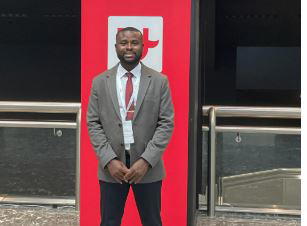
Dr. Okon Ekpe, a distinguished environmental engineering researcher at the Center for Air and Aquatic Resources Engineering and Science (CAARES) at Clarkson University, Potsdam, New York, is making groundbreaking contributions to address this urgent issue.
With over six years of laboratory research experience, Dr. Ekpe’s work focuses on developing innovative methods to detect and mitigate pollution while shaping policy recommendations for sustainable environmental practices.
The statistics underscore the severity of the problem. According to the World Health Organization (WHO), exposure to harmful chemicals causes 1.6 million deaths annually, and millions more suffer from chronic illnesses due to air and water pollution. In the United States, over 90% of individuals have detectable levels of pollutants such as pesticides, phthalates, and bisphenol A (BPA) in their systems, as revealed by biomonitoring studies conducted by the Centers for Disease Control and Prevention (CDC). In Nigeria, environmental degradation in the Niger Delta has left over 70% of communities without access to clean drinking water, while urban areas like Lagos grapple with unchecked air pollution and industrial emissions.
Dr. Okon D. Ekpe has played a pivotal role in several high-impact research projects, leveraging his expertise in advanced mass spectrometry analytical methods, to identify and quantify harmful organic micropollutants. His contributions were instrumental in generating critical data to support policymakers and environmental managers in designing effective mitigation strategies. These research initiatives have also attracted significant funding, underscoring the global relevance and impact of his work.
Dr. Ekpe contributed to securing and managing several prestigious research grants, including:
Korean Environment Industry & Technology Institute (KEITI) (April 2021 – December 2023, $600,000): “Development of environmental forensics based on high-resolution mass spectrometry to trace sources of subsurface contamination.” Ministry of Food and Drug Safety (MFDS), South Korea (April 2021 – December 2023, $913,000): “Investigation of the usage patterns of new illicit drugs in South Korea.” National Institute of Environment Research (NIER), South Korea (April 2021 – December 2021, $119,500): “Monitoring study (I) for the evaluation of aquatic ecological accumulation of environmental pollutants.” Busan Metropolitan City Fire & Disaster Headquarters, Korea (2020, $120,000): “Exposure and risk assessment of hazardous chemicals in firefighter’s working environments in Busan.” Korean Environment Industry & Technology Institute (KEITI), South Korea (June 2018 – August 2020, $640,000): “Development of pollutant discrimination technology using biochemical analysis in suspected areas of chemical accidents.”
These projects advanced critical areas of environmental science, including environmental forensics, pollutant monitoring, and risk assessment. Dr. Ekpe’s leadership and technical expertise were integral to their success, demonstrating his ability to bridge scientific innovation with practical solutions for addressing global environmental challenges.
Dr. Ekpe’s contributions are also recognized through numerous awards and honors, including the Graduate School Academic Excellence Award from Pusan National University and the 2022 BK21 Excellent Paper Award for Attracting Outstanding Talent. These accolades highlight his dedication to advancing environmental science and engineering.
Despite these achievements, significant challenges remain. Dr. Ekpe identifies key obstacles such as insufficient monitoring infrastructure, lack of public awareness, and the economic burden of implementing sustainable practices. Developing nations like Nigeria face weak enforcement of environmental regulations, while marginalized communities in countries like the U.S. bear the disproportionate brunt of pollution’s impact.
However, Dr. Ekpe sees a window of opportunity. His work underscores the importance of integrating technological innovation, community engagement, and robust policies. For instance, his advanced forensic techniques for tracing pollution sources offer scalable solutions for identifying and mitigating contamination in both industrialized and resource-constrained regions.
To address these challenges, Dr. Ekpe advocates for a comprehensive strategy. Governments must allocate resources for affordable and scalable pollution monitoring systems, such as real-time air quality sensors and advanced water filtration methods. Enforcing stricter environmental laws, especially in industrial regions like the Niger Delta, is essential to hold polluters accountable. Training local scientists and engineers in advanced analytical methods ensures sustainable management of pollution issues. Public awareness campaigns can drive grassroots action, promoting sustainable practices like reducing single-use plastics and conserving natural resources. Transboundary pollution requires a global response. Partnerships between research institutions, governments, and industries can foster innovation and share best practices. Providing tax breaks and subsidies for businesses adopting green technologies can accelerate the transition to environmentally friendly practices.
Dr. Ekpe emphasizes the need for proactive investment in preventive measures, stating, “A cleaner, healthier future is achievable, but it requires coordinated efforts across all sectors. We must prioritize sustainable practices, not just for environmental preservation, but for the long-term health and economic stability of communities worldwide.”
As a globally recognized expert, Dr. Ekpe continues to lead the charge against environmental pollution, leveraging his scientific expertise, innovative solutions, and strategic vision. His work offers a roadmap for tackling one of humanity’s greatest challenges, inspiring hope for a more sustainable and resilient planet.
Disclaimer
Comments expressed here do not reflect the opinions of Vanguard newspapers or any employee thereof.