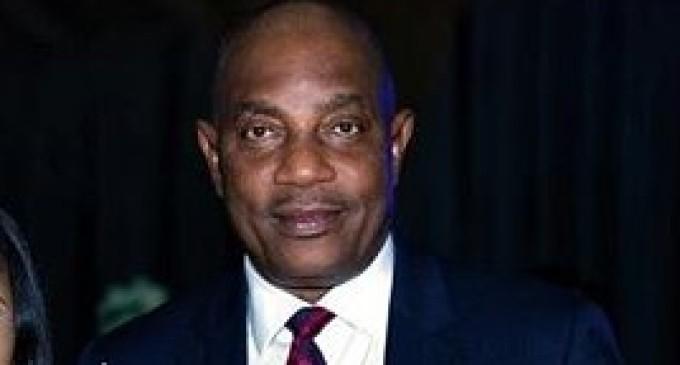
Solomon Arase
By Ikechukwu Ani
HE made his name in the Nigeria Police Force, where he rose to the zenith of his career and retired as the 18th Inspector General of Police, and till date, he is one of the best the nation has produced, even with his brief stay in office. He served while in the Force as Principal Staff Officer, PSO, to three different Inspectors General of Police, a position that exposed him to the dynamics and nuances of policing in different environments. Dr. Solomon Ehigiator Arase is obviously the embodiment of the best the force can offer in Nigeria, a nation battling with debilitating security challenges that have continued to defy immediate and long-term solutions.
He is a well-grounded intelligence officer, an acclaimed and celebrated international scholar, highly cerebral, and detribalised. His appointment and swearing-in as Chairman of the Police Service Commission, a Federal Government executive body that is constitutionally empowered to appoint, promote, dismiss, and exercise disciplinary control over officers in the Nigeria Police Force except the Inspector General of Police, on March 29, 2023, has since become a turning point in the lives of the commission and the Nigeria Police Force. It was a time when the commission was gasping for breath, tormented in different directions, including a protracted dispute with the Nigeria Police Force.
Dr. Arase admitted the enormity of the challenges facing him as he assumed office and declared: “I arrived to chair the Board with understandable uncertainty, having been an onlooker to the squabble between the PSC and the NPF. I, however, entrusted myself into the hands of God and hoped that my experiential knowledge in life would be an advantage for me. I immediately implemented measures and took steps towards resolving all lingering conflict and repositioning the Commission towards its optimal functionality in delivering on its mandate.”
He started with a robust stakeholder consultative forum where he invited and/or visited several stakeholders in the Police sector. His first stakeholder meeting was with the national leadership of the Police Community Relations Committee, PCRC, where he pledged to work in partnership with the Inspector General of Police to reinvigorate the Nigeria Police Force for better performance. Dr. Arase told his visitors that for the Police to excel in their day-to-day operations, there must be consequences for misconduct and benefits for exemplary behaviour. He noted that benefits and burdens must go together, stressing that he will strive to complement what the Police are currently doing to ensure that their operations conform to their rules of engagement.
The PSC chairman convened the maiden retired Officers Consultative Forum, where he declared that rescuing and repositioning the Nigeria Police Force was a collective task. He said the Forum was expected to provide retired officers with the needed opportunities and platform to give back to the Force and ensure “that the socio-political vagaries and contemporary societal complexities do not confine the Nigeria Police Force to a paper tiger in the security architecture of Nigeria.”
He continued his all-embracing advocacy meetings with the stakeholders of the commission with a visit to the CLEEN Foundation, a civil society group promoting public safety and security and accessible justice in Nigeria, and also hosted the leadership of the Nigerian Union of Journalists. At the CLEEN Foundation office, Dr. Arase declared that indiscipline will no longer be tolerated in the Nigeria Police Force while announcing the setting up of the Compliance Monitoring Unit, CMU, at the Commission to monitor and police the police. He insisted that a Police Force that does not connect with the public or respect human rights will find it difficult to succeed.
Speaking when he received the leadership of the Nigeria Union of Journalists, NUJ, led by its National President, Chief Chris Isiguzo, the chairman observed that the nation was going through transformation in all sectors with world-wide security challenges, which, he said, have imposed an additional burden on the nation to cope with rising criminality and divisive forces. These, he noted, required the synergy of all stakeholders to enable the nation to navigate through these trying times effectively.
The chairman also received a delegation from the UNDP and the German Government, where he canvassed for funding support and a productive partnership in improving policing in Nigeria in line with the on-going police reforms. Represented by Justice Clara Bata Ogunbiyi, a retired Justice of the Supreme Court, the chairman said it has been difficult to oversee the Police with the myriad challenges facing the commission.
He solicited the assistance of the organisation and the German governments in some areas that will help the commission rebuild the Nigeria Police Force for better performance. Dr. Arase also met with Beatrice Eyong, Country Representative to Nigeria and ECOWAS of the United Nations’ Women, where he pledged the commission’s commitment to restore the dignity of police women. The chairman, who visited the Nigerian office of the United Nations, admitted that discrimination against women, including Police women, was real and said the commission needed a strategic partnership with the world body to improve the welfare and self-worth of the Nigerian Police women.
He disclosed that under his watch, the commission will ensure a recruitment policy redirection that will see more women into the Nigeria Police Force so that they can compete favourably for management positions in the Force. He also met with delegations from the Public Service Institute of Nigeria and the National Examination Council, two highly rated Nigerian training and examination institutions. He bemoaned the lack of capacity in the commission and the Nigeria Police Force and vowed to close the capacity gaps in the two government agencies. He extended a hand of fellowship to the management of the two training and examination institutions so as to quickly fix these gaps in the interest of a viable and efficient policing in Nigeria, as, according to him, the Police, the lead agency in internal security, and its oversight body, the PSC, should not be allowed to lack capacity, especially at this critical period of nation-building.
The Commission has since started to enjoy the dividends of the stakeholder’s advocacy meetings, as four directors in the commission have concluded a one-week international training on accountable policing oversight and criminal justice. The four directors were exposed to an intensive one-week training organised by the Centre for Human Rights, University of Pretoria, South Africa, in conjunction with the African Policing Oversight Forum. They joined 81 others from 21 countries to undergo the training, where they were acquainted with topical issues such as international and regional human rights standards relevant to policing and the criminal justice system.
Dr. Arase has also since moved to reform both the Nigeria Police Force and the commission. The commission under his watch has approved policy guidelines on the deployment of AIGs, CPs, and tactical commanders and gender sensitivity in such deployments. It stated that the Nigeria Police Force should be guided by the principle of federal character in both recruitment (at all levels) and deployment of its personnel at management and tactical levels to ensure balance, equity, and fairness in the system.
Ani, spokesman of the Police Service Commission, wrote from Abuja.
Disclaimer
Comments expressed here do not reflect the opinions of Vanguard newspapers or any employee thereof.