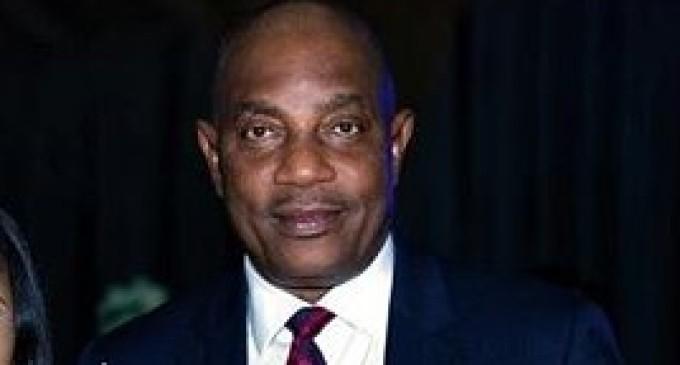
Solomon Arase
By Emma Nnadozie, Crime Editor
LAGOS—Barely few months in office as the Chairman of Police Service Commission, PSC, Solomon Ehigiator Arase, like a hurricane, has ignited an unquenchable fire and rekindled lost hopes over long advocated massive improvement in the Nigeria Police Force, NPF. His gigantic strides, so far, have, no doubt, smoothened the seemingly questionable capabilities of the management of the police to steer the ship to the path of success, in the past years.
His admirers said his intellectual formation took place at the Ahmadu Bello University, ABU, Zaria, where he encountered radical masterminds, who taught him about the social, economic and political issues plaguing Nigeria.
He started showing those radical perspectives on law enforcement from his days as an officer of the Nigeria Police Force. Those credible signs metamorphosed glaringly when he assumed the enviable position of Force Secretary, at the Louis Edet House, Force Headquarters, Abuja, where he was able to pilot affairs of the force creditably well.
Then, he became the overall boss of the force, and succeeded in recording many achievements. He established the Intelligence Response Team, IRT, to combat high profile crimes and criminality in the country. He also set up the Complaints Response Unit, CRU, to receive and address complaints of police misconduct from members of the public.
Before the completion of his tenure, Arase implemented policies to strengthen the capacity of police officers in forensic investigation and intelligence gathering. He also launched a community policing initiative, which involved collaboration with local communities to identify and address security threats.
There was no doubt that he left the exalted position of IGP better than he met it but, to many, he also left gaping holes seemingly difficult to fill. The truth manifested glaringly when most of his successors could not improve upon the decadent state of things, leading to the putrid stench now reeking from the force. Attempts were not made to fill those holes. Rather, they got deeper.
Today, by special divine intervention, Solomon Arase is back on the corridors of power as the Chairman, Police Service Commission – a body entrusted with the responsibility of influencing the recruitment, promotion, and discipline of police officers. He will be responsible for ensuring that the police force operates by the law and meets the needs of the community.
Before his appointment, police management was at daggers drawn with the commission over issues bordering on recruitment of constables and posting of commissioners to state commands, which the commission stated, unequivocally, are clearly their constitutional responsibilities. Unfortunately, the police did not see it as such.
The debacle led to so many lulls in the system, culminating in open antagonism and brick bats, which Inspectors General of Police capitalised on and continued to run the force like a personal fiefdom. The face-off was such that officers were promoted and posted by the police management without resorting to confirmation from the PSC. As the old saying goes, when two elephants fight, the grass suffers.
The lingering face-off, which was worsened by the taciturnity of the country’s leadership, created such a yawning vacuum in both the commission and the force to the extent that it nearly turned into a lawless arena. Many officers, rank and file were stagnated while the police leadership basked in the euphoria of asserting their positions, even when they discreetly nursed the ambition of ascending to the exalted position of the next chairman of the commission, after retirement. There were court issues over disputing stands, which ended in favor of the commission. Yet, the police hierarchy adamantly maintained their ill-intentioned stand.
Then, enter Hurricane Solomon Ehigiator Arase. His pronouncement as Chairman of the Commission was widely hailed by critical stakeholders, both in the police and the public, who are acquainted with his intellectualism and long nurtured ambition of radically transforming the Nigeria Police Force. Many saw his return as a dream come true based on the fact that even after retirement as the IGP, he continued to agitate for a better force and was suggesting positive measures that needed to be taken to alleviate the sufferings of men of the force.
To prove that better days are here, as soon as he was sworn in, he set the ball rolling by opening his doors for a historic visit by the Inspector General of Police, Usman Alkali Baba. The IGP, with his management team, congratulated Arase on his appointment and subsequent swearing-in, assuring him of the force’s full cooperation to achieve an enviable policing system. The meeting, which was at the instance of the IGP, was geared at cementing the relationship between the NPF and the commission for an improved working relationship.
Significantly, no sooner than the meeting was over, Arase swung into action. He conveyed a meeting with the National body of the PCRC in his office, where issues bordering on better relationship with the police were critically examined and thrashed out. The meeting was majorly aimed at seeking areas of cooperation with members of the public in fighting crime and criminality to a standstill in their respective areas of jurisdiction, and checking abuses by both parties. Areas of mutual interests were streamlined, while abuses were condemned for a better relationship.
Not done the new Chairman took the boldest step by conveying a meeting of all retired Inspectors General of Police and other retired officers, where far reaching decisions geared towards the betterment of the force were exhaustively discussed and agreed upon.
Commendably, Solomon Arase was able to assemble the cream of best brains that superintended over the force at different times whose intentions towards reforming the force were advertently or inadvertently crushed by either political considerations or sheer bravado of occupying such an exalted position. He succeeded in pleading with them not to relent but to join hands in building a new police force.
That singular feat, from all indications, re-enacted a spirit of camaraderie in most of the aged, tired but mentally alert ex-IGPs, and one could discern their poignant resolve to contribute their quota in helping the force grow bigger. The gesture was also extended to civil society organisations and human rights bodies, and more are still on the way.
Perhaps, one of the greatest beneficiaries of the these giant moves by Solomon Arase must be the present Inspector General of Police, Usman Alkali Baba, whose precarious relationship with the Police Service Commission, before now, was somewhat testy. Alkali’s era will, no doubt, benefit quantumly from the encomiums that will herald the positively significant achievements of Solomon Arase, when the chips are down. Nevertheless, it will serve as a lesson to him and other incoming IGP’s, who may desire to toy with maintaining a frosty relationship with the Commission.
Disclaimer
Comments expressed here do not reflect the opinions of Vanguard newspapers or any employee thereof.