By Charles Kumolu
Miller Felicia, 48, was a private primary school teacher in Rivers State when COVID-19, an infectious disease caused by the SARS-CoV-2 virus, struck. She stopped teaching when the Federal Government declared a total lockdown to reduce the spread of the disease, which was claiming lives then.
She then returned to her village, Odioko, in Ahoada East. The subsequent weeks became frustrating as she struggled to feed her three kids. Days passed and months passed, but no sign to lift the lockdown. She searched for jobs she could do to sustain her pending when the lockdown would be lifted, but she could not find any.
She decided to venture into the palm oil business, which she learned in 2019 through the Partnership Initiative in the Niger Delta (PIND), a not-for-profit organization working to address economic problems in the Niger Delta. But she had no land to cultivate her palm neither did she have the capital to begin the business.
“If I took a loan, it would be so heavy on me because the economy was bad. I started seeking help from people. It was then someone linked me up with a man,” she said.
Felicia pitched the palm oil business to a wealthy man in her community, who approved her pitch and bought hectares of land for her to begin to cultivate oil palm.
She began to develop the farm in 2020 and started planting in 2021. As she continued to develop the farm, she began to train oil palm farmers in her communities. Along the line, she came across the Oil Palm Growers Association of Nigeria (OPGAN) through the Entrepreneurship Development Institution (EDI) training programme of the Central Bank of Nigeria.
“They trained us on how to manage our farms, including cultivation of palm oil. I decided to join the association because we heard they were giving loans. Members of my cluster applied and six of us got an N10 million loan. While some of the members went into planting, others formed a cluster to build an automated mill,” she said.
But Felicia was lacking some skills to improve her farm business and struggled to access the market for potential customs. In 2019, she was chosen as one of the Service Providers (SPs) by PIND through its Market Systems Development (MSD) workshop to learn various skills and techniques to improve palm oil production and access the market.
Over the years, farmers in the Niger Delta have always struggled to address various challenges they face on their farms. The failure of the services market to develop in response to the clear commercial need of farmers is because of both demand and supply-side failures. On the supply side, Service Providers (SPs) lack the knowledge and skill to address the underlying challenges that farmers and enterprises face.
The few that have some level of skills largely focused on the donor market for their services and did not recognise the commercial potential of the local services market; many have very poor value offerings and are unable to engage other market actors with commercial incentives to support farmers.
On the demand side, the failure of farmers and enterprises to pay for support services serves as a major disincentive for SPs. Also, the poor skills and sometimes non-existent service market make it difficult for market actors with commercial incentives to support farmers to engage local service providers. Many farmers and enterprises were also unaware of the commercial returns to be gained from using quality service providers.
To address the challenge, PIND designed and anchored the sustainability of its interventions around a sustainable services market. The services providers’ model seeks to strengthen the service market to provide the needed support and services that enterprises and farmers require to improve their productivity.
It seeks to achieve this first through a series of capacity-building and mentoring initiatives that address the skills gaps that SPs face and ensure that entrepreneurial SPs in its value chains such as oil palm, cassava, aquaculture, and cocoa, are identified and equipped with the right tools and supported to build the necessary relationships to survive and compete in the services market.
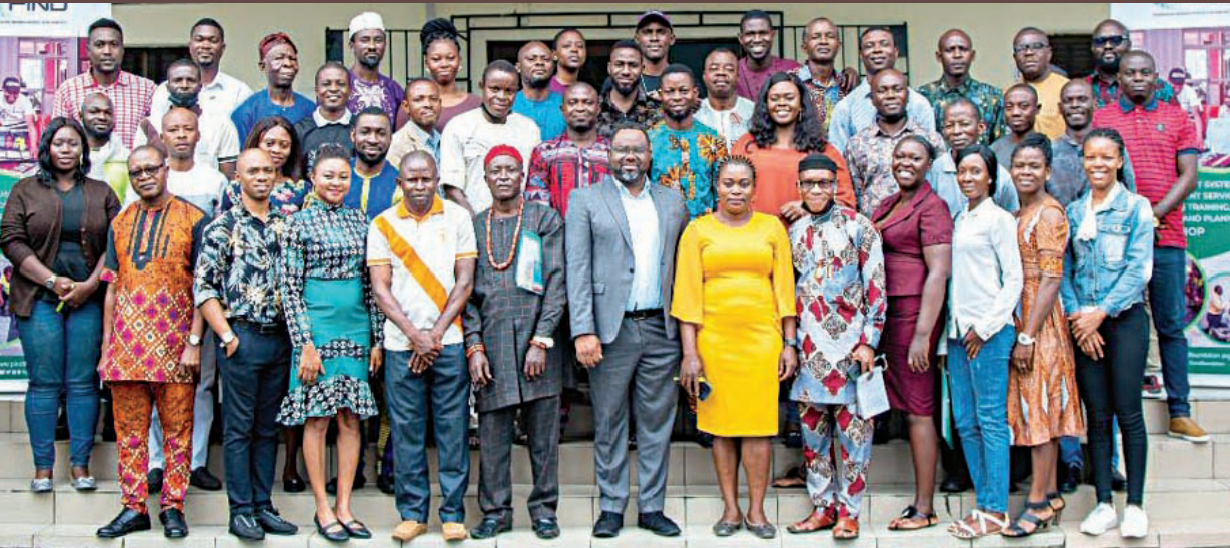
PIND recently hosted two productive workshops for its trained service providers under its MSD programme in Uyo and Warri, and Felicia was one of the SPs selected, which equipped the service providers with new business skills, practices, and processes to improve their service delivery to Niger Delta farmers and enterprises. They also provided opportunities to network and share peer-to-peer knowledge.
“I’m highly favoured to be among the participants,” Felicia said after service providing’ training in Uyo, Akwa Ibom state capital. “This training has given me an edge. My blood is hot to deliver. In every business, you will succeed if you have a vision. You must also have value. I am not the only service provider, but people cherished me because I know how to reward them. They have given me innovation to go and practice,” she said.
Felicia has gone to train over 500 oil palm farmers in her communities on oil palm best practices.
Emmanuel Ehimika was just a jobless graduate moving around the streets of Edo State and struggling on his cocoa farm when he met PIND and was taught how to commercialize his farming talent.
While Ehimika was farming, it was difficult to penetrate the market because the farmers are already used to free seedlings and services, especially from the federal government programmes and when the programmes end, the farmers are left with nothing to do and confused until he met PIND in 2009.
“Since my work with PIND started. It has transformed me from a common-need farmer to MD/CEO. My network coverage was very small, and it has now developed and made me an employer of labour,” he said.
A service provider, Gabriel Anthony Udo, thanked PIND for the opportunity and shared the impact the training has had on him.
According to him, “I want to thank PIND for this training. I have attended other workshops and training, but this is more exceptional. It is more impactful, and I’ve learned a lot. Due to this training, I am already making calls informing my workers of what to change.”
Ijeoma Ohaeri, a retired civil servant turned cassava farm service provider, echoed the same feeling of gratitude and accomplishment. She said, “I’m now a consultant, just consult me, and I will come and develop your farm for you.”
PIND’s Program Director, Dr. Effiong Essien, said of the workshops, “The end-goal is to improve the lives and livelihood of the small-holder farmers (SHFs), micro-small-and-medium-enterprises (MSMEs), and service providers through skill-building and skill-sharing. Thanks to their training, most of our service providers have now positioned themselves to serve as a bridge between farmers, enterprise groups, and other agro-allied actors.”
The workshops provided training on business development and management, business sustainability, capacity building, customer relationships, marketing/sales support services, and strategy development, among other skills to service providers in cassava, cocoa, palm oil, poultry, aquaculture and MSME value chains.
PIND’s MSD project focuses on the services market and employs a service provider model. This model leverages the capacity and skills of the service providers to boost overall market efficiency, productivity, and income. Following the workshops, the PIND service providers use their learned skills to help small-holder farmers’ SHFs and MSMEs in the region improve their efficiency, productivity, and income. They train the farmers and entrepreneurs on best farming practices, business management, soft skills, and conflict sensitivity training.
A poultry and business service provider, David Olukayode, praised the model, saying, “I see the PIND service providers’ model as a tree that cannot just make a forest but has several branches. So, through that, you can cross-pollinate and duplicate yourself. PIND is duplicating itself through the service providers who can now go into the world and create more service providers. And I am sure we will have more service providers from the farmers whose capacity we have built.”
Since its inception in 2012, PIND’s MSD project has reached 931,699 farmers and MSMEs in the Niger Delta with information on agricultural and business best practices. 457,728 farmers and MSMEs adopted knowledge, attitudes, and practices (KAP) that improved productivity to the tune of NGN 51.4 billion.
Felicia says she is now ready to contribute to reducing hunger in Nigeria and provide food.
“Now I want to feed the nation,” she said. “We should try and make farming attractive by bringing young people. I want PIND to try more and make my farm to be attractive by giving us all the support we need,”
Disclaimer
Comments expressed here do not reflect the opinions of Vanguard newspapers or any employee thereof.