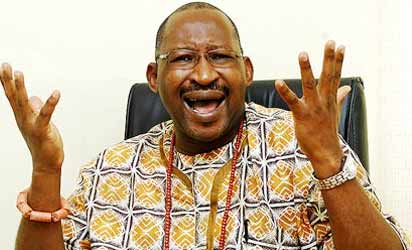
Obahiagbon
By Emma Amaize, Regional Editor, Niger Delta
FORMER House of Representatives, Patrick Obahiagbon, aka Igodomigodo, says Nigeria is an amalgam of diametrically opposed nations that has not learned any lesson from the July 29, 1966, military putsch.
Obahiagbon
Obahiagbon, who spoke to Sunday Vanguard said, “No doubt that the colonial creation of the Nigerian state is the fons et origo of our problems so much that some political and sociological thinkers postulate that the problem of Nigeria is ‘a bloody clash between irreconcilable civilizations foisted on us by our colonial suzerains.’
“Have we learned useful lessons from the remote and immediate causes that provoked the civil war? I am didymusian.
“It is indubitable that the July 29 military putsch, which is the second of serial military coups in Nigeria, was a counter-coup with Lt. Colonel Murtala Muhammed as its orchestral mastermind and that it was solely motivated by revanchism is the very reason it was daubed as ‘The July Rematch.’
“On January 15, 1966, motley of mutinous Nigerian soldiers with Major Chukwuma Kaduna Nzeogwu as its epicentre of gravity and whirligig, torpedoed our constitutional government in a sanguinary roforofo that left in its wake a preponderant number of soldiers and civilians of northern extraction committed to mother earth.
“The July 29, 1966 coupists held stringently to the opinion that the earlier aborted coup was an ‘Igbo coup’ targeted at the northern military and political solar plexus. They are quick to call to aid in corroboration of this aforementioned view, the passage of the Unification Decree.
“The January 15,1966 coupists were not tried for treason and were getting their salaries while in detention, created rumours of General Aguiyi Ironsi’s ethnic predilections toward Igbo.
“This was the bilious, caustic, virulent, acerbic, acrimonious, astringent and recriminalize ambience that occasioned the event of July 29, 1966.
“No doubt at all that the first military coup and others after it had its corrosive and debilitating toll on Nigeria’s democratic peregrination. When a group of young quixotic and chivalrous UK-trained army majors upended our democratic contraption on January 15, 1966, their stated mission was to extricate and disentangle Nigeria from the pestilential and philistinic phantasmagoria of malversation, nepotism, tribalism, ethnic chauvinism among others.
“One of the major casualties of this military gambadoism that took hold of Nigeria like gorgon medusa and scruffily seized it by its jugular for 29 years was the kwashiorkorization of our fragile federal configuration into unitary schemata.
Also read: July 30: Zioninsts leader invites Jerry Gana, Utomi, Soludo, Maku, others as cabinet members
“This putrescent unitarisation of our governance structure by our successive repressive military adventurers is what we still suffer today that has unleashed an armada of ethnic and regional militias chanting war songs of restructuring and at other times playing and dancing to musics of succession.
“Your conjecture is also as good as mine the extent to which military rule has extirpated corruption and all other maladies that Nzeogwu and his fellow travelers pleaded as a raison d’etat for their obtrusive incursions.
“The remote seeds of the Nigerian civil war were long sown by the colonial and decolonization gambit of British imperialism, but its immediate cause was partly due to the fact that our burgeoning independent political class was more of ethnic champions than they were nationalists, so much that they became apostles of apotheosizing our centrifugal fault lines over our centripetal agglutinants.
“This became the reason for the first coup and the concomitant counter coup and because the latter was revanchist in nature, it led to a progrom of one section of the country to the extent that they felt existentially threatened and had to take their destiny in their own hands and declared themselves an independent republic from Nigeria.
“Lieutenant Colonel Chukuemeka Ojukwu, who was then the Igbo Eastern Military Administrator, asseverated that ‘the brutal and planned annihilation of officers of eastern origin has cast serious doubts as to whether they could ever sincerely live together as members of a nation.’
“Thus the Nigerian civil war between the Biafran and Nigerian nation commenced on May 30, 1967 and came to an end on January 12, 1970. The civil war exposed the prostrate and invertebrate underbelly of our forced amalgamation to the extent that some scholars have stigmatized Nigeria as ‘a mere geographical expression’.
“I do not dispute the thinking that colonialists foisted the nation on us, but it is my strong contention that problems such as we have, no matter how humongous, will pale into thin insignificance with a visionary, purposeful and God- fearing leadership. A leadership that is pax -Nigerian in orientation and a philosopher- king in terms of cultivating the regime of mental magnitude.
“Happily with the kind of recusant follower-ship and catalytic citizenship daily enveloping our public space, I do not think we will need to wait for Samuel Beckett’s Mr. Godot for a period of aeon”.
Disclaimer
Comments expressed here do not reflect the opinions of Vanguard newspapers or any employee thereof.