COVID-19 patients who undergo surgery risk post-operative death — Study
•Doctors perform four surgeries in 12 hours
By Sola Ogundipe
Obstetrical emergencies are life-threatening medical conditions that occur in pregnancy or during or after labour and delivery. A number of illnesses and disorders of pregnancy threaten the well-being of both mother and child. An obstetric emergency in pregnancy can be caused by a number of factors, including stress, trauma, genetics, among other variables.

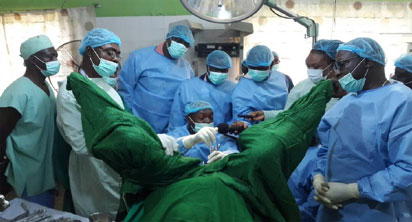
Cross section of Medical doctors carrying out Fistula surgery inside the operating theatre of the Usmanu Danfodiyo Teaching Hospital, Sokoto.
To manage such situation, doctors often require the patient’s past medical history, including previous pregnancies and deliveries to anticipate the possibility of complications.
At the Lagos University Teaching Hospital LUTH, eclampsia and preeclampsia are common obstetric emergencies and common causes of maternal and perinatal deaths. The obstetric unit of LUTH has been managing these and other complications and causes of maternal deaths for as long as the health institution has existed.
Towards improving maternal health and reducing maternal mortality morbidity, LUTH routinely carries out Caesarean Sections (C-section or CS) in managing certain obstetric emergencies. The procedure involves the surgical removal of a baby as an alternative means of delivery. About a third of all births occur through C-Section. A doctor makes incisions in the abdomen and the uterus to retrieve the baby. A C-section is often necessary based on the health of the mother or the baby.
On the 28th of September, 2018, four emergency Caesarian Sections were carried in the labour ward in LUTH. The procedures were carried out within 12 hours on women in various advanced stages of pregnancy. They were all unbooked patients as their antenatal care was not received in the hospital.
They were low income earners who could not immediately pay for the cost of health care. All had severe complications ranging from the sequelae of hypertensive disease in pregnancy – severe preeclampsia, eclampsia and eclampsia with Haemolysis, Elevated Liver Enzymes and Low Platelets (HELLP Syndrome), etc.
First to be wheeled into the theatre was Patient N, a 26-year old with eclampsia. Emergency Caesarian section was done under subarachnoid block. Surgery and anaesthesia were uneventful. She was transferred to the wards from the recovery room post-operatively.
Next was Patient O, a 33-year-old with severe preeclampsia complicated by acute kidney injury, also had emergency C-section under subarachnoid block. Surgery and anaesthesia were uneventful. She was planned for haemodialysis post-operatively, but suffered a cardiac arrest post operatively from suspected electrolyte imbalance with return of spontaneous cardiac activity after several minutes of cardiopulmonary resuscitation.
READ ALSO: Six dead, dozens hurt in Italy nightclub stampede
The patient required intensive care unit care but could not afford it and with no bed space available, was subsequently referred to a private facility where she was lost.
Third on the list was Patient M, a 33-year old with eclampsia and HELLP syndrome. She had emergency C-Section under general anaesthesia relaxant technique. Surgery and anaesthesia were uneventful. The patient required the intensive care unit care post operatively but could not afford to pay for it. She developed eclamptic fits while in the recovery room and was eventually transferred to the wards.
The 4th, Patient A, a 34-year-old with severe pre-eclampsia, had emergency C-section under subarachnoid block. Surgery and anaesthesia were uneventful and she was transferred to the wards from the recovery room post-operatively.
These cases aside, the emergency room of the obstetric ward in LUTH is constantly a beehive of activities from obstetrical emergencies. The health facility’s Accident and Emergency unit is also kept busy from by such events. A woman who had had three previous C-Sections developed complications from a 4th pregnancy was rushed into the emergency room. She was unbooked and unregistered for antenatal anywhere despite the high risk nature of her pregnancy.
Medical experts often advise women who have undergone three C-Sections to avoid getting pregnant again so as not to endanger their lives and the lives of their unborn babies.
“This particular patient had suffered placenta previa, a condition that arises when the placenta severes prematurely from the uterus causing profuse bleeding,” Senior Registrar, Obstetrics and Gynaecology, Dr. Osunwusi Benedetto observed.
“We realised her blood type was rare, which made it much more difficult to replace the lost blood. At that point, we were at a fix, whether to allow her bleed to death or devise something outside the box.”
She required urgent surgery to rectify the severed placenta, but had no blood left in her to sustain the surgery, but to save her life the medical team procured blood and commenced the surgery without her family depositing a kobo for her treatment.
Medical experts describe a C-section as a lifesaving intervention that can save the lives of mothers and babies. While it can be very safe in skilled hands a C-section carries risks and is very expensive to the health system.
“If a pregnant woman knows that she will require a C-section before going into labour, it is a planned (elective) C-section. But if decision is taken at short notice that a C-section is the safest way to deliver the baby, it is called an emergency C-section.”
Sunday Vanguard gathered that about one in four women who give birth in health facilities in Nigeria do so through a C-section. Most of these are emergency C-sections. Obstetricians and Gynaecologists at LUTH, explained that planned C-sections are usually done from week 39 of pregnancy because babies born earlier than this may not be fully developed for life outside the womb.
“A C-section may be earlier than this if there’s a medical reason for delivering the baby sooner. Possible reasons for having an emergency C-section are many and may include problems with the placenta, such as a low-lying placenta (placenta praevia); or the baby is lying in a difficult position for labour, such as bottom down (breech); or if the woman is expecting two or more babies, or if the pregnancy isn’t progressing and there are concerns about the health and safety of the mother and the baby.”
Indigent patients
In another instance, a patient on the operating table on the emergency room had lost a lot of blood and was slowly bleeding to death. The attending internist anxiously checked her pulse. It was feeble and growing weaker by the minute. She needed an urgent blood transfusion. But blood was not available. The blood bank had run dry due to high demand, and the patient’s relatives were nowhere to be found to purchase or donate the life saving blood. She faced certain death.
Head of the medical team turned to the young doctors and other members of the team with a request to volunteer to donate blood to save the life of the patient. It was not a strange request. Health workers at the tertiary health facility often donate blood for patients. Some go as far as contributing money for indigent patients to buy drugs, run tests and purchase other medical aids.
“Donating blood goes beyond the call of duty. A policy of the LUTH management is not to turn back patients with emergency cases even if they are unable to pay for treatment,” a Senior Registrar stated.
“In the case of this particular patient, my team members and I rallied among ourselves for blood. Eventually, some of us were eligible to donate, so we went straight into the process and gave her some pints of blood. That line of action was what her body needed first before any form of treatment instituted would work. The woman within days was hale and hearty, and I had this fulfillment that we were able to save her.”
In another instance, a woman who had septic arthritis was also admitted as an emergency case, but the Intensive Care Unit was full. Even though the patient was unable to pay for her treatment, the team rallied around to get her intensive care she desperately required.
“We approached the hospital management and we were graciously allowed to do the work of ICU for 48 hours. We abandoned our homes, lost sleep and other schedules so we could do the work of the machine. We became human ICUs”.
The hospital gave the patient five pints of blood without replacement. Two members of the medical team thereafter donated two pints of blood as replacement even as the medical team contributed money for her drugs.and she left the hospital in good health.
Dr Ochuwa Bobah, a Senior Consultant, Obstetrics & Gynaecology, gave another scenario: “A patient in the ICU accumulated a bill of N1.4 million despite other private donations from doctors and health workers. The pregnant patient came in moribund, which means she was just minutes away from dying. She was brought in by someone who claimed to be a Good Samaritan.
“The case was an emergency, and there was no history to work with. With no ‘relative’ to work with, we took her to emergency and operated on her. By morning, the person who claimed to be a Good Samaritan disappeared. Her husband came in, we asked how he intended to pay, he in turn asked to know what the doctors will do to clear the bill. Before we knew it, the man went away. The patient also absconded.
“Even if she didn’t abscond, there was no way we would have held her against her will. So many patients take advantage of this gesture from hospital management and staff because we have continued to err on the side of compassion. No day passes in this hospital without having an indigent patient in my ward alone,” she said.
But even as much as the hospital aims to support indigent patients, such practice is unsustainable. “Somebody must fund healthcare in a way,” said the Chief Medical Director, LUTH, Prof Chris Bode. “This is why we are advocating for all Nigerians to be under the health insurance scheme, so that even if the patient is poor and unable to pay for healthcare, there will be someone else somewhere paying for the bills.
When a 24-year old sickle cell anemia patient and mother of one, was admitted into the LUTH, following a referral from a General Hospital where she had earlier undergone a C-section on account of fetal distress, the managing team of nurses and doctors of the health institution’s obstetric ward swung into action to salvage and rescue the patient.
On admission, the young mother was profoundly septic, pale and in shock and penniless, even as she required multi-disciplinary care. The medical team, led by Dr Babah, rallied around to save the situation. Vital signs of the patient were quickly taken. Her Haemoglobin count was 5 percent and the white cell count indicated a roaring life-threatening infection.
Sunday Vanguard gathered that the patient required urgent blood transfusion but there was no relative available to donate for her. Without much ado, two doctors as well as a student doctor readily volunteered to donate blood for the patient. She was given seven pints of blood to save her from a crippling vaso-occlusive crisis. The hospital’s Medical Social Workers also raised money to pay for her drugs.
The young lady later developed septic arthritis, a common infection associated with her medical condition. She was now being managed by the orthopedic team. She couldn’t walk unaided and required an orthopedic walking frame. But it cost N11,000 and she didn’t have the money to buy one. Another doctor, a Senior Registrar in the OBGYN team, rose to the occasion and bought the walking frame for the patient with his own money. The was later discharged but continued to receive treatment from the orthopedic team for her infected hip joint condition.
“Saving lives is our normal call of duty, said Bode. “It’s what we do everyday. However, many of the facilities from where she received care are privately placed investments bridging the infrastructural gap and ensuring availability of services in our hospital. This is how we have been able to cope thus far. The Blood Bank which made available several pints of blood, fresh frozen plasma and other blood products that were used to successfully treat her is a PPP initiative that does not run as a charity.
“Similarly, the drugs she used should be replenished through cost recovery, lest we should have nothing to use for the next person in need. The reality is that we still run a cash-and-carry economy where over 70 percent of our patients pay out of pocket. Our obligation as a hospital ends when a patient is successfully treated. If our patients are encouraged to expect free service without any expectation of payment, the system will rapidly collapse because it is unsustainable.”
Bode notes that LUTH renders tertiary care services at modest cost, but services are however not free. An estimated N1 million in debt is written off monthly for indigent patients and lose about the same amount is lost to abscondment.
Disclaimer
Comments expressed here do not reflect the opinions of Vanguard newspapers or any employee thereof.