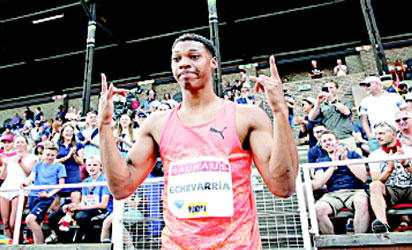
•Juan Miguel Echeverria
By Yemi Olus
A week ago, a 19-year old Cuban Long jumper by the name of Juan Miguel Echevarria performed an incredible feat that sent shivers down the spines of Athletics lovers all over the world! While competing at the IAAF Diamond League meeting in Stockholm on Sunday, June 10th, Echevarria sailed over a distance of 8.83m to win the men’s Long Jump ahead of favourite, South Africa’s Luvo Manyonga, who is the reigning World Champion in the event.

•Juan Miguel Echeverria
However, the teenager was denied a legal Personal Best or Record because the wind reading for the jump was registered at 2.1m/s, just one-tenth of a meter per second more than the legal wind of 2.0 m/s, which would have earned him a World Lead, National Record, Meeting Record, Diamond League Record and World U-20 Record.
That notwithstanding, his mark of 8.83m is the longest jump in the world in almost 24 years, as only five men have ever gone farther than that mark under any conditions, thus threatening Mike Powell’s World Record of 8.95m set at the 1991 World Championships in Tokyo.
2018 has been a fantastic year for the Cuban no doubt, and he had given a glimpse of things to come when he upstaged reigning World (outdoor) Champion Manyonga to win the World Indoors title in March this year with a jump of 8.46m, which was a World Lead at the time. The Rome Diamond League two weeks ago provided a rematch between the pair, with Manyonga taking the lead with a World Lead of 8.58m, while Echevarria followed in 2nd place with a PB of 8.53m.
According to a report by the IAAF on the youngster, it’s taken Echevarria 10 years to get this point, signifying that he started the Long Jump before he turned 10. Part of the article goes thus:
“Ten years – that’s how long this performance was in the making. To soar 8.83m through the air, the longest jump in the world in any conditions for 23 years, Juan Miguel Echevarria had to put in 500-odd weeks of training and pass through multiple coaches, who each added their own splash of paint to what he has become – a long-jumping masterpiece.
“Echevarria first took up Athletics at Ernesto Lucas elementary school in his hometown of Camaguey, and credits the influence of coaches Tomas Hernandez and Ivan Izaguirre for his early development. After showing promise at a range of events, he was selected to join the national youth team in his early teens”.
Echevarria was able to get to this point because his talent was identified while he was a kid, and properly harnessed, leading to his becoming the masterpiece he is today. Ironically, Echevarria is not the only Cuban who achieved something worthwhile this past week. A day before, his 17-year old compatriot and reigning World U-18 Triple Jump Boys’ Champion, Jordan Diaz leapt to a PB of 17.41m while competing in Havana.
Diaz’s new mark serves as the new U-18 World Record in the Triple Jump, improving on his former U-18 Record of 17.32m set in February. His new mark puts him at No.3 on the World U20 all-time list andNo.6 in the world this season across all age grades, including the senior category! To put things in perspective, this distance set by Diaz surpasses the Nigerian (senior) men’s Triple Jump Record of 17.26m set by Ajayi Agbebaku almost 35-years ago!
While I am wowed by the amazing feats being accomplished by this youngsters who belong to a country that has a proper structure that identifies and harnesses their talent early on in life, I can’t help but feel a twinge of sadness at our own situation in Nigeria.
I was at the AFN National U-20 Trials held last week in Ozoro, Delta State, and despite the screening exercise which took place, the competition venue was swarming with over-aged athletes who felt no sense of shame at chunking off a considerable number of years from their ages, all with the backing of their coaches and officials. When one of such athletes whom I knew to be over the required age was challenged, the 20-something year old retorted: “This is what the country has given us”.
Because the U-20 Championships served as Trials for forthcoming international competitions like the IAAF World U-20 Championships, African Youth Games and Youth Olympic Games, seniors suddenly become ‘youth’ athletes overnight, all because they want to be selected to represent Nigeria, while denying the real Youth and Junior athletes a genuine chance at being identified and groomed, and then the cycle continues. How then can we make meaningful progress in the sport when issues such as these, remain prevalent in our country?
Some of Nigeria’s best exports in Track and Field were discovered while in school, and they went on to enjoy long and illustrious careers, because they were discovered early and given the opportunity to blossom. The likes of Mary Onyali, Falilat Ogunkoya, Henry Amike and a host of others fall into this category.
As long as we continue to cut corners and fail to build a structure that identifies the potential in these athletes, and groom them for the future, we will continue to struggle on all fronts while the likes of Cuba continue to produce world beaters and champions.
Disclaimer
Comments expressed here do not reflect the opinions of Vanguard newspapers or any employee thereof.