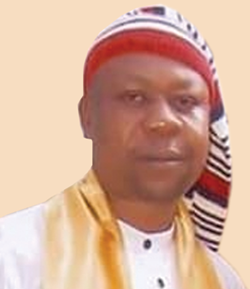
Onwughara.
By Juliet Ohwotite
Engr. Izuchukwu Joshua Onwughara, a corporate member of the Nigerian Society of Engineers, registered with COREN, is the Project Coordinator of Abia State Nigeria Erosion and Watershed Management Project, NEWMAP, a World Bank-assisted, state-led project in erosion control.

Onwughara.
He studied Civil Engineering at University of Nigeria Nsukka and upon graduation worked with Taisei W.A. Ltd. in the construction of Eleme Petrochemicals Complex. He had a brief stint in politics until 2005 when he joined the Abia State Civil Service as a Principal Engineer with the Ministry of works.Within the state service he has served in several positions in donor agency-assisted projects in the state which afforded him great opportunities in trainings and leadership development.
An ordained pastor who is working to reclaim and reconnect communities lost to erosion, Joshua Onwughara is an advocate of a sustainable earth and greener environment who is also reaching out to the poorest of the poor in remote communities affected by gully erosions through NEWMAP. He spoke with Juliet Ohwotite on NEWMAP’s achievements, efforts, challenges and support of the state government.
Excerpts:
What is NEWMAP all about?
NEWMAP stands for Nigeria Erosion and Watershed Management Project.The project development objective of NEWMAP is to reduce vulnerability to soil erosion in targeted sub catchments. Abia State happens to be one of the first seven NEWMAP states.
NEWMAP started primarily as a response to the cry by the governors of South-East of Nigeria to the immediate past President, Dr. Goodluck Jonathan asking for assistance from the Federal Government to combat the menace of gully erosion in the geo-political zone. The Federal Government then approached the World Bank for assistance. The project became effective in 2013 with seven states – the five South-Eastern states plus Cross River and Edo states.Today, the project is running in 19 states across the nation.
It is an eight- year multi-sectoral programme which combines rigid structures such as concrete channels and energy dissipaters with flexible elements such as reno-matrasses and gabion dams and bio remediation to effectively tackle gully erosion. With the addition of livelihood enhancement programs and a robust enlightenment and community ownership sensitization program which are transmitted through the community interest groups, a total package is thus delivered which reduces to the barest minimum the tendency of further erosion in such targeted sub catchment. Gully sites to be worked on are selected through a prioritization process at the state level.
These projects are capital-intensive. How much support are you receiving from the government to tackle erosion menace in Abia State?
The project design makes it state-owned and state -led because implementation is at the state-level. The fact is that it is not strictly a World Bank project, but a state project with assistance from the World Bank; so, when people call it a World Bank project, they are actually wrong. To show commitment, each state has to give what is called government’s counterpart contribution. The administration of Governor OkezieIkpeazu has been at the forefront. As soon as he came into power, he gave the initial N50 million that was needed for the resettlement activities; thereafter, he also gave another N300 million and as we speak, plans are under way to increase the entire counterpart contribution of the state from the present N350 million to N1 billion and in such austere times, I don’t know what else this governor can do for the state. He shows concern, he shows his humaneness, he shows he is interested in the wellbeing of his people and that he is concerned about the poorest of the poor whom this project targets in order to ameliorate their situation.
Beautiful! But you must be facing some challenges. Can you tell our readers some of these challenges and what you are putting in place to ensure desired results?
The first and biggest challenge is that of great expectations. Once people hear that there is a project dedicated to curbing the menace of erosion, they call you every time. We have a toll-free line which they can call at any time of the day. So people keep calling and writing letters, bringing in pictures of gully erosion menace and devastation, buildings that are falling in, roads that are cut into two, and the like. Each time they bring these requests; they expect us to just roll out equipment to the place and begin to work. Incidentally, it is not so.
Targeted sub-catchments
I talked about targeted sub-catchments; there has to be a measured way of selecting sites irrespective of how bad a particular site might be as at the time our attention is drawn to it.There is a framework for assessing sites based on clearly defined World Bank criteria.
On the basis of these, we draw up our long list which is taken to the State Technical Committee which is a body of the permanent secretaries of the relevant ministries and the State Steering Committee –the body of Honourable commissioners of the same line ministries, for proper prioritization. The final priority list is then transmitted to the governor who is the chief borrower for his consent.
So the major challenge is great expectations. We are not able to meet all the expectations. How I wish we could rush to every site we are called to come and intervene but it is not always possible. Land is fixed and for every square inch that is devastated, somebody feels it and we feel it the more because people look up to us.
The second challenge we face is the time taken for the rigorous and thorough processes leading on to actual intervention.We are running a race against time.
We also have the challenge of the development and management of the human capital who manage the project. For us as a team, we have a challenge to be better than we were the previous day.
The project team is putting up measures to fast track the process leading to the award of contracts by shortening the time of return for each activity. Alongside the Focal NGO engaged by the project, we are working to sensitize communities on project ownership and to create an enabling environment for service providers working in these communities.
Beyond the approval of our annual work plans and provision of the GCC, the state government is doing all within her powers to ensure smooth project implementation. We have wonderful cooperation from the communities where we are intervening already and we have an excellent relationship with the federal office of NEWMAP and the World Bank Country Office. All we just need to do is to double our efforts and make sure that we deliver on what is expected of us.
Tell us some of the projects you have done in the state already
The projects became effective in 2013. Between 2011 and 2013, states were asked to engage national and local consultants. They were asked to pick five priority sites and give to those consultants to prepare the designs so that when it is time for the implementation stage, each state will have designs ready to be implemented. When it was time to get into implementation by 2013, out of the five sites our consultant was working on, he was able to get three ready. They are Umuezeukwu in IsialaNgwa North, Amuzukwu in Umuahia North and Amuda-Achara in Umunneochi Local Government Area. Those three sites were publicly advertised and then there were bidders, the procurement unit did the processing and the contracts were awarded.
The contractors could not go to site because of some challenges within the states, but as counterpart fund was provided, we went to site to do the implementation of the Resettlement Action Plan, RAP. It is a form of Environmental and Social Impact Assessment, ESIA. It is for the compensation of those who may have to be resettled involuntarily as a result of our intervention and it is done with money from the state government. So, when we got the money from the state government, we went to the communities and did the implementation and then civil work started at those places.
At Umuezeukwu, they have achieved 100 per cent of the initial job and additional work was given to them. Today, they have achieved over 85 per cent of the additional works and they will soon leave that site. They had to reclaim a gully that was about 1.1-kilometre long, in some places, up to 25 metres wide and in other places, up to 10 or 15 metres deep. Communication between the two villages Umuezeukwu and Owo Umuezenta was cut off. Today, that place is perfectly reclaimed and the road has been put back in place, we have drainage channels on both sides of the road and the communities requested the reclaimed road be asphalted The project is nearing completion.
In Amuzukwu Ibeku, the contact for the remediation of a large gully was awarded and the contractor completed the initial phase, but while work was going on, two other landslides developed which gave rise to additional works. So, contract has been awarded for that additional work and the contractor is very busy on that. If you go to site today, you will see that the initial contract has been completed. It involves peripheral drains, a collector chute drain, a stilling basin and the outflow structures with vetiver grass and elephant grass mixed up and planted in the slope, beautifully done in Amuzukwu.
The third site is at Amuda – Achara in Umunneochi area. The contract was terminated due to non – performance of the contractor. Arrangements are almost concluded to reward that contract before the onset of full rainy season.
There is the fourth gully remediation site at Umuagu Ibeku/UmudaIsingwu/AmaforIsingwu. The project which was flagged off by the Governor in December 2017 is already 67% completed and additional works contingent upon the on – going works will soon commence alongside the major contract.
The fifth erosion site is at UmuogeleUmuakwu in Isialangwa north area. Again great progress is being made by the contractor handling this project.
The game changer or bigger one – the Aba floodemergency intervention. The design for these works have been cleared by the World Bank for four major flood plains in Aba namely the Ifeobara, Uratta,Umuagbai and Ndiegoro, popular flood flash points in Aba.The advertfor the award of Uratta and Umuagbai will soon hit the tabloids. Those are very big projects. When they are done, the story in Aba will change. In fact, with Uratta and Umuagbai addressed, Port Harcourt road would have been addressed and by the additional financing, we will go over to Ndiegoro and Ifeobara ponds. Only Aba people will appreciate the expected positive impacts of these works.
What other things would you like to tell the public about your organisation?
Making the earth more sustainable
I want the public to know that it is not really about the organisation but about how we can make the earth more sustainable. Let us live our lives in a way as to have an earth remaining for future generations. The money we pump into controlling and curbing erosive activities will be better used in other things that would develop the society if we live well, manage our society and environment well; have a good maintenance culture and try to nip certain things in the bud before they develop. A greener environment will be better for everyone.
Reducing abject poverty
Part of our activities, generally, is to reduce abject poverty and what that means to us here is that whatever is needed to be done to bring out the poorest of the poor to come to a better level, we should do it. So, when we get into a project community or sub-catchment, apart from working to recover the erosion-devastated area, we also do something else. We have a grant component in this project provided by the Global Environmental Facility, GEF and the Special Climate Change Fund, SCCF. Both funds are being applied to the preparation of Aba urban Storm Water Management Masterplan and for livelihoods enhancement activities.
In sub-catchments where we operate, after a study on the livelihood needs assessment of the area, we are able to help them through our NGO, to create such community interest groups, CIGs, along the lines of various trades or skill sets that they are interested in. They are helped to create community action plans. The NGO helps them to register such groups with the local/state government and when they do, we fund such groups; first, from the level of getting them instructors who train them on those skills and then fund them to actually implement those skills like poultry, piggery, farming, fisheries, cassava-farming up to the value chains associated with these activities. So, if one group is doing the cassava farming, the other group is into processing and selling and so on.
Already on this project, about N67 million has been earmarked for CIG activities in the three different communities. More than half of the sum has been disbursed as grants to the CIGs.The project also plans to support relevant line ministries to be able to raise nurseries and also raise the capacity of the Ministry of Environment to be able to respond to challenges of gully erosion even after this project must have ended. The project also works to get the communities to have a sense of ownership of the projects so that after we have left the place, they can maintain whatever structures that are built in their areas.
Disclaimer
Comments expressed here do not reflect the opinions of Vanguard newspapers or any employee thereof.