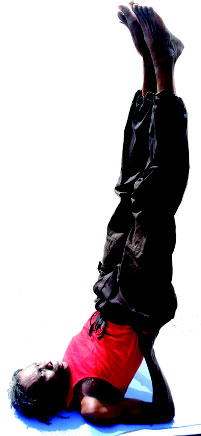
The Shoulderstand Pose
Abby, my yoga student related to me a poignant story about three weeks ago.
She had attended a Church service for a 70th birthday of a woman.
The surprise part of the story was when she said it had been arranged for a cardiologist to give a little talk on D.V.T.. (Deep Vein Thrombosis) which had caused the death of many people.

The Shoulderstand Pose
The cardiologist is said to have told the congregation that the incidence of people dying of DVT had risen by up to three hundred percent (300%). And that the cause could be on account of commuters in Lagos having to get stuck in traffic for several hours, this leading to blood clots forming, to induced death.
The doctor was said to have been very passionate in his plea for people needing to work closer to home to avoid the danger of crawling traffic and miles to go to reach home.
For him, the danger was too serious, for anyone to think of a way around the harm of being stuck in traffic for so long. And we are not talking of people who could reach the hospital for attention but those who were dead on arrival.
Health wise, my humble contribution is for people everywhere to regularly practice the Shoulderstand – a Yoga posture that has been proven to keep blood platelets from clustering up to form blood clots.
Below is an article I published years ago, but which can be of timely motivation for self-help!
According to research psychobiologist and Iyengar Yoga teacher, Roger Cole, “yoga and science go together very, very nicely.”
A scientist with a doctorate in Health Psychology, Cole’s studies involve the interface between physiological and psychological processes, specialising in research and biological relaxation, restoration, and biological clocks.
A gymnast when he was in high school, he has been practising for over 20 years and says that yoga offers “a vast storehouse of wisdom” about the body and mind that modern science can draw upon.
In his work as a researcher, Cole has documented the effects of various yoga postures on brain waves particularly relaxation poses such as Viparita Karani (Supported Inverted Pose) and Setubandhasana quickly manifested the data brain waves associated with deep relaxation.
He has also delved into the physiological effect of inverted poses, which he says dramatically affect hormone levels, brain arousal, blood pressure, fluid balance and a host of other factors among other changes.
When the body is turned upside down, the heart rate slows and the blood vessels dilate.
The extra blood in the trunk stimulates the baroreceptor nerves in the aorta and neck, which in turn signals the central nervous system to lower blood pressure and slow down brain waves.
Modern science offers Yoga, Cole says, a precious way of observing and qualifying such subtle phenomena, thereby broadening the body of yogic knowledge. “Some people look at the system of yoga as static-they think its perfect as it is,” says Cole, who teaches at the North country Yoga Studio in San Diego, California, USA. “But yoga is still evolving and we are still inventing yoga today.
“Science can manipulate matter and energy but it doesn’t discriminate between what is beautiful and sacred and what is not,” he enthuses. “Yoga brings that beauty, turning our investigation into a living art.”
The shoulderstand
Technique:
Lying on your back, draw up your knees, and place both hands at the back with the thumbs to the hips. With a bit of momentum, raise the legs up and point the toes skyward. For the beginner, a half-minute in this posture will do until over the longhaul you can say for upwards of two minutes.
Disclaimer
Comments expressed here do not reflect the opinions of Vanguard newspapers or any employee thereof.