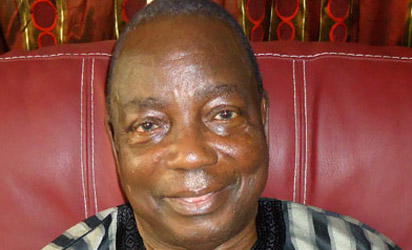
General Ogbemudia
•His passion, politics, and pitfalls
By Emmanuel Aziken, Political Editor
Dr. Samuel Ogbemudia’s foray into politics in 1981 came after a presidential blackmail, personally orchestrated by then President Shehu Usman Aliyu Shagari.
After his glorious eight-year stint as military governor of the defunct Midwest State, Ogbemudia’s heroic image was almost tainted by the allegation of involvement in the February 13, 1976, coup that killed then head of state, General Murtala Ramat Mohammed.
It was a twist of fate for Ogbemudia and the principal culprit of that coup.
In 1966, while serving as brigade-major of the military formation in Kaduna, Ogbemudia had locked up, Lt. Col. Bukar Dimka on the suspicion of plotting a coup.

General Ogbemudia
Ogbemudia, in an earlier interview with Sunday Vanguard revealed that that act of locking up Dimka was what saved him from being roped into the Dimka saga in 1976, because Dimka confessed that he couldn’t have revealed the coup plot to Ogbemudia, given his experience ten years earlier.
However, as the Second Republic progressed, a branch of the Northern establishment, (in)famously known as the Kaduna Mafia, appeared to have zeroed-in on Ogbemudia in the long-term power engagement with the rest of the country.
Whether Shagari was privy to the plot on Ogbemudia by the Kaduna Mafia or not remains unknown. The president, however, was the messenger.
The day of reckoning for Ogbemudia came one Sunday sometime in 1981.
Ogbemudia was in his Iheya Street residence in Benin when he was approached by his gateman that an Hausa man identifying himself as Shagari was at the gate.
Ogbemudia, according to a close source who he confided in, said he dismissed his security man, asking him, whether he knew who Shagari was? But the man persisted and Ogbemudia asked to let the man in and, behold, the President of Nigeria sauntered into his parlour, having arrived Ogbemudia’s Benin residence in an unmarked vehicle.
Ogbemudia was immediately reprimanded by Shagari who accused him of avoiding him despite repeated entreaties to see him in Lagos.
“You have been avoiding me even though I know you have been passing through Lagos,” the President was said to have told the former military governor.
Shagari had been mounting pressure on Ogbemudia to join the ruling National Party of Nigeria, NPN with the offer of flying the party’s ticket in the forthcoming 1983 election to match the popular incumbent, Prof. Ambrose Alli, of the Unity Party of Nigeria, UPN.
Ogbemudia, after futile efforts to throw back the President’s offer, it was learnt, insisted that he did not have the money for such an endeavour. To this, the President told him not to bother. The final condition given by Ogbemudia was that if he took up the offer, he would have to put his man as the state party chairman, and again President Shagari conceded.
So the following day, a Monday, a drama happened which led to the sacking of the then state chairman of the party, Chief Tayo Akpata, and in his place, Ogbemudia’s man, the recently retired policeman turned businessman and sponsor of the Yakon Group of Companies, Chief Tony Anenih, as state chairman of the NPN.
Akpata, who served as a commissioner in Ogbemudia’s military cabinet in Midwest State, reportedly held that as a grudge against his former boss till he died in 2014.
He almost always sought to avoid meetings with Ogbemudia or meetings held in Ogbemudia’s house.
With the enthronement of Anenih as state chairman, Ogbemudia’s successful march back to government began as he defeated Alli in the 1983 election.
Ogbemudia’s emergence as governor of Bendel State as it was, was only a plot in what the power mongers of the Kaduna Mafia envisaged as a long-term project to continue to pull the power levers in the country.
By 1981, the mafia was already looking towards 1987 when the second term for Shagari was to end. Having successfully nudged the multimillionaire businessman, Chief Moshood Abiola out of the 1983 contest, the political godfathers in the NPN were looking forward to a successful transfer of power to a person who would not harm the interest of the Mafia.
Dr. Alex Ekwueme, then vice-president, who had provided much of the money used in funding the party at takeoff was a ready choice. He was loyal. His only known rival for the ticket as at that time was Chief Adisa Akinloye, the powerful chairman of the party.
However, beyond the two men, another school of thought within the Hausa-Fulani hegemony was also making permutations on keeping the political ascendancy of the ruling ethnic group beyond 1987. For the later, choosing any prominent man from either of the two major ethnic groups in the South would be unsavoury for the Hausa-Fulani power bloc.
For this group, choosing a southerner from the minority group would better serve the interest of the mafia as the permutations were that a successor to Shagari from the Southern minority would not have the ethnic base to challenge the ascendancy of the Hausa-Fulani, a prospect that could not be said of either Akinloye or Ekwueme who were respectively from the Yoruba and Igbo ethnic groups.
Whether Shagari was privy to this permutation remains unknown and, President Shagari, now, 92 could not be reached on the matter as minders would not allow journalists access to the former President.
The Kaduna Mafia’s choice of Ogbemudia, according to observers, is best seen in how the Hausa Fulani had, at that time, used the minorities to balance and forge alliances at the expense of the Yoruba and Igbo in the South.
During military rule when consideration of that factor was played down and Ebitu Ukiwe was appointed as Ibrahim Babangida’s number two, the uproar that arose from ranking northerners in government, led to the ugly drama that was orchestrated with the ultimate goal of forcing a replacement with a more compliant Augustus Aikhomu from a minority group in Bendel State.
Also, when General Oladipo Diya was accused of trying to alter the apple cart, another Bendel man, Michael Akhigbe, came in as a replacement.
However, the 1987 permutations for Ogbemudia were derailed after the military intervened in December 1983 and aborted the Second Republic.
Perhaps, and may be, had the Second Republic not been aborted, an Ogbemudia presidency may have emerged.
Beyond the derailment of his governorship which was in its infancy, not much harm was done to Ogbemudia as the coup was heralded by an announcement by Brigadier Sani Abacha, head of the Second Mechanised Division, who was at one time a protégée of Ogbemudia prior to the civil war.
Between 1985 and 1992, he was tapped by the military government to head some government agencies among which were the National Sports Commission, Nigeria Railway Corporation, NRC. In both positions, he left office with relative degrees of success.
He also served as minister of labour in the Sani Abacha regime during which he successfully managed the one-time combative unionist, Comrade Adams Oshiomhole, president of the Nigerian Labour Congress, NLC.
Ogbemudia’s appointment as minister in the Abacha regime was the second time the two men would work together.
In 1966, Abacha had served under Ogbemudia who was brigade-major in the First Division of the Nigerian Army. Ogbemudia had picked him up at that time for his good marksmanship.
The good relationship between the two men culminated in the yeoman job by Abacha in saving Ogbemudia and his family from the pogrom that followed the July 1966 counter-coup.
As the Fourth Republic unfolded, Ogbemudia, unlike his first foray in 1981, did not need much persuasion. He, Anenih and Chief Gabriel Igbinedion, were the principal men who became the troika upon whom the Peoples Democratic Party, PDP came to rest on – at least in Edo State and much of the South South.
While Igbinedion successfully positioned his son, Lucky, for the governorship ticket of the party, Anenih also carved out a role for himself as leader. Ogbemudia’s lot was to tag along. That policy of tagging along even in the face of wrongdoing was a negative that many were to associate with Ogbemudia till he died. Even attempts by Anenih to save Lucky Igbinedion from himself did not yield much going by what became of the PDP since immediately after the latter’s tenure as governor.
The PDP government that he helped to enthrone was a near complete disappointment to him. Though he was a member of the Board of Trustees of the party, he played no significant role in the party during Olusegun Obasanjo’s two terms as Anenih increasingly overshadowed his influence in the running of the party in Edo State.
Ogbemudia was a very patient man who operated with much fortitude in the face of political backstabbing and betrayal. Apart from once towards the end of the Igbinedion era when he walked out on a peace meeting with Anenih, he kept the disappointments and hurts he suffered from allies to himself.
But privately, Ogbemudia expressed his frustrations. However, he rarely publicly complained about his relegation to near irrelevance in the PDP.
When towards the end of Governor Lucky Igbinedion’s second tenure that Anenih and the Igbinedions engaged in open warfare, Ogbemudia kept away from the two sides in the conflict that turned into war of mutual destruction. The warfare between Anenih and the Igbibedions eventually led to the enthronement of Oshiomhole who eventually boasted of retiring the two antagonists from politics.
Yes, Ogbemudia may have gone to rest, what may have become of a presidency that never was can only remain in the realm of conjecture.
Disclaimer
Comments expressed here do not reflect the opinions of Vanguard newspapers or any employee thereof.