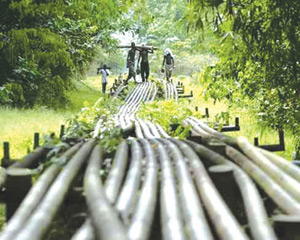
Oil-pipeline
When Vice President Yemi Osinbajo commenced his tours of Niger Delta communities in January this year, most sceptical observers saw them as just another round of jamborees by the Federal Government to buy time and sustain the current relative calm which pervades the oil-rich Niger Delta. The area had, hitherto, been wracked by a riot of militant attacks of crude oil infrastructure.
A clear dividend of his visits is the noticeable mindset change by the Federal Government, from “treating the Niger Delta militants as Boko Haram” as President Muhammadu Buhari had angrily put it, to constructively engaging stakeholders as partners for peace to enable the nation continue to leverage on the oil resources of the region to cope with the current economic challenges.
One of such welcome new approaches is the plan by the Federal Government to start converting the numerous illegal refineries in the creeks to “modular refineries”. Though a recent statement by the Senior Special Assistant to the Vice President on Media and Publicity, Laolu Akande, did not elaborate on how all existing operators would be accommodated in the scheme to avoid further complicating matters, we appreciate and commend the change of attitude from military confrontation to constructive engagement.
For years, successive administrations have responded to the existence of these refineries by despatching military task forces to invade and destroy these illegal facilities, thus worsening the environmental problems of the region. Invariably, after performing for the cameras, it had been alleged that some security officials are known to turn around to collude with the economic saboteurs for personal gains, which is why postings to the Niger Delta are are seen as lucrative.
We believe that organising the crude refinery operators into cooperatives or making them stakeholders in the establishment of these modular refineries will not only give the indigenes a sense of belonging and discourage them from destructive activities; it will also promote the reversal of environmental devastation which has made life hellish for the people. Furthermore, it will end the perennial scarcity and high cost of fuel products in the very theatre of crude oil production.
This new line of approaching the problems of the Niger Delta should be extended to other areas, including securing the pipelines and eradicating crude oil theft. There is little that can be achieved without making the local indigenes relevant in the drive to sanitise and develop the Niger Delta. Certainly, the conquest and pacifying strategies have been proved to be both expensive and of no beneficial effect.
Having made this pronouncement, we expect immediate action to follow. This will further build confidence among the people. It should not be just another case of government failing to walk its talk.
Disclaimer
Comments expressed here do not reflect the opinions of Vanguard newspapers or any employee thereof.