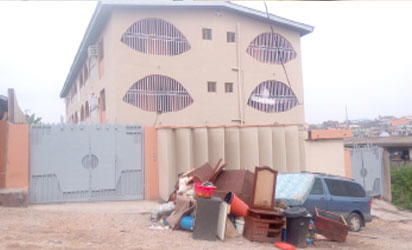
Tenant, Iwuoha’s property in front of the house as thrown out by the landlord
Concerned residents in the Federal Capital Territory (FCT), Abuja, note that paying huge sum of money as house rent in the metropolis has driven so many civil servants, artisan and other residents to FCT neigbouring states of Nasarawa, Niger and Kaduna.
In view of the development, most ministries, departments and agencies of government have provided staff buses for the staff which they manage in terms of fuelling and minor maintenance.
For instance, because of high rents in FCT, Mr Ikachukwu Ifeanyi, who works in Federal Secretariat, Abuja, but has to live in Suleja, Niger.
According to him, he has to relocate to Suleja where rents are relatively cheaper because his salary cannot support rents and living in FCT.
Observers note that Abuja, perhaps, remains one of the fastest growing cities in Africa with an estimated six million people and a vast land huge enough to provide good accommodation and other facilities at reasonable prices.
They argue that the soaring rents in Abuja is worrisome, posing a lot of difficulties to residents which successive governments have not been able to solve.
Mr Olamilekan Samuel, a civil servant and resident of Abuja, therefore, pleaded with the government to consider the option of building low-cost housing for low income earners, especially in the FCT satellite towns.
He observed further that building such houses was one of the possible alternatives for the government to curtail the excess of Abuja landlords.
Mrs Aishat Muhammed, a civil servant in Abuja, said she was worried by somewhat silence of the Federal Government and the National Assembly on why landlords were charging high tenancy rate.
She called on the government to regulate tenancy rates to curb the excesses of some landlords who charged exorbitant tenancy rates.
Sharing similar opinion, Mr Bunmi Gabriel, a resident of Abuja, said a situation where it could cost workers between N1.5 million and N1.8 million to rent a two bedroom apartment in the city centre and between N650, 000 and N1.5 million in FCT satellite towns called for urgent attention.
He argued that with this development, a staff on salary Grade Level 08 in the Federal Civil Service, who earned between 50,000 and 60,000, would have to save his salary for two years to pay for a two-bedroom apartment in Abuja.
But Sen. Dino Malaye, the Chairman of the Senate Committee on FCT, said the lawmakers were considering a bill to moderate tenancy rates in Abuja.
“We are putting together a rent edict for Abuja and we are doing this by law; there is a bill already that has been submitted to the Committee on Rules and Business for debate and upward passage.
“This bill is going to take care of rent edict in Abuja. It’s going to put into consideration all sizes and levels of buildings and will give a recommendation by law,’’ he said.
Similarly, Mr Babatunde Fashola, Minister for Power, Works and Housing, promised to strengthen the mortgage policy for Nigerians to access affordable housing, reduce corruption and encourage productivity in the sector.
He stressed the need for stronger mortgage policy in line with the change promised by President Muhammadu Buhari’s administration to pursue infrastructure development and specifically address the housing needs of Nigerians.
“I think that mortgage is the best practice and the way to go to reduce corruption and to encourage productivity.
“I suggest that our houses must be tied to our income which must be tied to our jobs and I think it is the way to create credit that our housing sector desperately needs.
“I do not think that we can seriously talk about transparency, if a large number of our people pay a two- year advance housing rent when they receive their arrears monthly.
“We must create credit because economies where people get paid at the end of the week and able to pay their rent at the end of the week; or are paid at the end of the month and are able to pay their rent at the end of the month,’’ he said.
He noted that some anomalies had affected the housing sector over the years, adding that that “if the income marches your obligation, you pay in arrears.
“No matter how hard we try to build to meet the budget of the demanding public, we must also respond to the question of credit for rent.’’
Miss Aminat Danladi, a resident of Abuja, nonetheless, called on the Federal Government to act fast by addressing outrageous tenancy rates in line with Buhari’s change mantra.
She called on the National Assembly to also act and fast-track the passage of the Rent Edict Bill before it to cushion the effects of the recession.
Disclaimer
Comments expressed here do not reflect the opinions of Vanguard newspapers or any employee thereof.