At midnight of October 1 1960, we who were not there have been told, a symbolic lowering of the Union Jack, the flag of the British Empire came down with an elegiac play of “Rule Britannia,” and up came, fluttering in the midnight wind coming from the lagoon, the Green and white flag of Nigeria, and then a change of the guards marking Nigeria’s independence from Britain. The Nigerian flag rose with the brash, marching tune of the new anthem:
“Nigeria we hail thee –
Our own dear native land
Though tribe and tongue may differ
In brotherhood we stand –
Nigerians all are proud to serve
Our sovereign motherland.”
It was a hopeful anthem. I was born in the post-independence generation. In fact, fifty years ago, come December. But I glimpsed the Nigeria that was possible. For a very brief period, my late father tried to make a philatelist of me.
For a while, I collected stamps in primary school, starting in my now lost “stamp book” with a 1924 stamp, which I do not now know how it came about. But what the stamps did for me was take me on long journeys. There was the purple stamp with the stacked groundnut pyramids of Kano. There was the stamp with the steamship apparently marking Nigeria economic activity and commercial modernity. There was the stamp on Nigerian wildlife and fauna. There was the stamp showing the Paper mills in Jebba.
Most Nigerian kids today may not know that there were National Parks like the Yankari Games reserve in Bauchi and Kainji where one could go camping with friends and family. I’m not quite sure if the Shere Hills in Jos still has the ambience for camping, or even the sense of safety that campers should have when they mount their tents to spend the week of their holiday in the solitude of open country.
Yet we talk about tourism in very glib ways these days without understanding the nature of the infrastructure necessary to sustain tourism. I saw a Nigeria where Civil servants were properly recruited and trained. It was a highly selective service, and for a while it thrived on merit before the idiocy called “quota system” destroyed both the mission of the Nigerian service and its quality.
Nigeria in fact inherited a first class civil service at the end of the colonial era that knew how to formulate policy, guide the programs of government, and organize public service with efficiency. In those years, Civil servants went to work dutifully from 7 am till 4 pm on week days, and for half a day on Saturdays.
The Administrative cadre recruited the best trained Nigerians, and gave them a good life and a sense of security and purpose. This was shattered by Murtala Muhammed and Olusegun Obasanjo in 1975, and subsequently, public service declined, and was finally shoved under the bus in the Babangida era. I saw a Nigeria where teachers in public schools mattered.
As a matter of fact, private schools were considered second-rate. The Government Colleges were highly privileged because they were well-funded, well-equipped, well-staffed, and ran programs that emulated the best practices at elite boarding schools in other places in the world. I saw a university system that was not only highly selective, but aspired to match their peers in the world.
Nigerians universities recruited widely from across the world, and built reputations on the work of its faculties working in Nigeria. Today, you have universities that really insult the idea of the university. You read Professors of English making inexcusable howlers, and you read the quality of thinking and research that would make good sophomores blush with embarassment. Why? Because the Universities that emerged in the last twenty-five years are “gbanjo universities.”
Not the kind of universities the Kenneth Dikes of this world managed with both care and purpose. Nations understand that there are two institutions they must protect, if they have to amount to anything in the world: its educational and research infrastructure, and its civil service. Successive regimes in Nigeria destroyed these two institutions of national life without blinking.

As a child of Igbo parents who began their professional lives in the West of Nigeria, one as a federal civil servant, and the other as a Teacher, I have long understood that what makes Nigeria actually beautiful is its great diversity of culture and people. Contact with other cultures often weans us of certain common presumptions.
As great travelers across the face of nation, the Igbo best embodied that possibility of welding a nation together because they, of any other sub-nationality of Nigeria, were the first to grasp the imperative of the nation as a modern necessity.
At Independence, and particularly because of the work of the Nationalist movement, most Nigerians, but particularly the Igbo had a sense of a “common nation” shared with others which must be built to compete with other great nations of the world. This idea of nation gave rise to the foundational sentiment of its first anthem, “though tribe and tongue may differ/in brotherhood we stand…” Azikiwe’s use of his chain of newspapers to convoke the very idea of “One Nigeria” and of one common national or sovereign destiny reverberated among a particular generation of Nigerians for whom the “sovereign mother land” remained sacrosanct, because their greatest adversaries were the colonialists. By 1966, only six years after the end of colonialism, Nigerians went to war.
The civil war continues to haunt Nigeria today because its ghosts were never properly buried. The contradictions of that war gave impetus to all the abominations that came to characterize the post-war nation, with the greatest impunities perpetrated by those who fought the Igbo, who have since abandoned the idea of “one Nigeria” because they no longer see it serving their long term interests.
Nigeria as we understand it today became something of a war booty, built on the ethic of “ike kete orie” as the Igbo would say, rather than on the collective or common good. It came from the ethic of war – this war booty mentality. It is not strange that we have had a relay, until the emergence of Umar Yar Adua and Goodluck Jonathan, of the field combatants who fought that war who continue to rule and finagle Nigeria in concert with their local and foreign partners.
That is why Buhari is now recycled to power nearly thirty years after he first overthrew the elected government of President Shagari on what has since been revealed as false pretense. Nigeria began to fail almost permanently at midnight of December 31, 1983. And it is sad that Muhammadu Buhari is yet to acknowledge this profound truth but chooses to continue to retail the fiction of his messianic mission.
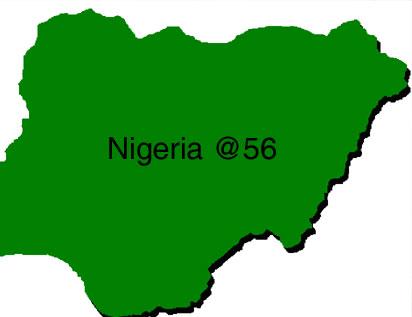
So, here we are, fifty six years later, after the Union Jack was lowered: the Green and white flag is in tatters; the hope and lilt of the lyric of Nigeria’s first anthem seems now to be a terrible joke. There is no sense of “our sovereign motherland.” Nigeria is broken.
The spirit of “nation” is in abeyance. There are separatist movements who are responding to profound perceptions of injustice and are fighting to break Nigeria. A new generation of Nigerians do not believe in Nigeria or its purpose or raison d’etre, and do not care about its promise, because they have never been promised anything but pain and poverty. Nigeria has done pretty little for anybody born from December 1983.
They who belong to that “angry generation” would sooner flee from Nigeria than build it because they see nothing to build. This Independence Day must compel Nigerians to really do a proper rethink; an honest reassessment of what it really means to be Nigerian today. Because, what we have now is both a categorical failure of the great promise of our early beginnings, and a nightmare from which we must force ourselves to wake.
Disclaimer
Comments expressed here do not reflect the opinions of Vanguard newspapers or any employee thereof.