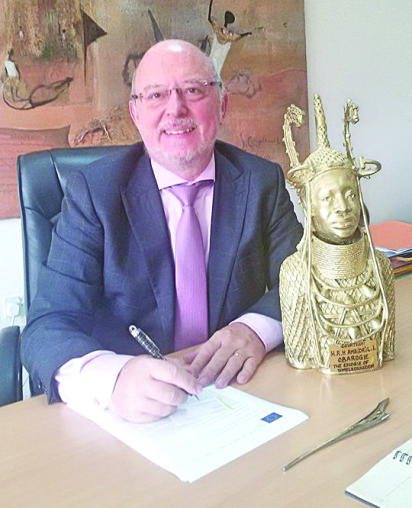
Ambassador De Loecker
By Onome Amawhe
How long has Belgium had a diplomatic relationship with Nigeria?
Belgium and Nigeria have maintained diplomatic relations since 1960.
What sort of legacy do the two countries have in terms of the relations?
The relations between Nigeria and Belgium have intensified since the transition of Nigeria to democracy. And it is the wish of the Belgian government to reinforce the relations even more, particularly in the area of supporting investment initiatives in Nigeria.
How would you characterize the relationship today?
Bilateral relations between Nigeria and Belgium are good because for many years, quite a number of Belgian companies have contributed to the expansion of the Nigerian industrial sector particularly in agribusiness. In this regard, most of the refined palm oil that’s being sold in Abuja comes from a Belgian-owned high-quality plant located in Edo State. Another sterling example of our good relations is the strengthening of the age-long collaborations between the Nigerian Ports Authority and Port of Antwerp in Belgium, which is the second biggest port in Europe. The Port of Antwerp actually played a role at the beginning of the Nigerian ports reform leading to the landlord model of port concession.

Ambassador De Loecker
What are the main areas of trade between the countries? In whose favor is the balance?
90% of Belgium’s trade relations with Nigeria is petroleum based. The Port of Antwerp imports low value Nigerian crude oil, and in return, we export various types of gasoline and gasoil to Nigeria, of a much higher value. In financial terms, this means that Belgium is gaining twenty times more foreign exchange than Nigeria. That means good business for Belgium but not for Nigeria. And I think that this clearly makes the case for improving the performance and output of Nigerian refineries, and also for opening up investment opportunities for increased Nigerian production.
Are there any trade deals that you have worked on between the two countries?
Belgium seeks to diversify and expand trade opportunities outside Europe. It has always been an internationally oriented country with a particular interest towards Africa. I am convinced that Belgian know-how in various industrial sectors, such as bioengineering in crops and cattle-breeding, transport management, environmental protection, water sanitation, electricity generation and distribution, can be of used for the development and diversification of the Nigerian economy.
Just to give an example: there is currently a major Fair going on in Belgium focusing on agriculture, and we have organized the visit of a Nigerian delegation in order to showcase the technological capabilities of Belgium in this field that could be useful to Nigeria in its efforts to diversify its economy, notably in the agriculture sector.
Allow me to plead a European cause, the European Partnership Agreement, which has already been agreed on by the European Union (EU) and West Africa, but still faces questioning in Nigeria, that is yet to ratify this treaty. Being Ambassador of a country that benefitted so much from opening its economy to international trade while improving its own competitiveness, I can only advise Nigeria not to isolate itself from important market opportunities, both on the import and on the export side. This would be a historic mistake.
The Belgian economic policy is, as a rule, non-protectionist. Belgium is an open economy. Located at the heart of Western Europe, it enjoys a key position in the European and international economy. It is very strategically located as a gateway in Europe with its free movement of persons, goods, services and capital. It is a stronghold for European trade.
What are the main Belgian companies here? Are they successful? Expanding? Or facing difficult times? What new companies are coming in?
– Some of the major Belgian companies in Nigeria are SIAT (palm oil plantations), CFE (construction), Nigerite/Eternit and ZETES. Two Belgian dredging companies are also involved in important projects in the field of port development in Lagos and Port Harcourt. The land reclamation of the Eko Atlantic project in Lagos is being carried out by Dredging International, which is also involved in dredging projects near Bonny Island and Port Harcourt. Its competitor Jan De Nul, also Belgian, was contracted in 2015 for the land reclamation project, where Nigerian giant entrepreneur Aliko Dangote will build his petroleum refinery and fertilizer plant. Some Nigerian industries have also shown a particular interest in the position Belgium takes as a center for shipping and maritime industry.
I also understand there is a Nigerian-Belgian Chamber of Commerce in Lagos. How active are they, and do you work with assisting them?
The chamber of commerce is involved in trade missions and also serves as an EU “Business Cooperation Centre” as part of a wider network of chambers aiming to promote and facilitate trade between Nigeria and the EU as a whole. The Nigerian-Belgian Chamber of Commerce is headed by Ms Paulette Van Trier, who also doubles as the Honorary Consul of Belgium in Lagos and is very active in promoting trade relations between both countries. Of course, we are in very close contact with them.
What has been your prime initiative since you assumed this role?
My prime initiative has been the support of trade and investment initiatives of Belgian companies in Nigeria. I am also currently working on a high-level Nigeria-Belgium Economic Summit in 2017 or 2018.
The life of a diplomat is marked by regular transfers to other countries. How does your family experience these changes?
To be honest, it is not always easy, because in essence you impose transfers to the whole family, even if it is not necessarily their preference as a way of life. We have grown-up children living in London and Brussels, and thanks to modern communication technologies, we keep in touch almost on a daily basis.
How would you describe the Belgian People?
– Belgium is, like Nigeria, an ethnically diverse country with different communities speaking different languages. As a people, we live together in a peaceful environment in a well-ordered way that guarantees enough welfare for every member of our society. This has not always been easy as Belgium was often a battlefield for the world’s most cruel wars. This is why nowadays Belgian people attach much importance to an integrated Europe. We understand the importance of integration and good relations with our neighbors.
What assistance does Belgium give to Nigeria? In what fields?
Nigeria isn’t a partner country of Belgium in terms of official development cooperation. However, we support private initiatives, especially to increase trade relations, as mentioned before. Belgium does contribute a lot to the development programmes of the EU, and specialized agencies of the United Nations that are active in Nigeria to tackle in particular the consequences of the conflict in the North East.
How is Belgium addressing the challenges of Globalization? And how is the multicultural experience working out for Belgium?
Globalization comes with challenges and opportunities. As an open economy dependent on exports, Belgium benefits from more international trade, as well as political integration with other States.
The process of integration has not always been easy though and the fight against all forms of discrimination and extremism is a daily battle.
Many inhabitants of Belgium are of foreign origin who have Belgian nationality and we consider them “our” citizens. Some people may consider this as a threat to their own customs, cultural identity and economic prosperity, but it is important to understand that the cultural diversity of a modern society is actually engendered by People with different backgrounds who all bring new ideas and contribute to our society, so it is better to embrace the existence of different cultures while respecting the rights of these people.
Also, in addition, Benin and Togo are countries in your diplomatic remit. What specific interests and challenges does this portfolio entail?
Unlike Nigeria, Benin is a partner country of Belgium for official development cooperation, so these relations are very important because Belgium supports many development projects in Benin. Belgian companies are also active in Togo. As you may know, the Togolese authorities are seriously developing the port of Lomé – in competition with the Lagos Port – and one of the dredging companies involved in this project is from Belgium
Can you tell us the specific number of Nigerian citizens living in Belgium presently?
I can’t give you a precise figure, but there are Nigerians who acquired the Belgian nationality, there are others residing temporarily in Belgium. Other categories are Nigerians visiting the country for business or tourism, and of course, there are those who illegally entered Belgium.
What have been your most interesting experiences here in Nigeria so far?
First, the magnitude and diversity of the country, in all aspects: cultural, religious, ethnic, socio-economic… This makes it a real challenge for leaders to govern this country in a democratic way. I was not there at the time of the presidential election last year, but it was of course a historic election, as the people were able to freely express their choice, and that choice was respected.
Disclaimer
Comments expressed here do not reflect the opinions of Vanguard newspapers or any employee thereof.