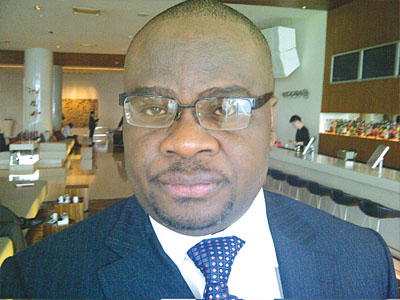
Kola Adesina
Chairman, Egbin Power Plc. Kola Adesina recently highlighted challenges facing investors in the power generation sector and recommended ways the federal government can prevent the country from witnessing a major energy crisis.

Adesina who boldly stated that his staff in Egbin rank among the best in Africa when it comes to power generation stressing that they remain the drivers of the company’s relentless quest for excellence and desire to redefine power generation on the continent also lamented beneath the giant strides so far achieved by the Egbin Power Station, lies a huge challenge.

“The power station currently suffers shortage of natural gas. The situation is worsened by renewed militancy in the creeks of the Niger Delta region, where oil and gas pipelines are being blown up on regular basis. This is a more compelling reason why the federal government must get its acts right in ensuring that peace returns to the region.
The company is at present grappling with economic woes occasioned by difficulties in accessing foreign exchange. At the time of the acquisition of the assets by the new investors, the exchange rate was N198 to the dollar. Having raised capital from banks, investors are now faced with the harsh reality of paying back in time of economic down turn. Indeed, the company is in trouble with the current exchange rate regime.
As a result of the harsh economic situation, liquidity problem has also set in, making it increasingly difficult for the company to finance its capital intensive operations.
One of the most difficult situations the company is currently facing is the huge legacy debt burden. It is estimated that electricity distribution companies (Discos) are being owed about N100 billion in the last two years. For these companies to live up to expectation, the government must take steps to settle these debts owed by its agencies. The bulk of these huge debts are money DISCOs are to pay the generation companies, the gas companies and others in the value chain of the power sector.
Indeed, power generation companies in Nigeria are owed, according to Adesina, “an estimated ₦100 billion in accumulated debts for power generated from November 1, 2013 till date”. Of this figure, Egbin is owed ₦44 billion for power generated from December 2015 to date and another₦22 billion in past debts, bringing the total amount to ₦66 billion.
“These huge debts owed generation companies”, lamented Adesina,”has put them in a cash liquidity crisis that has reduced their ability to pay gas supplies, and hence threatens to completely undermine the Electricity value chain and its ability to continue to serve customers.”
The issue of gas however goes beyond generation companies’ inability to pay for the quantity supplied.Dallas Peavey Jr., Chief Executive Officer of the power station laments the persistent shortage of gas supply despite the huge investment the owners have made to boost the capacity of the power plant. This, he said, has heightened continuing challenges in ending daily blackout in the country since private investors took over the station.
Against the backdrop of the many challenges facing the power sector in Nigeria, government, through the Nigerian Electricity Regulatory Commission (NERC) under the Multi-Year Tariff Order (MYTO) 2015, sought ways of reducing the heavy burden on private sector investors in the sector by reviewing the tariff. Even with initial opposition from the Nigerian public and Organized Labour unions, the new tariff regime still took effect from February 2016.
Babatunde Fashola, Minister for Power, Works and Housing made a concerted effort to explain to Nigerians, the rationale behind the new price regime. “The truth is that tariff is about price and if the raw materials like gas, power plants, spare parts, labour have gone up the price of the finished product cannot be the same,” said Fashola. He stressed that “if the price of the product is not right there is no incentive to produce more of it. This can only result in scarcity and high prices. It is simple economics. Without the right tariff there will be no power because it is now in the control of entrepreneurs.”
That was very instructive but as convincing and logical as Fashola sounded in this regard; the Senate directed that the new price regime should be suspended, apparently in sympathy with the consumers. But then, in the long run, the Senate, the labour and other pressure groups urging consumers not to pay the tariff may not be helping the consumers at the end of the day. If power is underpriced, Investor would not only run at a loss, but may lead to a situation where they will not be able to generate and take power to the consumers- a total power sector collapse, a much dreaded situation that could take the economy to its tethers end.
Yet as serious as the issues of debt and cost reflective tariff are to the sector, these are not the only critical challenges confronting the investors.
Transmission is another. While some observers say there has been some noticeable reduction in system collapse in the transmission network post privatization, other analysts are concerned that the numbers of collapses are still too many to call for worries, citing 2016 where system collapses by mid-year had exceeded the ones experienced in 2015.
The reality on ground today is that the investors in the power sector are agonizing and wondering if they took the right decision in the first place. Prior to take-over, they had looked forward to: realistic tariffs, stable exchange rate and steady supply of forex to fund required investment, a ₦100 billion subsidy support from the Federal government; a supportive and enthusiastic banking sector and security of gas pipeline for regular supply.
All these sum up to one disturbing fact: All generation companies have been operating at a loss since privatization Unless some drastic measures are taken by the government, the nation may be heading to a major Energy Crisis of grave implications to the economy.
Adesina, in a paper he presented at the Lagos Business School recently, broke his recommendations for a way out of the logjam into two.
One, Sector funding. Here, the Egbin Power Plc. Boss advocates full implementation of cost reflective tariffs, otherwise subsidies be provided to cover shortfall; immediate payment of all MDAs’ debt, full funding of TCN or it should be concessioned to ensure improvement in grid stability and easy access to fund by investors.
The second leg of the recommendations was captured under regulating reforms.
Here, Mr. Adesina wants the regulator to be consistent and fair, respect for contracts legally consummated, legislative measures – including initiatives like mobile courts, to discourage power theft.
With the huge resources that these private sector investors have committed to turn around this power plant, and the numerous challenges they are still facing in their quest to ensure steady power supply, everything that is required to ensure that they meet their targets must be put in place without further delay.
Government may have to summon an urgent meeting of all stakeholders in the power sector from which urgent measures to light up Nigeria will be arrived at and immediately executed to the letter. Nigerians have suffered enough of energy crisis.
Disclaimer
Comments expressed here do not reflect the opinions of Vanguard newspapers or any employee thereof.