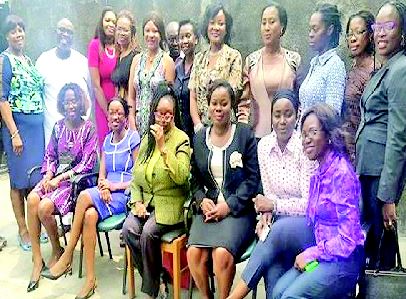
A cross section of participants.
By Juliana Ebere Obi
Nigerian women live under the fear of domination and marginalization; they live in a constant state of inequality. They are also seen as inferior gender in some cultures and ethnic groups in the country. A bill aimed at the elimination of discrimination against women was turned down for a second reading at the Nigerian Senate on March 15 2016. Among others, the bill was designed to address women’s freedom of movement, female economic activities, girl’s access to education, equal rights for women in marriage, divorce, property/land ownership and inheritance. This issue has caused reactions from most Nigerians who felt the bill was long overdue.
However, the bill enjoyed the support of many senators who spoke in its favour, senators like Bala Na’ Allah. “The discrimination is a worldwide issue and there is a need for adequate measures”, he was quoted as saying. He also stressed the need to protect the widowhood and inheritance rights of women.
The Senate Deputy President, Ike Ekweremadu, supported the contents of the the bill, but not actually as a law. “Only last night, I was going through a document prepared by George Bush of America. Those countries that are doing well are those that give women opportunities. Where I came from, women don’t eat egg and are restricted from touching the non-essential parts of animal. But now that has changed. What is needed is time and education; not necessarily legislation.”
Sadly, senators like Ahmad Sani Yerima, who is also a former Governor of Zamfara State, Senator Rufai Ahmed, Senator Adamu Aliero, Senator Emmanuel Bwacha, among others spoke against the bill and eventually, the nays had it.
How exactly are we meant to prevent violence against women and girls when parliament can’t pass the Gender and Equal Opportunity Bill? What then does the future hold for Nigeria when a good number of her female citizens are given cane instead of sugar-cane and the ones below 18 are forcefully given ‘penis instead of pen’? This action by the parliamentarians shows how women are not valued in this part of the world. No wonder the present condition of the abducted Chibok girls still remains uncertain.
In a survey conducted on 50 doctors and nurses – 28 nurses, 13 doctors – it was discovered that the respondents had at one time or the other treated injuries resulting from physical abuse and sexual molestation and an overwhelming percentage of the patients were females below 18 years. Facts like these, quite unfortunately, have been overlooked by the Nigerian Senate in its failure to pass the bill into law. The voices of the commoners as well as those of the elite have been raised in support of the plight of the female gender.
That of Chief Femi Fani-Kayode, former Aviation Minister is worth recalling here: “We live in a strange country where evil is swept under the carpet and often justified, and where those that expose it and speak truth are demonized, hated, despised and more often than not, threatened with violence persecution, intimidation, arrest, litigation and court action. There is clearly a perpetuation of evil in this country among the ruling elite and the feeling that anyone can get away with anything provided they have money and power.”
Chief Fani-Kayode was commenting on the case of 14-year-old Ese Oruru who was allegedly adopted by her lover and taken away from her loved ones in Bayelsa State to the city of Kano, to be married. This is one of the numerous cases of female discrimination and molestation in this part of the world.
If a bill that was designed to protect the female gender in Nigeria did not survive second reading in the Senate, what then is the fate of womanhood?
- Miss Obi wrote from the Fed. Polytechnic, Bida, Niger State.
Disclaimer
Comments expressed here do not reflect the opinions of Vanguard newspapers or any employee thereof.