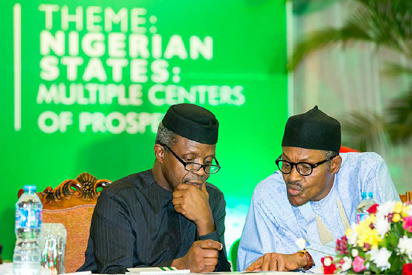
President Muhammadu Buhari and Vice President Yemi Osinbajo at the opening of a 2-day National Economic Council Retreat at the Statehouse Conference Centre on 21st March 2016.
By Dele Sobowale
“Buhari says power crisis no laughing matter, targets 10,000MW.” PUNCH, March 22, 2016, p 2. In the report by Olalekan Adedayo, President Buhari said, “Nigerians favourite
talking point and butt of jokes is the power situation in our country.

President Muhammadu Buhari and Vice President Yemi Osinbajo at the opening of a 2-day National Economic Council Retreat at the Statehouse Conference Centre on 21st March 2016.
But, ladies and gentlemen, it is no (longer) laughing matter. We must, and by the grace of God, we will put things right.
In the three tears left to this administration, we have given ourselves the target of 10,000MW distributable power. In 2016 alone, we intend to add 2,000MW to the national grid.”
Thus on Monday, March 21, 2016, President Muhammadu Buhari opened the much awaited economic retreat which was widely believed to be be convened to chart a new economic course for the country. In many respects, it was a disappointment. For an administration which was elected on the CHANGE mantra, very little has changed. In many respects, what the retreat finally decided could be described as “the same stale stew, warmed up, and served in new plates.” (apologies to Babangida). The place to start is Buhari’s statement at the opening of the retreat.
On the whole, what the retreat announced as decisions, were at the same time original and good but of little practical value. What was original was not good; what was good was not original. So let us examine them one by one.
Perhaps because the All Progressives Congress, APC, was not sure of winning the 2015 elections, the party never had a blue print for economic development. Even the village idiot now knows that. They are now just floundering around trying to cobble together a set of economic policies; but, without mutually agreed ideological basis.
When Buhari announced the 10,000MW target for 2019, he probably did not realize that he would be the third President since 1999 to make the promise. That makes the statement good, but not original. Furthermore, the 10,000MW target had been used twice before to defraud Nigeria by his predecessors in office. Below is a brief summary of our recent history with presidential promise of 10,000MW which was never delivered.
In 2003, President Obasanjo, who does not know his left from right, appointed Engineer Lyel Imoke as Minister for Power, who promised to deliver 10,000MW by 2007. It was on the basis of that fraudulent claim that $13-16 billion, according to late President Yar’Adua, was raided from several accounts, invariably without the approval of the National Assembly, NASS, for Obasanjo’s phantom power project. History had already recorded that Obasanjo and Imoke squandered our resources and left the nation with less than 3,000MW.
In 2008, late President Yar’Adua announced that he was going to declare a POWER EMERGENCY. Nothing happened more than three months after – prompting me to publish an article on these pages titled POWER EMERGENCY ALREADT DECLARED in July 2008. Shortly after that, Mrs Diezani Alison-Madueke, then Minister of Transport, under Yar’Adua announced that the government had concluded plans to increase power supply to, you guessed it, 10,000MW soon. Yar’Adua passed on leaving us with about 3,800MW – which was not even consistent.
For sheer authority lying, it would be difficult to beat the Jonathan administration which followed. In addition to the President himself, he had several high-powered professional dissemblers to assist in making promises about power supply which were never delivered. Among the eminent people were: President Jonathan, the Vice President (Sambo), two Ministers of Power (Professors Nnaji and Nebo), Minister of State for Finance (Yerima Lawal Ngama), Minister of Information (Maku) and the media owns Senior Adviser (Abati). The lies they told Nigerians about power supply can fill a book. But, just for the record, let us recall a few.
President Jonathan launched a ROAD MAP TO POWER project in 2012 promising to increase power supply to 14,300MW by December 2013. Today we are still battling with under-3000MW power supply. Vice-President Sambo weighed in the following year announcing 20,000MW to be made available soon. Professors Nnaji and Nebo promised twice each to take us to the 10,000MW level between 2011 and 2015. Nothing of sort happened.
Then it was the turn of the spin doctors to assure us that all was well. Former Minister of Information, Labaran Maku once told an international audience that Nigerians enjoyed 18 hours power supply. Jonathan made the same claim in an interview with Christiane Amanpour of CNN who looked at our former president with disdain as he spoke.
Finally, our own dear Reuben Abati, in his rejoinder to the query by Dr Ezekwezili about the $43 billion left in Excess Crude which had vanished, started with a gem.
According to Reuben, Jonathan met the power supply at 2000MW (it was untrue) and brought it to 4,500MW (only for one day) and he thought Nigerians should be grateful for that achievement.
In reality, Jonathan added less than 1000MW to the regular power supply in his five years in office. But, Abati was not about to allow facts to get in the way of propaganda.
We have dwelt at length over power because Buhari has bottomed the Economic agenda on power supply and to remind the President and Fellow Nigerians that we have heard those promises before.
And, as if to demonstrate that nothing has changed, the Minister of State for Power, under Buhari, Mustapha Shehuri announced that the Federal government had set a new target of 20,000MW by the year 2020.
Here we go again. The President said 10,000MW by 2019 and his Minister announced 20,000MW a year after. In any case 2019 is only three years away and 2020 a mere four years. Do they actually expect us to believe this? And, if not what becomes of the rest of the economic programme?
Disclaimer
Comments expressed here do not reflect the opinions of Vanguard newspapers or any employee thereof.