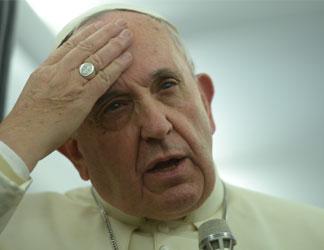
Pope Francis
By Donu Kobara
Pope Francis has said that the Catholic Church is not interested in donations from wealthy individuals who have cruelly exploited their fellow human beings.
“I think,” the Pontiff told a crowd of pilgrims in Rome’s St Peter’s Square last Wednesday, “of some benefactors…that say ‘take this offer for the Church’, and it is profit from the blood of those abused, treated as slaves, workers with poorly paid jobs…[and] I say to these people: ‘Please, take back your cheque and burn it’ [because] the people of God, the Church, do not need dirty money.”
I am a Catholic myself and have long thought that my Church has a bad habit of turning a blind eye when rich or powerful Catholics misbehave. Indeed, quite a few dubious characters – whose sins as politicians, businessmen or whatever are no secret to the general public – have received prestigious papal knighthoods and enjoy the privilege of socialising with senior clerics such as bishops and cardinals.
It is immensely refreshing to hear such an unequivocal condemnation – from the paramount Oga of the Catholic Faithful – of unworthy folks who think that they can buy their way into the Vatican’s good books (and Heaven!) via hefty cash gifts.
You can fool some of the people some of the time. But you certainly can’t fool God or his vicar on earth, the marvelously and fearlessly principled Pope Francis!
Accounting for recovered funds
Talking about dirty money, the Federal High Court sitting in Lagos has, in a landmark judgement, held that successive governments, since the return of democracy in 1999, “breached the fundamental principles of transparency and accountability” by not revealing details relating to recovered stolen public funds.
Justice Mohammed Idris then (in response to a suit filed by an NGO called the Socio-Economic Rights and Accountability Project – SERAP – ordered President Muhammadu Buhari to “ensure that his government, and the governments of former President Olusegun Obasanjo, former President Umaru Musa Yar’Adua, and former President Goodluck Jonathan account fully for all recovered loot”.
The court said that details that should be disclosed include information regarding the total amount of stolen public assets that have been recovered by each government and information about exactly how such monies have been spent.
Detailed information
Justice Idris dismissed all the objections that had been raised by the Federal Government and upheld SERAP’s arguments. Consequently, the court entered judgement in favour of SERAP against the Federal Government; and, according to a report in this newspaper, made the following declarations:
…That the failure and/or refusal of the respondents to individually and/or collectively disclose detailed information about the spending of recovered stolen public funds since the return of civil rule in 1999, and to publish widely such information, including on a dedicated website…violates Articles 9, 21 and 22 of the African Charter on Human and Peoples’ Rights (Ratification and Enforcement) Act;
- [And that]…by virtue of the provisions of Section 4 (a) of the Freedom of Information Act 2011, the 1st Defendant/Respondent is under a binding legal obligation to provide the plaintiff/applicant with up to date information…
Reacting to the court ruling, SERAP’s Deputy Executive Director, Olukayode Majekodunmi, said: “This judgement confirms the persistent failure of successive governments starting from the Obasanjo government, to respect Nigerians’ right to a corruption-free society…The judgment is an important step towards reversing a culture of secrecy and corruption that has meant that high-ranking government officials continue to look after themselves at the expense of the well-being of majority of Nigerians, and development of the country… SERAP will do everything within its power to secure the full and effective enforcement of this judgement.”
I heartily salute both SERAP and Justice Idris for their courageous stances and am deeply shocked that Buhari’s administration, which claims to be a valiant champion of the suffering masses and an uncompromising opponent of financial skullduggery, tried to block this case on various grounds, including a ridiculous (in my opinion) insistence that SERAP lacked the locus standi to institute the action.
Come to think of it, why did the case even have to go to court in the first place? We keep hearing about VIPs sneakily returning vast sums to the Treasury. But we never know for sure whether these rumours are true or how much is involved.
Now that the governments’ lawyers have tried to gag SERAP, they have effectively confirmed that a covert refunding exercise is, indeed, underway. And I must say that allowing miscreants to quietly buy their way out of trouble is an extremely dishonest way of dealing with an issue that should be a matter of public record.
Why do the Federal authorities arrogantly prefer to operate in the dark within this context? Why are they not making more of an effort to win our trust and show us that they are vigorously protecting our interests and being honourable?
Why are the Federal authorities taking the risk of allowing us to suspect that selective justice is taking place behind closed doors? Why are they exposing themselves to allegations that some lucky miscreants are getting special treatment, while others are being arrested, tried and vilified?
Why do the Federal authorities find it so hard to simply name and shame EVERY thief and to not only tell us how many billions culprits have coughed up but what exactly has happened to these retrieved amounts? What do they have to hide?
At a time when most Nigerians are enduring countless stresses because the economy is in appalling shape – I can’t recall things ever being this bad – is it too much to ask that President Buhari shares a few facts and figures that will lift our weary spirits and convince at least some of us that he is on the right track?
Disclaimer
Comments expressed here do not reflect the opinions of Vanguard newspapers or any employee thereof.