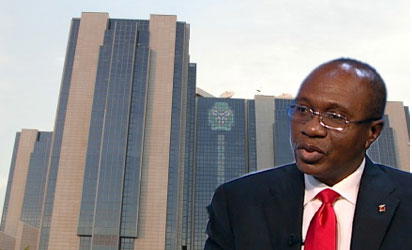
Emefiele CBN Governor
BY OLAYINKA AJAYI
From oil crash to TSA (Treasury Single Account), to JP Morgan, it has evidently been a trying time for the Nigerian financial sector. It has therefore been a very busy year and a half for the policy managers at the Central Bank of Nigeria. How effectively has the apex bank managed what is arguably one of the most difficult periods in Nigeria’s economic history? Has the bank shown sufficient capacity to manage the crisis in terms of the policy options, given the prevailing policy environment? What are the steps it has taken so far? How have the indicators stacked up in response to the steps taken?
Vulnerabilities, buffers and conditions precedent
A survey of the countries most affected by the fall in oil prices indicate that the conditions that prevailed in each country at the time the crisis hit determined the severity of impact. Like most or all oil-dependent economies, Nigeria’s external vulnerability was high, representing the high degree of dependence on oil as primary source of foreign exchange. But unlike most, our buffers were low showing the low level of savings overtime from record oil revenues. When oil prices began their dramatic tumble in June 2014, Nigeria’s foreign reserves placed the country in the bottom half of the top 20 oil exporters, even though Nigeria is one of the top five earners.
To be fair, there is little to hold the present leadership responsible for the poor management of our reserves that left the economy so terribly exposed and little prepared for the crisis. In the six years that passed since the last global financial crisis, the foreign reserve, which once stood at $62 billion, failed to record a net increase in volume. In fact the flow was negative and stock depleted further by almost a quarter in the year leading up to June 2014, when the current leadership of the apex bank took over the affairs of the bank. It was, incidentally, the same moment that oil prices began to tumble. Talk about negative providence.
Of course, nobody, including the CBN leadership, had the time to complain about what was not done in the boom years to prepare us for this crisis. The very urgent task was to get on with the job at hand.
Expectations and policy choices
Reaction by the CBN to worsening foreign exchange shortages seemed at the time like a series of panicky, uncoordinated response to a crisis that was overwhelming in its sheer scale and intensity. With time, though, it became clear that the widely derided ‘demand management’ was neither so unorthodox nor wrongheaded as we first imagined. In its Global Economic Prospects (GEP) report in 2015, the World Bank had reported that in the wake of the crash in oil prices, exporting countries were largely expected to curb imports owing to limited supply of forex. Thus, in a way, the choice of rationing forex wasn’t really a ‘choice’ in the true sense of the word.
The decision by JP Morgan, the US investment banking firm, to delist Nigeria from its Emerging Market Government Bond Index (GBI-EM) presented its own set of problems. It was not difficult even for those with only a conversational knowledge of the economy to recognize what we saw at the time as signs of an ailing economy gasping for its last breath. It (JP Morgan’s announcement) was without question the kind of bad news that only begets more bad news, heaping more misery on the country. To be sure, JP Morgan was complaining, more specifically, about a lack of liquidity and ‘transparency in the foreign exchange market’.
So besides having to contend with the growing problem of dwindling forex (especially since the import bill was escalating) there was a liquidity problem which has its own colossal inflation and interest rate implication for the economy.
It is not clear how much of a problem the liquidity issue was posing for monetary policy until JP Morgan sounded the alarm, or what the apex bank was doing to deal with the problem, but there was no doubt that this ‘new’ problem with its potential effect that could accelerate a full blown financial crisis needed a more immediate intervention. It has now come to light that the bank had deployed something similar to what economists call ‘quantitative easing’ to address liquidly. Yet, monetary policy also needs to be tightened to control inflation and contain capital outflow.
The proof of the pudding
It is easier for the policy wonks to debate the soundness of these policy instruments a priori, but for the uninitiated, we are only able to discuss the effectiveness of these policies ex post, that is after the fact. Starting with the TSA and JP Morgan, it is something of a miracle that, six months on, the aftermath looks very unrecognizable from the massive rumpus that both events generated – about banks running out of funds to lend to businesses, interest rates hitting the roof, money deposit institutions closing shop, investors exiting in droves. At the moment there is an apparent ‘credit squeeze’ on the private sector, but obviously not for reason of poor liquidity in the system. The evidence from available data shows that there is a “surfeit of liquidity”, but with most bank lending activities characterized by credit to the public sector. Of course this is one more headache that the apex bank will have to deal with.
As for the situation with capital flow, the stock market lost 28% of its value in 2015. But then, less than 5% of the decline occurred in the last quarter of the year, indicating that there was little or negligible ‘JP Morgan effect’ in that sector.
The inflation monster, for all practical purposes, seemed to have been kept within coping limits. For most of the countries hardest hit by this crisis, inflation has ranged anywhere from 12% to 108%. Nigeria is somewhere around 9.6%.
Devaluation, no magic bullet, certainly not the only bullet
Yet, the big elephant in the room has been whether the central bank should remove all pegs and allow the naira to flow freely as market forces direct. The calls have become very strident especially from Western media analysts who believe that the naira needs to find its ‘true value’ somewhere around the 250/dollar mark, so that foreign investors can be assured of the true dollar value of their investment. However, the CBN has elected instead to keep the peg, but review periodically to determine what it considers appropriate for macroeconomic stability. It has determined that rate to be currently N199/dollar, about the midpoint between the original rate and the speculated market value. The CBN says it aims to stabilize the market first, and then move towards greater flexibility.
Again for the uninitiated, the arguments seem respectively tenable. But then what does the umpire say? A recent report published by the IMF, titled Global implications of lower oil prices, argues that “complete deregulation does not necessarily solve the problem, as it helps only partly to lessen the external and fiscal impact of lower dollar oil prices”. But even the ‘part’ solution has its own caveat – it would occur only if “there are no foreign exchange mismatches resulting, for instance, from a high degree of dollarization.” So what option for policy? The report believes that “a country with a fixed exchange rate regime would need to considerably tighten macro policies (especially fiscal policy), if it wants to maintain its current peg”.
With this report, it became clear why the CBN had opted instead for a ‘de-dollarization’ policy in the first place, as it is obviously a root problem. The decision to eventually suspend direct forex sale to BDCs, requiring them instead to source for forex from autonomous sources may have been to address the concerns by JP Morgan and co of ‘transparency in the foreign exchange market’.
Not forgetting, monetary policy is a twin
The very close complementarity between monetary and fiscal policy seems to have defined the CBN’s own policy boundaries. For instance the bank’s credit policies should reflect considerably government’s growth projections and priority sectors. Inclusive growth should also determine how much of the relevant indicators it wishes to place entirely at the mercy of the market. Most of the pieces don’t fall into place until the budget becomes a working document.
While the jury may still be out on some of the steps taken by the CBN to combat the effect of this crisis, the task confronting the apex bank is best captured in the IMF report referenced earlier in this article. It notes that in the wake of the crisis, “Central banks will have to balance the need to support growth against the need to maintain stable inflation and investor confidence in the currency”. It means therefore that the issues are not so straightforwardly simple as they first appear to the rest of us.
As for the CBN, it must demonstrate that it is at least applying the right remedies. So far, the bank appears to have shown enough capacity to see us through this crisis.
Disclaimer
Comments expressed here do not reflect the opinions of Vanguard newspapers or any employee thereof.