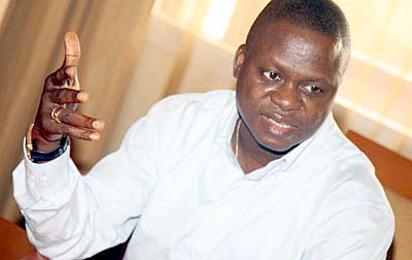
Timi Alaibe
Timi Alaibe cuts the picture of a young, cute Nigerian.
But beneath that veneer is a very strong character steeped in intelligence, foresight and an uncommon determination to ensure that Nigeria is made great using the vast resources of the Niger Delta, his geopolitical zone, as a catalyst.
This was what then President Olusegun Obasanjo and late President Umaru Musa Yar’Adua saw before appointing him Managing Director of the Niger Delta Development Commission, NDDC; and later, as Honourary Special Adviser to Yar’Adua on Niger Delta Affairs. It was Timi Alaibe’s well-grounded understanding of the region, it’s nuances and all that recommended him to Yar’Adua. And the story of Amnesty cannot be told without the pivotal role he played, working with some leaders of the region, which eventually led to the disarmament of the Niger Delta militants.
Last week, Alaibe pricked the conscience of the Nigerian state in a paper titled “PRESIDENT MUHAMMADU BUHARI CHANGE AGENDA AND THE NIGER DELTA STRUGGLE FOR DEVELOPMENT”.
The following, is an adaptation of Alaibe’s presentation in a thematic form.
Radical in approach, rich in content, clear-headed in context and meaningful in scope, the suggestions here presented, if implemented by the BUHARI administration would not only leave a lasting legacy, it would to a large extent demonstrate that there is nothing really new about nation building. Inventiveness and creativity oiled by uncommon commitment to deliver are all that are required to move any nation forward.
Thematic focus on development
As many would appreciate, while Development is a major component of the “Niger Delta Struggle”, there might be considerably more to it than Development strictly speaking in the conventional sense that embraces mainly physical (infrastructural) and economic development. Broadly, there are also political, philosophical, nationalistic and structural dimensions to what has become known as the Niger Delta Struggle. Though these dimensions remain vital to Nigerians of the Niger Delta region, especially in the long run, and may in many ways be intertwined with the Development dimension, it is useful that we do not pretend to have them on the front burner. It is better for focus and speedy results, because to bundle up all the dimensions together may impede clarity and speed on actualization of the Development dimension.

Timi Alaibe
Sober reflection on choices made
A final attempt to put the foregoing preamble in perspective is that; the socio-political and structural aspects of the Niger Delta struggle, as valid and justifiable as they are, have the potential to be more emotive and may require more deliberate and delicate handling, possibly over a fairly longer term. To compound this, there is the unfolding reflection particularly amongst Niger Delta folks (i) on the one hand, whether or not the immediate past administration headed by one of our own maximized the available opportunity to actualize the goals of the Niger Delta struggle, and (ii) on the other hand, whether or not the Niger Delta people and especially the region’s elite and activists made an earnest, collective and conscientious effort to get the last administration to so maximize the opportunity. This reflection, described so subtly, may continue for quite a while and take on a variety of turns. It may trigger various perceptions and misconceptions as to whether or not the answers to the two co-questions above raise any estoppels, however temporarily, on the issues and advancement of the Niger Delta struggle, more so the deeper and underlying politico-structural dimensions. In the meantime, the arising dust could arrest or slow down economic/infrastructural development and the region may suffer stagnation. The people, while maintaining their historical aspirations, cannot wait and cannot be kept waiting any longer for development!
BUHARI and the need to keep faith with everybody
Similarly, the Buhari Administration would itself be eager to deliver as fast as is realistic on the expectations of Nigerians generally and to justify the high wave of local and global goodwill which (to paraphrase President Buhari’s quotation of Shakespeare) if not taken quickly by the flood will not only wane but lead us to miseries. Also, the new President will be determined to demonstrate in all possible ways that, in his own words, he “belongs to everybody” – including Niger Deltans in particular, by delivering visible development to the people.
It is within the context so painted that the focusing of this dialogue on the Development side of the Niger Delta Struggle is significant and is perhaps half of the task already. But that said, and in relation to that context, what is or would be “Change” for the Niger Delta? We can attempt to frame the answer(s) in a few very simple terms.
What is change for the Niger Delta?
Change for the Niger Delta, in terms of development, would to a large extent simply mean the following:
INFRASTRUCTURE: Provision of infrastructure and social amenities, such as will make life more meaningful and enable them communicate and compete on equal terms with other parts of the country and the world.
EFFECTIVE PARTICIPATION IN THE NATIONAL ECONOMY, especially in the sectors that are based on the region’s endowments such as the maritime/marine and petroleum sectors.
ENVIRONMENTAL PROTECTION, particularly from the ravages of petroleum pollution, safeguarding the vitality, fertility and integrity of their environment, and by extension their physical health and traditional livelihoods/local economies.
Infrastructural development of the Niger Delta
Under this heading, the following broad action points are recommended as means of delivering infrastructural and socio-economic development on a strategic, coordinated and transformative scale:
As an immediate quick-win strategy, quickly identify all on-going, abandoned and newly awarded Federal Government projects in the region and put on a fast track completion plan, even if that requires setting aside extra funds. Where necessary, appropriate pricing reviews (including downward revision in glaring cases) and contractor-capacity appraisals can be urgently but carefully undertaken, but allowing only minimal disruption to project workflow. This will show immediate FG activity in the region, demonstrate government continuity beyond doubt, create many jobs in the meantime, scale up the region’s collective goodwill for the administration, and enable government to devote minimum required time/attention to articulating a coherent and comprehensive infrastructural plan for the region. Suggested timeline for commencement and visible activity/progress: 0-6 months from 29 May, 2015.
Midterm Review/Infrastructural Component of the Niger Delta Regional Development Master plan (NDRDMP) and the Niger Delta Technical Committee Report (NDTCR)
Commission immediate midterm review of the NDRDMP and the NDTCR. As part of this process, extract a comprehensive physical infrastructural blueprint for the region and make it very widely available, accessible and assessable by affected communities, development partners and the general public. The entire review and project specification process should be intensively inclusive and collaborative from start to finish, involving FG, NDDC, state governments (including periodic sessions with state legislatures), local and international development partners and concerned communities. The strategy for collaboration and mutual ownership should as far as possible include joint or common preparation of scope, definition and division of roles and project sponsorships, open tender consultant selection and terms of reference, progress monitoring and evaluation, and (at least, partial) cost-sharing for the Masterplan review and implementation. While collaborative implementation of resulting plan could commence through efficient administrative coordination, it is strongly recommended that special ‘collective’ multi-tier policy and legislation be enacted to make it legally enforceable and thereby easily inculcate it in respective FG, NDDC and state governments’ budgets.
Timelines: commencement of midterm review in 3-6 months, completion of midterm review in 12-18 months, and commencement of visible (revised) Masterplan implementation in 15-24 months from 29 May, 2015.
East-West Coastal Road
As a fast forward trigger for (A) and (B), building on existing groundwork, immediately commence the transaction structuring and preparation of the proposed East-West Coastal Road project on a grand public-private partnership and “crowd financing” model, with a view to concluding project flow/dynamics and commencing construction in 12-18 months from 29 May, 2015. This project begins from Odukpani Junction in Cross River State and stretches 704 kilometres in length along Nigeria’s Atlantic coastline, plus additional 106 kilometres in spurs, with 180 bridges, and connecting over 1000 communities, terminating at Ibeju on the Lekki-Épé Expressway in Lagos State. Design drawings and tender documents are completed and available in NDDC. The project will provide a linear infrastructural backbone for the explosion of development across the region and particularly for the possible actualization of the envisioned East-West Energy and Development Corridor that will establish Nigeria irreversibly as the leading hub of the full petroleum-energy-maritime value chain in Africa, a global leader in local content attainment and a major exporter of petroleum products rather than crude oil. Properly packaged and executed, both the construction and operation stages of the project will be similar in job creation and transformative impact to the Hoover Dam in the early 20th Century in America.
Existing East-West Road: This is probably the easiest quick win for the Buhari Administration. One of the most important roads in the country and connecting about 8 states of the federation, there have been instalmental attempts over the past 16 years to rehabilitate this badly damaged road. But many sections, including the Bayelsa State and Cross River State sections, are still not done or completed, constituting a treacherous danger to lives and creating frustrating interstate traffic gridlocks. Taking the immediate bold step of completing this road between June 2015 and 29 May 2016 would be sharp signal of President Buhari’s commitment to provoke development and economic activity in the Niger Delta.
Make cities growth poles
Collaborate with respective State Governments to expand or upscale selected cities to serve as major growth poles in the region. For example, Greater Port Harcourt City that has already been started by the Rivers State Government, Yenagoa in Bayelsa State and Calabar.
Direct NDDC and the Infrastructure Concession Regulatory Commission to develop a standing institutional partnership that will evaluate and create a steady pipeline of PPP infrastructure projects that will aim at delivering 2-3 times as much value of projects as each billion Naira of NDDC’s regular funds could otherwise deliver.
Confronting the funding challenge
Much of the funding for A-C above can be sourced from the statutory contributions being owed NDDC by the Federal Government from President Obasanjo’s Administration through to the end of the President Jonathan years. That debt is reported to now stand at a humongous over N750 billion. Also, as originally proposed by the late President Yar Adua, a special fund should be earmarked and ring-fenced to undertake these interventions and to minimize incapacitating bureaucratic delays.
Youth development and capacity building
THE AMNESTY PROGRAMME: President Buhari’s promise that despite the imminent end of the Presidential Amnesty Programme for ex-agitators his Administration will invest heavily on the projects and programmes currently in place is highly reassuring. The Amnesty Programme scored highly on the disarmament, demobilization and training of a number of ex-agitators and thereby helped greatly in stabilizing the security conditions of the Niger Delta, increase oil production in the country and averted the threatened collapse of our national coffers. However, a strategy for employment and reintegration of the youths is yet to be put in place or successfully executed. Also, major aspects of the Amnesty Programme relating to the implementation of sustainable infrastructural initiatives as originally conceived and agreed with key stakeholders and committed to by the President Yar Adua Administration have not been implemented. President Buhari’s assurance can therefore now be followed through in the manner set out below:
(i) The existing training and other projects of the Amnesty Programme should be critically reappraised, streamlined in sync with the demands of the marketplace and capacity building needs of the region and transferred at the formal expiration of the Amnesty Programme to the Ministry of Niger Delta Affairs for effective and regularly monitored implementation. In fact, all on-going skills acquisition and youth capacity building initiatives being handled by the Programme and the Federal Ministry of Niger Delta Affairs should be harmonized and jointly administered.
(ii) However, specialised skills acquisition schemes that are under statutory agencies such as NIMASA (for maritime capacity building) should continue to be handled by them. In these and all other cases though, the programmes need to be reappraised, upgraded, made practical, comprehensive and internationally marketable, as anything other than internationally certifiable or ‘accreditable’ trainings is a huge and painful waste of limited public funds. Many of our current maritime trainees, for example, have only classroom training and no experiential training in sea faring and are therefore not employable, whilst countries like Singapore and the Philippines generate billions of dollars annually from supplying internationally marketable seafarers. In line with the President’s assurance to invest heavily in these programmes, there is urgent need to acquire experiential training vessels and other requisite equipment.
(iii) A special youth employment agency or department should be set up to be aggressively devoted to matching trained youths with employment opportunities. This could be a separate agency under the superintendence of the Minister of Niger Delta Affairs but working closely with relevant departments of the NDDC, to allow for one body to focus on training and another on job placements. Alternatively, both functions could be domiciled with the NDDC’s respective directorates, with the Directorate of Commercial and Industrial Development handling training and the Directorate of Youths handling placements, both in close coordination with each other. There should be clear milestones and targets and periodic public reports, maybe quarterly, to ensure results, granted that the agency or relevant directorates will be adequately staffed, retooled and funded.
(vi) There is a strong moral case for the thrust of all current and subsequent youth development and empowerment programmes to target youths in the region generally, to avoid the perverse consequences of appearing to favour only militant youths and neglect peaceable youths.
Effective participation in the economy (petroleum and maritime)
Pending or along with the passage of the Petroleum Industry Bill, announce a minimum host community content level within the Nigerian content implementation, across the entire enterprise chain of the petroleum and maritime industries. Combined with aggressive implementation of a more flexible modular refineries scheme and a riverine petroleum products distribution system that should be established or quickly reinforced by the Buhari Administration, this will give the Niger Delta region and its mostly riverine communities a felt sense of belonging, create several hundred thousands of jobs, minimize oil theft and pipeline vandalism, and reduce the environmental destruction of the area. The agencies that should be directed to enforce this policy thrust are the Minister/Ministry of Petroleum Resources, Nigerian National Petroleum Corporation/Nigerian Petroleum Investments Management Service (NAPIMS), Nigerian Content Development and Monitoring Board, and the Nigerian Maritime Safety and Administration Agency (NIMASA). The timeline for commencing visible implementation of this proposal, including release of initial guidelines, should be 2-6 months.
Also as part of an industrialization plan and the aspiration of being Africa’s energy hub, a detailed plan for the development of more gas power plants, refineries, petrochemical industries, fertilizer plants and similar petroleum value chain projects should be articulated in collaboration with the private sector and multilateral development finance institutions, to be hosted mostly within the proposed East-West Energy and Development Corridor. Faithful articulation and pursuit of this agenda will unleash potentials in the region and for the entire country on a scale that would surpass even the President’s farthest dreams and create an eternal legacy for him and our country.
Ongoing oilbloc divestments
In the same vein, by mere policy guidelines and regulations, the Minister of Petroleum Resources can direct that the wave of ongoing divestment of stakes in oil mining leases and prospecting licences make room for host communities to enjoy direct equity participation on a carried basis in such divesting assets.
Brass LNG
Speed up the actualization of this overly delayed and chequered project, to target achievement of final investment decision by the shareholders by December, 2015 latest and commencement of full scale EPC works in the first quarter of 2016.
Discriminatory gas master plan
Review, update and aggressively drive the recently unveiled and otherwise impressive national Gas Masterplan to integrate the economic interests and industrialization aspirations of the Niger Delta region. The Gas Masterplan as currently designed is barely concerned with extracting gas from the region and piping to other parts of the country and the world to power their industrialization. This could cause another round of avoidable social tensions and disruptions whenever the import becomes clear to communities and elites in the region.
Central coordination of all interventions and repositioning of NDDC
The current major twin problems with Government’s response to the development challenges of the Niger Delta are (i) the uncoordinated rash of interventions, often working at cross purposes or in duplication of roles, and (ii) the worsening institutional weakness of the Niger Delta Development Commission. To compound this, NDDC is burdened with multiple and shifting layers of both legislative and administrative oversight that often leave the Commission at the mercy of various vested interests. Added to its epileptic funding and poor executive management selection for the body, it is rendered practically incapable of delivering on its mandate. In particular, the prevailing governance structure and supervisory arrangement has clogged its smooth operation and caused it to haemorrhage. To deal with these twin problems, it is recommended as follows:
All major interventions in the Niger Delta should be placed under the central coordination, but not direct day-to-day management, of the Minister of Niger Delta Affairs, who it is assumed would be an eminently competent hand for the job. The Federal Ministry of Niger Delta Affairs need not be distracted with routine contracts and mundane initiatives, but should rather be concerned with overall Niger Delta policy and strategy, cabinet level representation of all Niger Delta affairs and interventions, promotion and packaging of highly strategic and value-adding big-ticket projects and initiatives (not necessarily to be contracted out by the Ministry itself), coordination and monitoring of operational agencies/interventions, and the building of collaboration and synergies between such agencies/interventions and other tiers of government, MDAs and development partners.
Reposition NDDC for effectiveness
The NDDC repositioning programme that was started during the late President Yar Adua’s Administration but later stalled should be immediately reactivated, updated and implemented speedily to arrest the rapid loss of focus by successive managements of the Commission. This would include a review of the governance and oversight system to improve organizational efficiency and accountability. Also required is the installation of effective executive management and project management capacities, along with appropriate business control systems to enhance transparency and mandate delivery.
The combination of all these will help to plug leakages and displace such short sighted practices as the annual spending of billions of Naira on contracts for clearing of water hyacinth and bazaars of endless new contract awards and abandonment of previously budgeted-for and on-going projects which have now thrown NDDC into deep technical insolvency. Then President Yar Adua’s directive/guidance to the Commission and respective Governors to embark on collaborative budgeting between them to avoid duplication and maximum value for money, and to focus on big-ticket high-impact projects also commends itself to the new President’s consideration.
Environmental protection
Commission a region-wide credible assessment of the state and impacts of petroleum pollution of the environment, and undertake a comprehensive clean up and ecological restoration programme, at the cost mostly of the petroleum industry. Alternatively, apply the UNEP (United Nations Environment Programme) Environmental Assessment of Ogoniland as a template and implement across the region.
Relocate NOSDRA headquarters and fund the agency
Similar to the President’s welcome order to relocate the counter-insurgency command centre to Maiduguri, near the theatre of operation, Mr President is urged to kindly relocate the headquarters of the National Oil Spill Detection and Response Agency (NOSDRA) from Abuja to a location in one of the oil producing (and therefore oil-polluted) states. Adequate funding for this most important environmental regulatory and control agency should also commence in line with its extremely important mandate. It has suffered from near zero funding since its inception, showing a lack of political will to enable it perform its functions.
Oil Theft and Pipeline Vandalism
Radically restructure the pipeline surveillance system to become genuinely community driven in effective collaboration with appropriate security institutions. The current model does not appear to have worked, going by the continuing high rate of oil theft and pipeline vandalism that leaves communities, the environment and the entire country as victims. Concerning large scale or industrial oil theft however, especially at the oil terminals, President Buhari will need to combine cutting edge technology and his famous courage and incorruptibility by bringing the highest level of political will to bear on national/maritime security institutions, NNPC, the Federal Ministry of Petroleum Resources and possibly key elements in the private oil industry in order to put a stop to this malady that has gone on for decades, even before militant agitation started in the Niger Delta. That game is for the so-called big boys and their international rogue collaborators. Marching orders from Mr President to the relevant security service chiefs, with publicly declared targets and quick distinctive sanctions will produce astonishing results even before the end of 2015.
Fix a zero gas flare deadline
By the instrument of an Executive Order, and following consultations with the Ministers of Petroleum Resources and Environment respectively, Governors of affected states, representatives of impacted communities and leading independent experts, the President should fix a zero gas flare deadline. Stiff sanctions for defaulters should include possible revocation or suspension of oil mining or prospecting leases, as the Chadian Government was reported to have done last year to a Chinese petroleum exploration company for environmental violations.
Coastal management plan
As part of the midterm review of the Masterplan, inaugurate an integrated coastal management plan for the region that will entail systemic and holistic protection, management and (commercial) enhancement of the coastal-ecological features of the region. This will deal substantially with the flooding, erosion, soil subsidence and similar challenges of the region and even convert them over time to massive revenue spinners from ecotourism, prime waterfront developments, inland waterways transportation (itself a more cost efficient but equally effective means of conveying goods in-country and a relief on road maintenance budgets), etc.
Inclusion in national scheme of affairs
A good example of the challenge here is that while the FG set up the Petroleum Equalization Fund several decades ago to abridge or subsidize the cost of conveying petroleum products to all parts of the country and thereby equalize pump prices across Nigeria, the peculiar challenges facing riverine communities in the Niger Delta on account of their terrain were not taken into account. The irony therefore was that coastal dwellers were forced to pay higher than dwellers in other areas of the country for what came from their communities. This was a later day manifestation of the basis for the Niger Delta’s pre-Independence, pre-crude oil clamour for self determination, i.e. that the Delta is so remote from mainland Nigeria that Nigeria’s central authorities could not be impelled to take account of their peculiar problems.
The Petroleum Equalization Fund’ working with other relevant agencies, should therefore be made to make ample provision for a petroleum products distribution system that maintains adequate and regular supply at equal prices for coastal communities.
Lessons from the Niger Delta for national security situation
Nigeria faces its most pressing national security crises from two flanks, the North East and the Niger Delta, with the Middle Belt-North Central axis as a possible third flash zone. While the Niger Delta Amnesty Programme and other responses to it may not have been perfect, there have been measured successes, the best example of which was the Disarmament, Demobilization and Rehabilitation (DDR) component. We cannot afford to encourage any appearance of a tradition of appeasing criminality and deviant behaviour, mostly when it borders on terrorism. Yet, the lessons and even errors from the Niger Delta Amnesty Programme need to be carefully studied and – where feasible – applied towards disarming and reducing the ranks of Boko Haram: at the very least abating any further influx into the group.
This calls for a well thought out DDR strategy/Hearts and Minds campaign that will draw heavily on the resurgent international support and overarching global commitment to counter-terrorism. Mr President and his team are invited to give detached consideration to this prospect, simultaneously with renewed strategies for degrading the group’s capacity for destruction.
Disclaimer
Comments expressed here do not reflect the opinions of Vanguard newspapers or any employee thereof.