By Dayo Adesulu
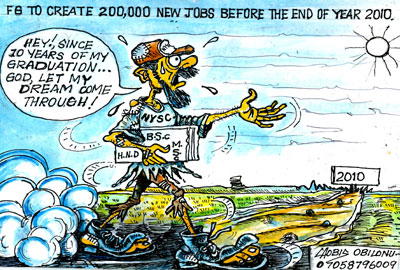
As graduate unemployment rate soars in Nigeria, Ghana, Kenya and South Africa, report has revealed that students in these sub-Saharan African countries no longer see their future in conventional salaried employment, but rather in self-employment. The research which was conducted by more than 6000 final-year students and focus groups with students in all four African countries is a focal point of discuss at the ‘Going Global’, the British Council’s annual conference for leaders of international education in London.
 According to National Bureau of Statistics, unemployment rate in Nigeria increased to 23.90 percent in 2011 from 21.10 percent in 2010. Unemployment Rate in Nigeria averaged 14.60 Percent from 2006 until 2011, reaching an all time high of 23.90 Percent in 2011 and a record low of 5.30 Percent in 2006.
According to the Statistics South Africa,unemployment rate in South Africa increased to 26.40 percent in the first quarter of 2015 from 24.30 percent in the fourth quarter of 2014. Unemployment Rate in South Africa averaged 25.27 percent from 2000 until 2015, reaching an all time high of 31.20 percent in the first quarter of 2003 and a record low of 21.50 percent in the fourth quarter of 2008.
Quoting Ghana Statistical Service, unemployment rate in Ghana decreased to 5.20 percent in 2013 from 5.96 percent in 2010. Unemployment Rate in Ghana averaged 8.82 percent from 2001 until 2013, reaching an all time high of 12.90 percent in 2005 and a record low of 5.20 percent in 2013. Unemployment Rate in Ghana is reported by the Ghana Statistical Service. In Ghana, the unemployment rate measures the number of people actively looking for a job as a percentage of the labour force.
Kenya National Bureau of Statistics says, ”unemployment Rate in Kenya increased to 40 percent in 2011 from 12.70 percent in 2006. Unemployment Rate in Kenya averaged 22.43 Percent from 1999 until 2011, reaching an all time high of 40 Percent in 2011 and a record low of 12.70 Percent in 2006.
Meanwhile, the findings by the researchers represent the second published report of a three year research project ‘Universities, Employability and Inclusive Development’ (2013-2016), commissioned by the British Council and being led by a research team at the United Kingdom’s University College London Institute of Education. The research which focuses on Nigeria, Ghana, Kenya, South Africa, and the UK for comparative purposes aimed at projecting and exploring the role of higher education in fostering employability and developing just and prosperous societies.
At the conference, the report findings were launched and discussed by a panel of students from Nigeria, Ghana, Kenya, South Africa and the UK.
The report states that for many graduates, the great promise of the university has not been fulfilled adding, ‘’Diplomas have not provided automatic white-collar employment as may have been the case in previous decades, and in some contexts such as Nigeria, employment rates are no better for graduates than for those with primary or secondary level qualifications.”
The report shows a rising focus on self-employment instead of salaried employment – seen most obviously in Kenya, with a staggering 64 per cent of students aspiring to be self-employed. In the UK, the proportion of students who are in self-employment or starting their own business six months after graduation is only 4 per cent.
A clear finding from the survey is that for universities to be able to play a significant role in the continent’s social and economic progress, African institutions should not view students just as consumers, providing ‘value-for-money’ products that will be attractive to the market, but should include them as primary stakeholders in the collective task of ensuring a rich and relevant learning environment.
The survey pointed out six key issues which include; students no longer see their future in conventional salaried employment. Giving back to their communities is an important goal for students and Careers services and skills development programmes are underutilised. Others are, students from disadvantaged backgrounds face an uphill struggle. Universities are still characterised by rote learning and despite the critical problems, students are unwilling to speak out about the problems their universities face.
Reacting to this survey and seeking a way forward to the dawnward trends, Tony Reilly, the British Council’s Director in Kenya, at the conference said: “Higher education is becoming increasingly important in the context of the knowledge society, and governments and development agencies alike are showing greater recognition of higher education’s critical contribution to development in the post-2015 agenda.’’
He said, if Africa is to harness the enormous potential of its burgeoning next generation and reap a demographic dividend out of its youth populations, the issue of graduate employability needs to be first understood and then tackled head on.
He averred that given the significant lack of rigorous research in the four countries in question, it was essential to develop a strong evidence base on the subject as a means of informing national policies, institutional reform and programme interventions. “We hope the findings of our research will help UK universities to build sustainable partnerships with their Higher Education counterparts in sub-Saharan Africa, and that these partnerships will act as a significant nexus of positive change” Reilly said.
According to him, a major challenge for the region is that higher education systems have been allowed to expand without corresponding resources, leading to questions being asked around the quality of graduates exiting universities into an already congested job market.
The report argues that as been the case in primary education in the past two decades, a shift of conception is needed from access to quality, or access with quality and relevance.
On his part, the author of the report, Dr Tristan McCowan said: “A revealing aspect of the research is that students in the survey were for the most part positive about their universities, despite the serious concerns over quality expressed by other stakeholders. ‘’It seems they either lack a benchmark by which to evaluate their institutions, or are aware of their shortcomings, but do not feel at liberty to criticise them. ‘’Informally, students express their concerns, but they lack channels through which to influence their institutions.’’
He urged universities to reconsider how to engage students as partners in the task of enhancing the learning environment adding that empowered students should be able to provide constructive feedback on the provision they are receiving. He maintained that they are a vital piece in the puzzle of ensuring higher education quality in Sub-Saharan Africa.
Disclaimer
Comments expressed here do not reflect the opinions of Vanguard newspapers or any employee thereof.