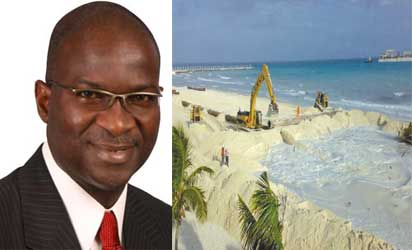
Fashola
By Jude Njoku
AS the annual Lagos State International Climate Change Summit enters its seventh year, environmentalists and climate change experts have begun to take stock to evaluate grounds gained as well as set an agenda for the future. The annual forum which seeks to explore the challenges and opportunities of climate change in Lagos in particular and the world in general, is slated to hold between April 21 -24, 2015 at the Eko Hotel & Suites, Victoria Island, Lagos.

fashola-and-bar beach-reclaim
The three-day conference which has “Seven years of Climate Change Governance in Lagos State:
Celebrating Success Stories, Reviewing Challenges and Setting Future Agenda” as its theme will chart the way forward for the sustainable development of Nigeria’s “”Centre of Excellence
In its seven years of existence, the summit has addressed various measures of combating climate effects through various mitigation and adaptation actions.
It has also shared best practices across boundaries, and explored inherent business opportunities. The summit has also focused on the vulnerability and adaptability of climate change in major facets of life.
The outgoing Governor of Lagos State, Babatunde Raji Fashola explained that the input of the Lagos State Government in environmental regeneration and infrastructural development are in furtherance of sustainable environment. “In Lagos, we have continued to landscape and beautify hitherto open spaces and loops that were then hideouts for miscreants.
We have also modernised parks and gardens, as well as established an agency named the Lagos State Parks and Gardens (LASPARK) whose major role is to oversee the parks and gardens in the state and to continue the greening initiatives in order to assure modern town planners that the state is methodically planned with all its resources for an enviable regional national development,” he said.
The Commissioner for the Environment, Tunji Bello quoting Governor Fashola declared: “Gone are the days when we could succinctly draw a line between the rainy season and dry season; gone are the days when harvest was predictable and bountiful; gone are the days when select species of certain fish were readily available on the menu table”.
Bello observed that most of the goals and targets set by the summit within the last seven years have been to a large extent achieved. His words: “High level of greenhouse gas (GHG) emission has been greatly reduced as a result of our numerous greening programmes – as the plants use up carbon dioxide and release oxygen as waste – such that Lagosians now breathe in cleaner air than before.
“The government has also built five Independent Power Projects (IPPs) in Lagos Island, Alausa, Akute, Mainland and Peninsula, leading to the decommissioning of several hitherto active industrial generators across the state, and greatly reducing air and noise pollution as well as conserving and ensuring energy efficiency,” he said.
Among the numerous achievements of the summit, according to its organisers include the draft Lagos State Climate Change Policy Document and Action Plan, Lagos State Adaptation Strategy Documents produced to reinforce actions to address the challenges of climate change;
the heightened collaboration with various non-governmental organisations (NGOs), Vulnerability Study on Coastal Areas to Climate Change in the state in conjunction with the United Nations International Development Organisation (UNIDO), the Eko Atlantic Project, Shoreline Protection of the Bar Beach and Rehabilitation of the Drainage Infrastructures in Lagos.
Climatechange
Others include the introduction of mass transportation systems including Bus-Rapid Transit, BRT and Light Rail Project, School Advocacy Programme, Yearly School Exchange Programme to Germany (where students from Lagos State public schools are sponsored to join their counterpart abroad), as well as participation of various government officials at international climate change conferences and events.
Additional achievements include establishment of waste-to-wealth programmes (such as Nylon Buy-back, Waste-to-Compost and Waste-to-Energy), Annual Tree Planting Campaign, Car Horn-free Campaign, the Greening Programme, and passing of laws to protect the environment.
For example, it is now an offence to fell a tree in Lagos, as doing so attracts a fine and the planting of five trees for every fallen tree. Amid the enactment of fresh laws (such as on noise pollution), environmental laws are likewise being harmonised, even as the Kick Against Indiscipline (KAI) has been elevated to the status of an Agency to enforce environmental laws.
Disclaimer
Comments expressed here do not reflect the opinions of Vanguard newspapers or any employee thereof.