orphans
By Gabriel Olawale
Despite setting out very early, the heavy traffic along Orile-Badagry expressway, Lagos, ensured that this reporter did not get to Araromi, Badagry, location of the Lady Atinuke Oyindamola Memorial Home before 1pm. On entry into the premises which is fenced, the sight of the three building inside, comes as a bit of a shock. A first time visitor to the Home would have no cause to cheer. Right from the gates, the feeling of despair, desolation and despondency is immediately apparent.

Mrs. Elsie Akerele
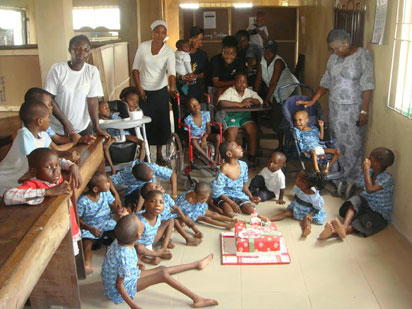
The initial observation is that while the place is not particularly run-down, it nevertheless habours an eerie aura of neglect and palpable lack. This is a home quite right, but it is not homely. It is a place of wants that does not want you. Inside the expansive compound, infants and little children, scattered around. Some are orphans, physically or mentally challenged.
Others are abandoned at birth; call them unwanted children or children of wants, and you would not be wrong either way.
This reporter, who spent 24 hours on the premises, had an insight into the world of goings on in an orphanage. Lady Atinuke Home is a place where child die for want of just N1,500 to access medical treatment Just one visit to this Home is a revelation about the harshness of life for Nigeria’s special child;
besides the trauma of not being able to express their feelings and needs, coupled with the disappointment they suffer from parents who gave birth to them and the lack of care and attention from government makes life even tougher.
It’s a stark illustration of the hardship children often undergo when conditions are not favourable. About 23 of the children were seen inside one of the buildings. The building in question was said to have been donated by a philanthropic American lady, Mrs. Laila Peison who visited sometime ago and saw them in squalor. At that time, just one building was on the premises and the whole thing look congested and dark and out of her kindness ensure the realisation of the building.
Several of the children were on wheelchairs. A few were crying, many playing and one or two just looked on in helplessness. In the building next to this one, staff of the Home were seen cleaning up and dressing some of the children. The situation was not particularly palatable to behold, but some children had a semblance of hope boldly written on their face. Investigation by Good Health Weekly revealed that some of the children were abandoned at a crusade ground after their parents waited in vain for a miracle.
There are children who were found in other places such as the pigsty, by the road side, a small number at the hospital premises while some where brought in by their parents and abandoned to their fate. who didn’t want to have anything to do with them again because they deliberately left wrong forwarding addresses with the Home and have not been traceable.
For eight years the Home has existed, the survival of these children has being a tug of war. It was gathered that on a particular occasion, one of the children died as a result of the inability of the Home to raise a paltry sum of N1,500 for treatment. The situation of the children has deteriorated so much that some of them whose homes could be traced are being returned to their family.
Even as this persists, it is alleged that the Lagos State government still calls on the Home for child rescue without offering assistantce to it, on the excuse of having no provision for such assistance in the budget. It was rather disturbing to discover that every child in the Home wears diapers that are changed every three hours. Aside the fact that it takes more than an hour to feed a child, their clothes need to be changed after each meal.
Special learning: Their own mode of learning is a bit different from conventional learning alphabet and numerals. They first concentrate on survival, some were seen learning to sit, others were still sucking their thumbs. Many of these special children are unable to eat the normal food provided for others simply because they are unable to swallow or chew. This compels the staff to liquefy or mash the food before the children are able to take it down their throat.
Much later, as this reporter went around the premises, a woman approached the entrance gates carrying two nylon bags. The staff of the Home became excited and welcomed her warmly. From indications, she was well-known, as children in the building painted blue also welcomed her and even manged to show some sign of appreciation,
The visitor was moved to tears when Ruka, one of the older children in the Home, got up to appreciate her. Ruka’s story is worth telling. She was found with her mother at Ketu market by Missionaries, about eight years ago. The duo had been taking refuge there because of inability to rent an apartment. Ruka was 16 at that time. The mother was later given some money to start her own business, selling sachet water and two crates of empty bottles for selling soft drinks while Ruka was left in the home.
So after eight years at the Home, Ruka’s condition has now changed for good and she is now a supporting care giver.

orphans
Elsie Akerele’s story
Ruka’s story was quite interesting and intriguing but it was the encounter with the Proprietress, Mrs. Elsie Akerele whom the children look up to as their benefactor. Akerele told Good Health Weekly that a day cannot pass without her looking for one or two churches in the environment to seek help for these starving children.
“Even when I am on sick bed, I still have to stand up and go round the churches in this environment to beg not only for money but anything they can assist us with. My huge debt in the neighbouring market has made me popular,” she explained.
Akerele who set up the Home about eight years ago could not have imagined things would turn out so bad. Her passion for the survival of special children prompted her to sell her house at Idimu in Alimosho Local Government of Lagos State to build a proper Home where challenged children would take refuge.
Currently, her inability to meet up with payment of the staff salary has caused some to shun their duty. With 13 staff left providing service, Akerele still owes them four months salary.
“When we had meeting about an hour ago, I admitted that I owe them and promised to pay. But my greatest scare is if they all refuse to show up one day, what will happen to these children?” She wondered. The Home’s effort to get the support of two local health workers from the Local Government Area proved abortive as several letters written were not attended to.
To meet up with feeding the children, Akerele explained that it has been a real challenge. “There are times we would not have common milk in the home to give the children. I would wake up very early to begin looking for reverend fathers or sisters who will give us milk to make them look attractive a little bit. Their immunity is very low, you can see a child playing now and within a blink of an eye, he or she might start losing strength and become weak. That is why we have being in and out of the hospital.
“On several occasions, I have written to the government to give us two nurses to support us, but no response till date. A child has died here because we were unable to raise N1,500. This is very sad and I don’t want to lose any other one.
“We wear only second hand clothes that good Samaritans bring to the Home. Early this year when we experienced serious hunger, the clothes that my daughter bought for me during her wedding, were sold. I had to sell them. All my grandchildren have an impact on this Home because they give us most of their clothes along with ones that people brought for us.”
Mental growth
To ensure they grown mentally, the Home employed two special education teachers – one for speech therapy and the other for physiotherapy, but due to their inability to meet up with the charges , the speech therapist stopped visiting. “Ideally these children need a physiotherapist at least four times a day, but due to lack of support the Home could not afford more than once or twice a week.
“It depends on the child’s case but if we are to pay a physiotherapist alone it will be about N30,000 per week because it is charged per session. “For speech therapy, one session per child is N3,000 that is, if they are many. Some weeks if we don’t have donation of food, we normally leave physiotherapy and look around for what to eat. That is why these children are still like that, assuming we have consistent therapy for them, things would have improved.
To ensure their stomachs are not empty, the staff blend plantain for them to eat due to its richness in iron among other things. Some were seen taking blended maize with milk. Those learning to swallow were observed taking their food. Continuing, Akerele said she discovered during the care for the children that they need enough iron-rich food. “That is why we give them a lot of unripe plantain and draw soup for those learning how to swallow.”
OVC challenges in Nigeria: The last available statistics put the World population of orphans at 143 million and Nigeria 17.5 million (UNICEF, 2008). Currently, population of orphaned and vulnerable children is believed to have topped 25 million, yet 80 percent of institutions taking care of orphans in Nigeria are private Homes and orphanages while state owned orphanages are very scanty all over the nation. This makes the bulk of providing care and psycho-social support rest on the shoulder of private homes and orphanages.
Uncertain future for OVCs: The Secretary General, Association of Orphanages and Homes Operators in Nigeria, ASOHON, Dr. Gabriel Oyediji who is the founder of Compassionate Orphanage, Lagos and Docas Adunola Oyediji Motherless Home Ibadan, Oyo State, said OVCs, in Nigeria face an uncertain future as the availability of funds for their care and support continues to dwindle.
Tangiblesupport
Oyediji predicted that failure of tangible support to address the current financial predicament of orphanages over the next decade, could potentially spell doom has many OVCs are likely to die off as a result of lack of placement and rescue opportunities.
“The private homes and orphanages provide nutritional support, educational support up to tertiary institution, medical support even surgeries when needed, clothing and all forms of physcho social support, building maintenance, staff salaries, transportation among others without the government offering any financial grant to reduce the financial stress.
“This is a wound, a tragedy and a shame of our nation. And if the government continues to show nonchalant attitude towards the financial predicament of orphanages, it is predictable that in another 10 years many orphanages will close down. “Many abandoned and vulnerable children will die due to lack of placement; there will be increase in mortality in existing orphanages for lack of good nutrition and medical care.
Oyediji warned that many abandoned babies in gutters and dustbin will also die due to lack of rescue opportunity. “Many brilliant children in orphanages will have half education or will be out of school, facilities in homes will be deplorable for lack of funds to put them right.”
Disclaimer
Comments expressed here do not reflect the opinions of Vanguard newspapers or any employee thereof.