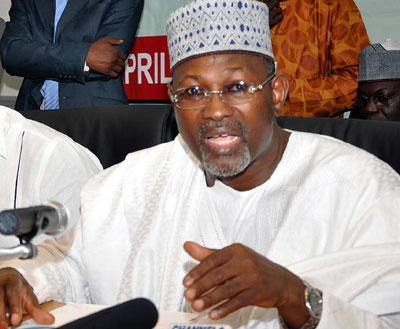
INEC Chairman Prof Attahiru Jega during the nationwide broadcast announcing the postponement of the N/Assembly elections, Saturday, in Abuja.
By Johnbosco Agbakwuru & Joseph Erunke
ABUJA — The Senate, yesterday summoned Chairman of the Independent National Electoral Commission, INEC, Prof. Attahiru Jega, to appear today at the plenary to explain circumstances behind the postponement of the general elections initially slated to hold on February 14, but had to be shifted to March 28.

The INEC boss is also expected to explain whether the commission was ready to introduce the use of card readers for the forthcoming elections.
Jega’s invitation was occasioned by the motion moved by the Senate Leader, Victor Ndoma-Egba, for the INEC Chairman to brief Senators on the issues concerning the postponement of elections and other issues relating to commission’s preparedness for the conduct of the general elections.
Ndoma-Egba further said that Jega should also demonstrate the workings of the card reader and its deployment before this Senate.
He recalled that the commission “had earlier fixed February 14, 2015 for the presidential election and February 28 for the gvernorship and state House of Assembly elections.
“That on Sunday, February 8, 2015, INEC announced a postponement and rescheduling of the elections to March 28, 2015 for the presidential elections and National Assembly elections and April 11, 2015 for the governorship and state Houses of Assembly elections respectively.
“That apart from the security reports cited by the commission for the postponement of the elections, critical issues like the distribution of the Permanent Voter Cards and the palpable apprehension that considerable number of eligible voters maybe disenfranchised and that the proposed deployment of card readers by INEC for the conduct of the elections may amount to a contravention of Section 52 of the Electoral Act 2010.”
Ndoma-Egba said if the issues were not resolved before elections, the conduct of the elections may cause more complications.
But the Minority Leader, Senator George Akume, said the opposition in the Senate had no objection to the invitation to the INEC chairman on the postponement of elections which he said was a very sensitive issue.
He, however, added: “But, we also want to add that in inviting Jega, we should invite those who wrote, advising him that because of their inadequacy to provide security for the exercise, the exercise should not hold.
“It is important because Jega had spoken before that he was ready to go ahead with the elections. Jega was ready until he was overruled. Mr. President, the National Security Adviser who first stated this issue of postponement in London raised a major issue that the distribution of PVCs was behind schedule and that so many people had not been availed the opportunity to collect the PVCs.
“The issue of providing security cover was not the reason advanced for possible postponement. Eventually, this became an issue. I say it is sensitive because time is of the essence. We want to hear from them why they cannot provide security for an exercise that will last for only a day or two.
“Let us remember that only 7,000 troops are required to handle the issue of Boko Haram and even then it took a regional contribution to get that 7,000. We have a military force that is over 100,000 and therefore, Mr. President we want to amend this by saying that Jega should come along with the service chiefs.”
The Senate President, David Mark, said he appreciated the points made by the Leader and Minority Leader and that it was appropriate for Jega to first appear before the Senate to give explanations on the issues raised.
The Senate President said: “If Jega says that these are the reasons, then, we will invite the service chiefs.”
Advising that there was no need to pre-empt anything, he said: “Jega is going to appear before us here. When he comes tomorrow, if he shifts the blame in any direction, then we will invite the people involved.
“I think that is my candid opinion and it is a proper procedure to follow. Since the return of this country to participatory democracy in 1999, all Nigerians have been committed to the protection of our democracy. The role of the opposition in a democracy is clearly established in the constitution of our country and other relevant extant legislations. It is the responsibility of all of us to continue to support democracy in the land.”
Disclaimer
Comments expressed here do not reflect the opinions of Vanguard newspapers or any employee thereof.