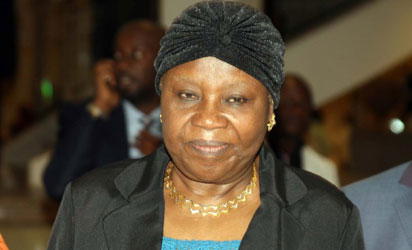
*Aloma Mariam Mukhtar
By Ikechukwu Nnochiri
She came, she saw- and to an extent, reinvigorated the fervour to stamp out the burden of corruption that has in no small measure weighed down the scale of justice in Nigeria.

*Aloma Mariam Mukhtar
As the first female Chief Justice of Nigeria, CJN, Justice Mariam Aloma Mukhtar formally bows out of active judicial service today having clocked the 70 years mandatory retirement age, posterity will surely recognise her efforts at weeding out bad-eggs from the Bench.
The outgoing CJN spent barely 28 months in office. She took over from Justice Dahiru Musdapher who retired on July 15, 2012.
Succession to the post of the CJN has always been based on seniority.
Undisputedly, no administration in the judiciary ever made attempt to fight corruption like Mukhtar whose regime saw the sack of about seven Judges within a period of two years.
Remarkably, since 1963 when the Federal Republic of Nigeria was proclaimed and Dr Nnamdi Azikiwe became its first President, no woman ever manned the justice sector.
The situation deteriorated to the stage that an ex-CJN and a sitting President of the Court of Appeal, publicly poked themselves over alleged plan to subvert justice in a gubernatorial dispute involving Sokoto State.
Consequently, while answering questions from the Nigerian Senate on July 11, 2012, Justice Mukhtar admitted the presence of bad eggs at the top echelon of the judicial arm of government, even as she vowed to fight and expose such persons before her exit from office.
Thus, few days after she assumed duties, Justice Mukhtar went through 337 petitions filed against judicial officers before the NJC.
Lamenting that the integrity of the judiciary was fast eroding, the outgone CJN disclosed that she “inherited 139 petitions, 106 of which were vexatious or baseless, only 33 of the petitions were considered worthy of attention.”
According to her: “After my assumption of office as Chief Justice, 198 fresh petitions were filed; of this number, 150 were found to be frivolous, 15 are awaiting responses from Judges and only 21 were slated for consideration.”
To prove that it was no longer business as usual, Justice Mukhtar, on February 28, 2013, sacked two justices, Charles Archibong of the Federal High Court Lagos and Justice T.D. Naron of High Court of Justice, Plateau State.
Acting alongside the NJC, she further set up a ‘Fact Finding’ Committee to investigate allegations of corruption against Justice Abubakar Talba of FCT High Court, who was eventually handed a one year suspension on April 26, 2013, following the slap-on-the-wrist sentence he handed to a self confessed pension thief, Mr. John Yusuf, who had openly admitted that he stole N23billion pension fund.
To heighten her stoic stance against judicial impunity, Mukhtar directed a full-blown investigation into the petition that was filed against the former Chief Judge of the FCT, Justice Hassan Lawal Gunmi, who voluntarily retired from office on May 13, 2013 to become an Emir in Zamfara state.
The FCT CJ, who has since gone before the Federal High Court in Abuja to challenge the decision of the NJC to probe allegations of corruption against him, relinquished his office to replace the former Emir of Gunmi town, Alhaji Aliyu Abara who died on May 7 last year.
Meanwhile, with the hindsight of experience, Justice Mukhtar, knowing that some of the supporting staff in the justice sector connive with corrupt lawyers to pervert the course of justice, on June 17, vowed to sack any of them found wanting.
In a keynote address she presented at a workshop organized for that cadre of judicial officers by the National Judicial Institute, NJI, she said: “Let me quickly add that the fight against corruption in the judiciary is not only targeted at judicial officers but also against any member of staff of the judiciary who finds luxury or convenience in engaging in corrupt practices or engaged in any other unwholesome conduct.
“It is a notorious fact that this category of workers has in the past caused leakages of judgments written by judges which were yet to be delivered.
“Litigants’ applications are at times not filed in their case files thereby denying the judges from acting on them. Some of them midwife between the litigants and the judges in the sale of judgment, or provide information to litigants on how some judges can be approached to compromise his or her judgment. All these they do for fee at the expense of judiciary integrity and image.”
On June 2, Justice Mukhtar, while superintending over the meeting of the Federal Judicial Service Commission, FJSC, dismissed five Supreme Court workers and one staff of the Abuja Division of the Court of Appeal for leaking judgment in the case between Senator Alphonsus Igbeke and Lady Margery Okadigbo, before it was delivered on May 31, 2013.
FJSC further requested the Attorney General of the Federation, AGF, to further investigate and possibly prosecute Igbeke and one Collins Okechukwu for allegedly aiding and abetting the leakage. Although there have been many cases of leaked judgments in the judiciary, that was however the first time such incidence was investigated with the culprits apprehended and punished.
To further sanitize the system, the CJN on May 17, 2013, maintained that beside outcome of petitions filed against judges, she introduced the use of performance evaluation reports by the NJC to boot out incompetent and indolent judges out of the bench.
“We are now thinking of looking at the performance evaluation of the judges for the purpose of discipline. If a judge cannot deliver three to four judgments in a year, there is no use keeping him on the bench other than to be shown his or her way out,’’ she added.
In furtherance to that, the NJC under Justice Muhktar, on February 27, sacked two more judges after they were found guilty of judicial misconduct.
The judges, G.K. Olotu of the Federal High Court and Justice U. A. Inyang of High Court of Justice of the Federal Capital Territory, Abuja, were sent on compulsory retirement with an order that they should vacate their offices immediately.
The Council in a letter it wrote to President Goodluck Jonathan, pleaded that the two Justices should not be allowed to adjudicate in any court in the country, stressing that pursuant to its findings, they ought not to sit on the Bench.
Sequel to its deliberation on the report of a Five-Man Committee that were mandated to investigate judicial officers with very low performance or non-performance, the NJC further threatened to sack two more judges over their alleged indolence.
According to a statement by the Director of Information at the NJC, Mr. Soji Oye: “At the end of deliberation on the Report of the Committee, Council found Hon. Justice A. A. Adeleye of High Court of Justice, Ekiti State and Hon. Justice D. O. Amaechina of High Court of Justice, Anambra State, respectively culpable of very low performance. Consequently, Council decided to issue warning letters to them for decline in their productivity.”
As she hands over the baton of leadership to the most senior justice of the apex court Justice Mahmud Mohammed today, the outgoing CJN has said she feels no remorse over the toes she stepped on while in office.
Speaking with members of the National Association of Judiciary Correspondents, NAJUC, in her office on Tuesday, Justice Muhktar, further justified all the actions she took while in office.
Justifying the reforms she introduced during her tenure which included the approval of full automation of courts in Nigeria to allow for e-filing of cases, Justice Muhktar said: “When there are reforms, there are bound to be people who are not happy at all, because there are people who do not want change. But I defied whatever it is that may bring problem and ensure that things are properly done. That is what this is all about, for things to be done properly. That is all. It is for the interest of the institution, not for anything else.
“I don’t bear any grudge against anybody. I don’t go out of my way to victimize anybody. All I wanted was to improve what was on the ground and the system. And I am happy that some are appreciating even if some others are not. It is natural that those, whose shoes one had stepped on will not be happy with one. But I take it in my stride, it is natural. As long as the generality of the public think that I have improved the system that is very satisfactory to me”, she added.
The new CJN, Justice Mahmud Mohammed who was formerly the Deputy Chairman of the NJC, hails from Jalingo in Taraba State and was born on November 10, 1946.
He studied for his Bachelor’s degree in Law (LL.B) at Ahmadu Bello University, Zaria, graduating in 1970, after which he attended the Nigerian Law School in Lagos and was subsequently called to bar in 1971.
He began his career in the public service with the Ministry of Justice of the defunct North-eastern and Gongola States, as well as served on the bench in Gongola.
In 1991, he was appointed the acting Chief Judge of Taraba State, and later confirmed as the substantive Chief Judge of the state in the same year.
Prior to being appointed a Justice of the Supreme Court in 2005, he was a justice of the Court of Appeal and then its presiding justice.
In addition to his legal qualifications, he holds a certificate in Legislative Drafting from the Commonwealth Institute of Legislative Drafting; a certificate in Human Resource Planning and Management from the National Institute of Public Management, Washington USA; a certificate of Administration of Justice in a Presidential System of Government from the Institute of Judicial Administration, University of New York, USA; and a certificate from a Government Legal Advisers course from the Institute of Advanced Legal Studies, University of London, UK.
In his years in public service, he has served as a member of several committees and panels.
He holds the national honours of the Commander of Order of the Niger (CON) and Officer of the Order of the Federal Republic of Nigeria (OFR), and is a member of the Bar Council, Council of Legal Education and the Body of Benchers.
Disclaimer
Comments expressed here do not reflect the opinions of Vanguard newspapers or any employee thereof.