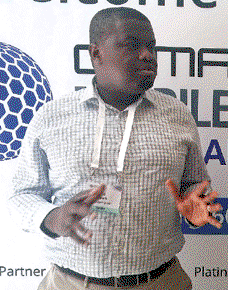
At the just concluded GSMA Mobile 360 held in Cape Town, South Africa, the Group Managing Director and Chief Executive Officer, Terragon Group, Elo Umeh, was among the discussants during a session on ‘Delivering Affordable Access to the People of Africa’.
 Telling the story of African mobile ecosystem, he tipped app innovations to foster affordable access across the region.
Excerpts
Where Terragon Group plays
The digital mobile ecosystem, the entire spectrum is being covered by Terragon Group’s digital media and that means that services that ride after these networks have been built and the broadband has reached the end-user, the services that extend it, how the user interfaces and consumes the content. That is where we play.
How mobile has helped Africa
It is evident. It is all over the place. The connectivity is getting everywhere. The voice and internet connectivity is everywhere. It is pervasive. I will cite a couple of examples. There are several things that are evident of what is happening and a lot of these things are driven by mobile.
This is because there was never computer or pervasive computer-based access. So we can see it every day, but now after all these networks have been built, what then is the next layer?
The next layer is, how do we make sure that people get all the things they want to consume using their Smartphones?
Who is going to enable that? The simple example is that the farmer in Benue has planted yams and by the time he wants to harvest the yams, he sells it to a middle man, that middle man sells it to another middle man, and then that middle man then sends it to Port Harcourt or Lagos or Abuja, what we are now doing is that we set up a system where that farmer can stay in Markurdi and contact a buyer in Lagos via his mobile device. That is the next level. Those are services and they are basic services that run via SMS.
Something else is the media owners. For instance, the Vanguard newspapers invests a lot on their internet channels. They put content on internet channels. But Vanguard newspapers also has relationship with advertisers but there are various technologies that support those channels, those internet and mobile channels are available 24 hours and the content is being fed to the people.
So, we help them with monetising their mobile internet channels. By monetizing, we mean, bringing in the advertisers and ensuring that every page refreshed have another advert which continues to run on an ongoing basis.
Our Innovations
Some of the kind of innovations we bring to the market is click to SMS. How it works is when you are browsing on your phone, you see a banner ad, you click on that banner ad and it takes you to to your SMS page and tells you to send an SMS and that’s how you start an engagement with a brand. That is click to SMS.
There is also click to call.
Another area which is almost intangible is in the area of data. In Nigeria, there is an acute lack of data but every quarter as an organization, Terragon publishes research report and distributes it into the ecosystem at no cost. That is another way we are driving affordable access.
With these reports, we are educating the population on the possibilities in digital. We are educating brands and agencies on the possibilities in digital and we are educating the entire spectrum on the possibilities in digital.
Anybody can look for our reports, take it up and consume it and use it for economic and for whatever reason they want to use it for.
That is another way we are driving affordable access because the alternative will be to source these reports by paying for it. In those little ways we are driving significant affordable access.
If you talk about the depth of where we started, when we started off as a business, we went to publishers and told them we would build mobile sites at no cost.
This is another way we are driving affordable access because at zero cost we will build mobile site for you. We have done it for several organisations and at no cost to them. And we did this because it was important they come on board the internet.
At first, many of these organisations did not get a sense of where people were accessing their contents from. They didn’t know that people were accessing their contents from mobile sites, so we gave them data and showed them the numbers and we then built mobile sites for them.
International players versus local players in driving mobile in Africa
I think everybody is contributing. International players like Google, Facebook, Opera, Oracle, Cisco, are all playing their parts.
But I think that the onus is on the local African companies who can feel the pulse of the average African and so the responsibilities lie on African companies to innovate, to drive innovation that will foster affordable access on the continent and get the critical mass on the mobile channel.
Empowering Africa for the future with affordable access and mobile
It is very clear. Already we have millions of Smartphones but a significant number of these smartphones all run on international applications.
That is already a challenge. Individuals, companies, need to innovate along those small things. Mobile apps, for instance. There needs to be some innovate around mobile apps. Let there be some prevalence around the use of African mobile apps. That is already one way.
There is a need for some innovations along that line. Those are some of the things that two or three people can start doing. They just need to come up with exciting ideas and then innovate around it. We cannot wait for the international companies, because the model and their understanding is driven by what holds internationally.
African mobile market 10 years down the line
I don’t like to predict the future. But I will say certain things. I think what the GSMA Mobile 360 forum said today is very valid. More and more connections will continue to happen. Something else i think that will continue to happen is the internet. The penetration will continue to grow and will become better. The speed and quality will be better.
A lot of things will be significantly internet driven.
Currently you watch television using the television, you are going to be watching that TV on several devices. You are going to be watching it on mobile phones.
You are going to be able to project it from the mobile phone to a wall and other things like that. I think that mobile phones will continue to become a dominant interface.
My central message
Localization was my central message. Those localizations have to be across territories. Nigeria is different from Kenya, Kenya is different from Ghana.
There are similarities here and there. We can amplify the similarities but there are salient differentiators and we have to pay attention to those differentiators as well.
How are they different and how do we innovate around those differences so that unique selling propositions in each of the markets are brought out so that there are increased adoptions? The answer is localisation and the responsibility around that localisation lies with African entrepreneurs.
Role of Terragon Group in growing the mobile ecosystem
Like i said earlier, we are playing across the spectrum, and the mobile ecosystem. We help mobile operators solve the problem around over-the-top players. So we are looking at the mobile operators and telling them we have this solution, we can help you deal with some of the issues that are around over-the-top players as broadband and internet penetration continues to grow.
Some of these solutions are very unique to Africa and because we have looked at the challenges in the developing market. The challenges in the developing markets are different from the challenges in Europe and Americas.
We develop products for mobile operators in these areas. That is one of the things we are doing and we think that we are helping out with technology. Recently, Linda Ikeji’s site was down and we came to her rescue.
It was only the mobile site which we built for her over the years that was available because the domain and everything was being managed for her in trust. When her site was down, that was the only site available to her. This is another way we are helping publishers and content owners.
Disclaimer
Comments expressed here do not reflect the opinions of Vanguard newspapers or any employee thereof.