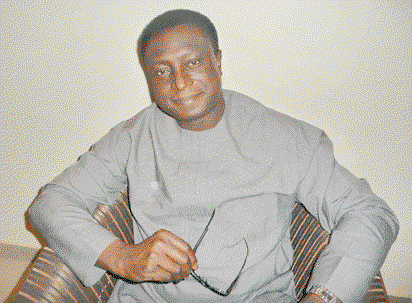
Emmanuel Igah
By Florence Amagiya
Dr Emmanuel Igah is the Managing Director, Phobos International, Abuja/Paris. In this interview, he speaks on insurgency, how it affect investments, the image of Nigeria abroad and what President Goodluck Jonathan should be doing.

Emmanuel Igah
One of your areas of competencies is negotiation. Negotiating with Boko Haram was a key demand by the Islamist group to release the Chibok girls. Do you think govt was right to have rejected the demand?
Boko Haram demanded the release of nearly 100 of their men who are currently held in detention. This is an unacceptable starting point in any eventual negotiation.
We all know what happened when a Boko Haram activist was released from detention following pressures from various quarters – he later became the brain behind the first bombing of Nyanya motor park in the outskirts of the federal capital, Abuja, which claimed dozens of lives.
At this point, Boko Haram believes it has the upper hand and so can dictate the tune. For any meaningful negotiation to take place, the Federal Government must first regain the military initiative and break the backbone of Boko Haram.
This is taking time to happen even with the support of the international coalition now on ground for the past two months, but we will get there. The increased politicization of the Boko Haram issue (and the Chibok abducted girls crisis) against the back drop of the forthcoming 2015 general elections may not be helping matters. The government was able to negotiate an end to the Niger delta militancy because its leaders put on the table, clear-cut demands regarding resource distribution, environment and development of Niger Delta region, where the oil comes from. The challenge with Boko Haram is that it is difficult for the government to negotiate with a bunch of irrational extremists demanding that the country do away with so-called western education, which they consider sinful.
Let’s talk about Nigerian’s image in the international community in the wake of the Boko Haram activities?
Sustained bomb attacks, wanton killings and kidnappings by Boko Haram insurgents have driven the image of Nigeria in the international scene to low ebbs. The impression is created that the country is in a state of full-blown inter-religious war, whereas, the great majority of Nigerians live and work together harmoniously in spite of the nation’s religious and ethnic diversity. Government should embark on a well articulated image building drive in the international community, through effective communication, articulating the policies and programmes being implemented to accelerate development, and highlighting the immense opportunities available for foreign investors. I think government understands this imperative and is already taking some steps in this direction.
How does insurgency affect foreign direct investment in Nigeria?
Nigeria topped African countries as Foreign Direct Investment destination in the last three years with FDI inflow exceeding 7 billion USD annually, a laudable performance. Although the Minister of Finance, Ngozi Okonjo-Iweala, assured at the World Economic Forum held in Abuja this year that FDI has not been reduced by insecurity in the North-East, the fact is that Nigeria should be doing much better if the insecurity factor was not there. Prospective investors, particularly, may adopt a wait-and-see attitude or be tempted to divert their investments to other countries perceived as safer. And when the decision to invest in Nigeria is finally made, they may not want to put their stakes in the northern part of the country due to huge over head costs of security. This penalizes the North, where Foreign Direct Investment is badly needed to create jobs and spur development, as well as facilitate the eradication of poverty.
In spite of government efforts to revive the economy, the common man still does not feel the impact. What do you think is wrong with government programmes?
It is mainly an issue of governance and the vision of leadership for the collective good of the entire people of the nation. The Federal Government’s directive fixing minimum wage at 18,000 Naira per month, for example, is not being implemented by many state governments. This measure would have gone a long way to better the lot of the common man. Nigeria also has to grapple with unemployment affecting its teeming youths, even graduates of science and engineering disciplines, which shouldn’t be the case at this stage of its development. Among the factors hampering the success of government policies and programmes is insufficient commitment of the actors at various stages of the implementation process to achieving all the goals fixed; secondly, government programmes may not adequately integrate projects with high multiplier or trickle-down effects, such as agricultural and infrastructural projects.
For instance, over the decades, emphasis has been placed on the elitist air transport to the detriment of rail and road transport infrastructures, more beneficial to the masses. The focus by the present administration on agricultural reform and the revitalization of our moribund railway system, just at the SURE-P (Subsidy Re-investment and Empowerment Programme), is a most welcome development. Finally, we can’t run away from mentioning the impact of unbridled corruption, which may deprive government programmes of substantial parts of the resources needed to achieve total success, but this has been the bane of Nigeria’s development over several decades.
We have the Vision 20:2020 that is supposed to take us to the level such that we will be among the 20 most developed nations by the year 2020 that is six years away. Do you think the realization of the goal is realistic?
It would be hard for Nigeria to meet its Vision 2020 goal of becoming one of the world’s 20 largest economies, with just six more years to go. However, the country has made appreciable strides and the prospects of economic growth are good. Nigeria’s economic growth would have hit the double digits by now if the challenges militating against progress had been surmounted. We have talked about the security situation which is an immediate priority. Another major challenge is the critical situation of power supply which heavily impacts the manufacturing sector, with industries running well below installed capacities, as well as commercial businesses. However, the on-going restructuring of the power sector, if well managed, may yield tangible results in good time to get us closer to the Vision 2020 target. Furthermore, government should see the estimated needs of over 17 million housing units as an opportunity to re-energize the economy towards achieving its Vision 2020 ambition and breaking the jinx of unemployment.
If you meet President Goodluck Jonathan today, what will you tell him about Nigeria’s development.
There would be a lot to tell the President, but my words to His Excellency would focus on three vital issues as follows: “Mr President, Nigeria got its development wrong the day it turned its back on agriculture, in the advent of the oil boom of the seventies. Today, less than half of Nigeria’s over 97 million hectares of cultivable land are being exploited. I would encourage your Excellency to vigorously pursue your Transformation Agenda for the agricultural sector, and establish a robust agro-allied industry, which is the first economic sector in a developed country like France. Secondly, Mr President, coming from the academia, Nigerians look up to you to consider seriously the state of our educational system, education being the bedrock of development. The quality of education has been declining generally and our schools and institutions of higher learning seem to be experiencing a deep-seated malaise, leading often to long-drawn strikes rarely seen elsewhere in the world.
Sending our children to read abroad as many well-to-do families now do is not a panacea, since majority of Nigerian parents cannot afford that. All Nigerian youths have right to affordable quality education within the country, proffered by academic staff happy with their jobs, and the nation has the means to provide for it. Finally, your Excellency, please make mandatory, the national identity card and the registration of all births and deaths in the country. This, over time, would generate reliable demographic data needed to place our future national head counts on a sound scientific footing, thereby minimizing contention. These actions would constitute a great legacy from you to Nigeria.”
 You are also expert in population, why do you think census is such a controversial issue in Nigeria?
Population census has always been a controversial issue in Nigeria because population is a factor in the creation of local government areas, which in turn determines the number of legislative seats allocated the states in the National Assembly. It also, by virtue of the number of local government areas, influences the revenue allocation to the states, notwithstanding the derivation fund set aside specifically for the oil-producing states. Population was a parameter in the administrative structuring of the nation into regions, provinces and districts in the colonial era, just as in the successive processes of creation of states and local government areas in post-independence federalism. In this context, states and local governments would want to see themselves well placed in the population ranking.
Nigeria was recently rated as Africa’s biggest economy overtaking S/Africa. How do we take advantage of the large economy to benefit the average Nigerian?
Three keywords articulate the answer to this question: “empowerment”,” inclusion” and “equity”. Government has to empower the people to be full actors of Nigeria’s economic growth, not only to reinforce it and make it sustainable, but, in return, for the population to benefit from the prosperity in the process. Government needs to create an enabling environment for businesses – small, medium or big to thrive, so that more jobs can be generated to get our teeming unemployed youths into the economic system in an inclusive approach. Besides, governance should be sensitive to the need for equity. Our leaders must understand that all Nigerians are entitled to partake in the nation’s wealth and get a fair reward for the input they make into this wealth and national development. For instance, is it normal that some states or institutions would refuse to implement the minimum wage policy which is a way towards a more equitable redistribution of the nation’s wealth?
How did you start up in life, to the point you are today!
I hail from Otukpo in Benue State. After my secondary education in Government Secondary School, Kuru, and advanced level studies, I secured a French-Nigerian Government joint scholarship to study Architecture in France in the late seventies. This took me to learn and master French language, making me fluently bilingual in English and French. After returning home to accomplish my National Youth Service in Abuja and lecturing in Kaduna Polytechnic, I went back to France and later obtained my Doctorate degree in Economic Geography and Development Planning in University of Paris-Sorbonne, Paris. I later rounded off my education with a Master of Business Administration from the International School of Management (Paris/New York). My professional career has been essentially international, covering Africa, the Middle East, Europe and America, etc, with engagements with international organizations like the United Nations, UNESCO and the European Union.
I have been also actively involved in developing scientific, cultural and economic relations between France and Nigeria (which earned me the French National Order of Merit Award in 2001). I have just completed a mission with the American oil and gas company, KBR, in the construction of the Escravos Gas-To-Liquids Project for NNPC/Chevron JV – a mega-plant (converting natural gas into diesel and other products) now operational, which Nigeria should be proud of. I am now back to Phobos International, a Consultancy company which aims to promote investment and development in Nigeria, and Africa generally. Dr Igah handled the production of the “Atlas of Nigeria” and “Nigeria Handbook”, and similar publications for several African countries.
Disclaimer
Comments expressed here do not reflect the opinions of Vanguard newspapers or any employee thereof.