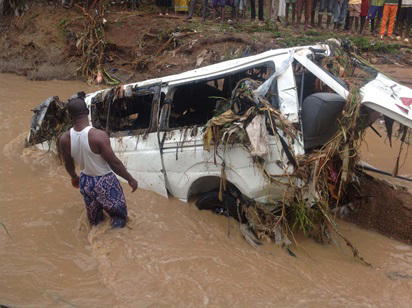
VEHICLE DAMAGED BY RAINSTORM ON AJASE IPO ROAD IN ILORIN ON THURSDAY (10/4/14). 2245/10/4/2014/OOH/CH/AIN/NAN
By KINGSLEY ADEGBOYE & MONSUR OLOWOOPEJO
A few months into the current rainy season, Lagos residents are already counting their losses following the havoc wreaked on their buildings and properties by rainstorms across Lagos metropolis.

The rains which are often accompanied by stormy winds have destroyed houses and properties belonging to corporate bodies and individauls.
Places affected by persistent rainfall, which usually start during the early hours of the morning include; Ketu, Ojota, Somolu, Lagos Mainland, Oworonsoki, Oyingbo and Ebute Metta. Others are; Lagos Island, Ajegunle, Surulere, Mushin, Oshodi, Iganmu, Gbagada, Ikoyi, among others.
The Nigerian Meteorological Agency had predicted that Lagos will experience heavy rainfall accompanied by thunderstorms in 2014, adding that it will last till November. However it is difficult to control rain storms as this is an act of nature. But according to the Disaster Centre Guide, the damage done by a rain storm can be reduced when certain steps are taken.
The intensity of the storms has shown that the building housing the national studios and workshop of the National Gallery of Modern Art, National Theatre, Iganmu, the SS Mulumba and David Catholic Church, Lawanson, Surulere, were massively affected by the rainstorm.At Gbagada, an electricity pole fell on the Owonroshoki-Oshodi Expressway leading to gridlock while traffic officers were seen diverting vehicles. The National Theatre Staff Mosque was also affected by the rain when a part of its fence collapsed.Apostle Gabriel Ayodele of Praying Band, Saints Matthias New Church of Cherubim and Seraphin at Abule Nla, Oyingbo, said that the rainstorm removed part of their church roof.
Mr. Israel Monday of No. 55, Brickfield, Ebute Metta, said he was woken up by the rainstorm which damaged the entire roof of his house and destroyed property worth N200,000. Furthermore, part of the roof of the building housing Tetrazzini Food Plc., National Theatre, Iganmu, was also destroyed.Some buildings were damaged on Apapa Road, Lagos, while scores of houses were also affected at Goriola, Nosamu and Alayabiagba Streets in the Olodi-Apapa area of Lagos.
It was equally gathered that the roof of the officers’ quarters of the Otto Police Barracks in Lagos Mainland was blown off leaving the occupants stranded and their belongings scattered.
A female officer, who spoke on the conditions of anonymity said: “the saddest part of the situation is that this is a yearly occurrence but thank God no life was lost.“We are all stranded here with our children and our properties. We don’t have anywhere to sleep”, she noted.
It was further learnt that at least not less than 15 buildings were reportedly damaged by the rainstorm at Ebute Metta area of Lagos, southwest Nigeria. The affected structures were located at Ondo, Abeokuta, Tapa, Osholake and Bola streets.
On Apapa road, a roof fell on vehicles parked at Obadare Church. At Osholake, Ondo, Abeokuta and Tapa streets, the storm was reported to have damaged at least 10 vehicles.
Emmanuel Ajayi, a resident on Abeoukta Street, said his family members were getting ready to go to church when the rainstorm started. “It is shocking that I am homeless within a twinkle of an eye. I woke up and decided to prepare for church but suddenly the sky was dark and wind started blowing. Before I knew it, the wind blew off my roof. The rain destroyed my properties but I thank God my family was not hurt,” he lamented.
Govt assures residents
The state government had earlier advised residents not to panic but go about their normal business activities, noting that canals are regularly cleaned and maintained to contain stormwater generated during the rains.
A statement by the Ministry of the Environment, stated that; “Lagosians must have noticed that it has been raining heavily across the state in the last four weeks and must have also noticed occasional flash flood on some roads around the state.
This is as a result of high intensity which has greatly slowed down the percolation rate of storm water generated and the high saturation level of the soil”. Commissioner for the Environment, Tunji Bello, said:“Whenever it rains heavily across the state, this naturally leads to a rise in the Lagoon and ocean, which automatically locks up all the canals in the state, and until the water in the ocean and Lagoon recedes, that is when our canals can discharge water bodies.
“The after effect is that it takes a long time before water discharges into the Lagoon as well as the time it eliminates all back flows.’’
Floods…
AS the rainy season intensifies, several parts of Lagos are beginning to wear horrible look. Most roads in the state are now flooded and impassable.
This is most evident in lowbrow areas of the state. It will be recalled that the state government had in March, 2014 unveiled the seasonal rainfall prediction. The government said that the state would experience 263 days of rainfall with severe thunderstorms.
Since the unveiling, the state has experienced heavy rainfalls which had forced some car owners to either abandon their vehicles for commercial buses, or spend several hours in traffic because the roads are waterlogged, impeding vehicular movement.
June is the month with the highest rainfall. It was gathered that hardly did a day pass in June without recording heavy rainfall. Whenever this occurs, residents are left with tales of woe.
Outstanding rainy days with attendant flood
On April 13, 2014, rainstorm destroyed property worth millions of naira after an early morning downpour; affecting public and private buildings, churches, shops and mosques.
The rain which started at about 7:30 a.m. was accompanied with stormy wind that disrupted service in most churches in Ketu, Ojota, Somolu, Lagos Mainland, Oworonsoki, Oyingbo and Ebute Metta.
Others are: Lagos Island, Ajegunle, Surulere, Mushin, Oshodi, Iganmu, Gbagada, Ikoyi, among others.
Easter Sunday, April 20, 2014
The state was again flooded. It led to vehicular traffic in some axis of the state. Many vehicles got stuck in the heavy flood that resulted.
The rain, which began shortly after most church services ended, was heavy in most parts of the city. Some of the worst hit areas include: Ogba, Ifako-Ijaiye Local Government, Mushin, Bariga, Abule Egba and Ikeja.
June 12, 2014
A two-hour downpour caused heavy flooding in different parts of the state forcing many who were returning from their offices to wait longer than expected.
Hours after , many residents were forced to stay indoors, while those who were already in their various shops and business centres when it started raining, lamented over poor patronage.
In Victoria Island and Ikoyi , scores of people were sighted wading through large puddles of water that had taken over different sections of roads. Scores of commuters were also stranded at various bus stops, as many commercial buses had apparently been trapped in the ensuing gridlock.
June 27 and 28
Another rainfall inflicted pains on residents. Some of the axis affected were Ojo, Mile 2, Oto-Awori and other communities along the Lagos-Badagry expressway.
At Mile 2, the inward section of the Lot 1 of the ongoing 10 lanes Lagos-Badagry expressway was badly flooded. This led to traffic snarl. Many commuters were forced to treck to their destinations.
Disclaimer
Comments expressed here do not reflect the opinions of Vanguard newspapers or any employee thereof.