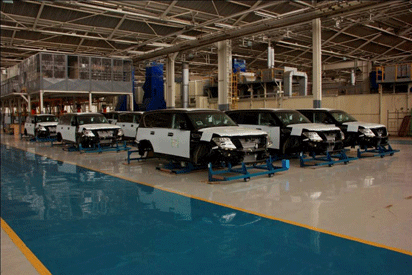
Nissan
By Dele Sobowale
“History is, indeed, little more than the register of the crimes, follies and misfortunes of mankind.” Edward Gibbon, 1734-1794. (VANGUARD BOOK OF QUOTATIONS p 92).
Edward Gibbon, perhaps the greatest historian the world has ever known left us with the great epic THE RISE AND FALL OF THE ROMAN EMPIRE. So, he is as qualified as anybody to summarise for us what history is all about. His comments about register of follies, if taken with another view of history, which says history repeats itself, will help us to understand where Nigeria stands today with respect to automobiles assembled in Nigeria.
 Last week, the Japanese car manufacturer delivered to President Jonathan the key of a NISSAN PATHFINDER assembled here in Nigeria. It was by any measure a great day in the life of the Jonathan administration. So great, one of the President’s admirers could not help sending me a text message to ask why Nigerians don’t want Jonathan to continue in office after what he called an unprecedented feat. The president’s admirer was wrong, of course. Jonathan had only re-enacted, in a small way, something which the Alhaji Shehu Shagari administration had done before and in a more ambitious way.
I certainly hope that NISSAN had done its homework well – including examining the reasons why the previous attempts to assemble automobiles, cars, buses, trucks and trailers, failed in Nigeria the first time around.
Traveling around the country today, one can still find carcasses of what were supposed to be car dealerships for PEUGEOT and VOLKSWAGEN vehicles – many of which never received a single car from Peugeot Automobile Nigeria Limited, PANL or VOLKSWAGEN OF NIGERIA, VON before closing down. Watching President Jonathan, the NISSAN representative and the Minister for Trade and Industry smiling broadly, when the key was presented, I was filled with joy and apprehension – in equal measures. We have been here before and it had all ended in failure.
HISTORY OF VEHICLE ASSEMBLY IN NIGERIA
This is not an exhaustive report, but a brief summary of our previous attempt with car assembly in Nigeria. Contrary to what the person sending the text message claimed, it was a Northern President, Alhaji Shehu Shagari, and, later Babangida, whose governments licenced companies to assemble cars (Peugeot and Volkswagen), buses (Steyr), trucks (Mercedes and Leyland) and trailers (MAN) at, Kaduna, Lagos, Bauchi, Enugu, Ibadan and Kano respectively. Steyr, the IBB era assembly, incidentally, also produced tractors.
The projects were considered viable at the time because the Shagari administration came into office in 1979 at a time when the price of crude oil was climbing to $25-8 per barrel from a modest beginning of $3-4 per barrel in 1973 – when the oil boom first started. Secondly, Nigerian workers, in the private and public sectors were still enjoying unprecedented astronomic increases, up to 1000%, in personal incomes brought about by the Udoji wards of 1976.
Demand for cars was so strong that prospective buyers had to deposit the full price of the cars with dealers five months in advance, and still pay something “on top”, as they said in those days, if they wanted to have a car. Tokunbo cars had not yet arrived in a country whose economy was “bursting at the seams” – according to a TIME MAGAZINE article. The Nigerian economy appeared to be riding a never ending escalator guaranteed to bring in more wealth over time and the rising demand for cars was expected to last almost forever.
It must be added that Nigeria, at the time we are discussing, which now seems like it never happened, was so rich the country gave loans and grants to poor African nations, provided financial support to the political struggle in South Africa and established a fund – Nigerian Fund – with $100 million, at the African Development Bank, ADB.
The nation then was a net-creditor to the world; not a debtor nation as we are today. Everything considered Nigeria was in a strong position to attract the investments in automobile assembly at the time.
Given the pent-up demand for automobiles and our strong financial base, it was easy to convince Peugeot, Volkswagen and Mercedes in particular to attempt vehicle assembly here. Government also supported the initial efforts by the plants by making Peugeot the official vehicle for governments and most transporters already favoured Mercedes trucks as an alternative to Bedford trucks.
For a while, it appeared that Nigeria had indeed entered the automobile assembly age. Vehicles were sold as they came off the line. Indeed, they could not come off the line fast enough. Profits were made initially and plans were underway to expand production. Suddenly, or so it seems now, with the benefit of hindsight, the price of crude started going down on account of a global recession caused by the high price of crude oil itself.
Nations, like Japan, and most of Europe and even Africa, were struck with imported inflation and trade imbalances – while Nigeria and the Organisation of Petroleum Exporting Countries, OPEC, were the only gainers from the trend. The first step taken by the affected countries was to devise ways of reducing their crude oil consumption and imports.
Unfortunately, since the OPEC countries were also import-dependent, they ended up importing the inflation they had induced globally. The drop in the global demand for crude, for reasons too numerous to discuss in a short article, sliced the price of crude from the high point of $28 per barrel to under $20 and the trend went gradually downwards – until it hit bottom at $9.95 per barrel.
Visit: www.delesobowale.com or Visit: www.facebook.com/biolasobowale
Disclaimer
Comments expressed here do not reflect the opinions of Vanguard newspapers or any employee thereof.