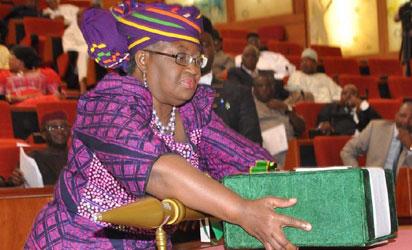
File: Okonjo-Iweala
By Dele Sobowale
“You burn the house to roast the pig. It was the only way mankind always roasted pig.” Saul Bellow. (VANGUARD BOOK OF QUOTATIONS 219)
Back in January this year, as members of the National Assembly, NASS, returned to their duties, at the Three Arms Zone, I made the point that this year’s budget would be the fifteenth to be prepared for execution by elected officials. I also predicted that we would be fortunate to have a budget signed by the President by the end of April.
Well, blessed are those who expect the worst, under circumstances such as these, because they can never be disappointed.

File photo: Okonjo-Iweala presenting the 2014 budget in Senate
It was not surprising, therefore, when the NASS, Senate and House of Representatives, after a great deal of neglect of the 2014 Budget hurriedly passed the budget before proceeding on their Easter break. They did not want to be accused of withholding the budget until May. That might be clever politics; but, it demonstrates deficit of statesmanship. Certainly, the Federal legislators know from experience, that after the amendments they have made to the budget, the President was not going to automatically sign the proposed Appropriation Bill into law.
He and his economic advisers will take a look at the proposals from the NASS to determine whether or not they can execute what had been sent to them. That will take some time; sufficient time to send the approval forward into May. From all indications, that was precisely what some of the legislators wanted. They have laid the trap that will make it possible for them to blame the President for not executing the budget 100 per cent – without acknowledging that they contributed to, or, indeed, made failure inevitable.
By contrast, for years, under the various military regimes, the military Head of State announced the following year’s budget on New Year’s Eve. I know because I undertook the budget analysis for VANGUARD from 1990 till the last one in 1999. Furthermore, a week, or so after the Head of State had spoken, the Federal Minister of Finance would provide the details, the regime of tariffs, taxes, investments, grants and financial package designed to achieve the clearly defined budget thrusts. A few days after that, the Central Bank of Nigeria, CBN, would announce the complementary monetary policies which would aim to achieve the goals stated without disrupting the exchange and interest rates regimes.
They didn’t always attain success. But, everybody was aware of what was promised for the year and there was a basis for assessment of results. Everything moved like clockwork. But, it is not only military regimes which accord annual budgets the seriousness they deserve. All the leading economies in the world, including those we have surpassed when our GDP was rebased, treat annual budgets as sacrosanct. Between the Executive and the legislative branches, the budget must be determined by a certain date or there would be strong political backlash. Not here in Nigeria.
President Yar’Adua was the only President to acknowledge that the budgets passed during his tenure of office had not been fully executed. That was in 2009; and, he promised to do better. Death, unfortunately, claimed him. So we will never know if he would have redeemed his pledge. From 2010 till now, the pattern had been the same. The Executive branch presents the budget later than the time stipulated by law. Invariably, it lands in the NASS just as the lawmakers are packing their bags for the Christmas vacation. So nothing happens until the second week in January. In the interim, a national disaster or a major scandal would have occurred – polarizing the nation and providing opportunity for hostile politics.
When NASS resumes, the budget would have been pushed off the top of the year’s agenda. The national calamity (these days it is Boko Haram) or the scandal (this year the scandals were bullet proof cars and $20-47m missing from NNPC; and two private jets) were the hot items which called for the re-order of priorities. And, it was not until they ran out of steam on those three issues that it occurred to Senate President, David Mark and Speaker, Aminu Tambuwal, that they owed the nation a duty to pass the budget. Is that anyway to manage an economy with annual GDP of $510m per annum?
Now that the buck had been passed to the President’s table, will it stop there or will he pass it back to the NASS, as he did last year and brought the country almost to a halt by refusing to sign the budget passed by the NASS? If he does, the nation might be held in suspense for another month while they sort out their differences – which are mostly politically motivated. That means the actual budget and the allocations to each sector might not be known until June. How on earth does anybody expect the budget to be fully executed by year end when the implementation does not start until July?
Meanwhile, rebasing our economy, as a result of which we now have annual GDP of $510 billion, has called into question the adequacy of our annual budgets. Countries with large GDPs generally also operate with huge expenditures for power, infrastructure, education, health, transport, security etc. Is it not possible that we have been under-budgeting for an economy so large and consequently creating a situation in which the vast majority of our people, not just the political opposition simply refuse to believe the new GDP attributed to the country?
Disclaimer
Comments expressed here do not reflect the opinions of Vanguard newspapers or any employee thereof.