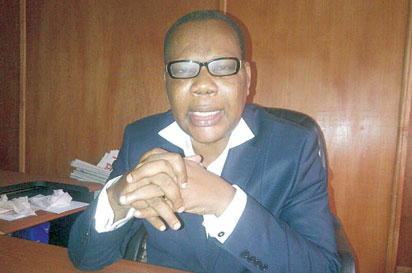
Pension & You met the president of Human Capital Providers Association of Nigeria (HuCaPan), Mr. Neye Enemigin in his office. He spoke on a number of issues in the workplace, and made suggestions on how to resolve some of the issues in dispute. This edition of Pension &You shares with readers the thoughts of an experienced human resource expert for the benefit of employees, employers, managers and other readers.
By Funmi Komolafe

DO you think that reform is necessary at this stage of implementation?
Well, I think so. The Pension Act was signed in 2004 and it became effective in 2006 and it has been operated for seven, eight years or more, so there is a need to review. If you have done anything for a while, there is the need to review — is it in line with the objectives or can we make it better? So, I think the reform is necessary.
I would like the Pension fund to be invested in housing. For example, in the United Kingdom, it is pension fund they used to build houses for workers. Why can’t we use part of this to build for workers?
I know there is National Housing Fund and other similar agencies but its not enough. There is a deficit of about 17 million in housing. It’s huge and governments aren’t doing enough. Lagos State for instance started something like that.
Shelter, health, education are key things for all human beings. If somebody worked for 35 years and has no house, it is a terrible thing. If this fund can be deployed to housing at low interest rates; about six percent, it will go a long way. I hope the states, especially in the North will be involved in the contributory pension scheme. There will be enough funds to do many things for workers.
Should the employers contribute more to the fund as suggested by some stakeholders?
Well, it would be unfair on my part to say that the employer should not contribute more, even though I think employers in Nigeria are over-burdened with too many contributions, too many levies, charges etc.
At the end of the day, they don’t focus on the business of creating wealth, providing employment which should be their primary focus. It should not be about looking for money to do this or that.
Having reviewed the Pension Act, we feel that the pool that is available is not enough to fund the retirement benefits of employees when they leave. It can be reviewed upwards and the employer can be asked to pay more so that under this Pension Act, a lot of employers no longer pay gratuity.
Why do most employers shy away from gratuity now? Should gratuity be expressly stated in the amendment to the Pension Act?
In the first place, what is the objective of gratuity? The objective is that after the person has served the employer for a given number of years, the employee should have something to fall back on retirement which is the same thing that the Pension Act is providing for so, it will look like a duplication but as an individual, I think that employers that can afford and I know a few employers still have gratutity and those who can afford it should continue to pay gratuity.
Back to pension issues, we are talking about employers contributing more. What about employees?
Well, under the amendment proposal before the National Assembly, the employee contribution is supposed to move from seven and half per cent to eight per cent while that of the employer will move from seven and half per cent to twelve per cent. So, the one for the employer is really going up.
In your view, isn’t that too high for the employer?
I think it is too high. I would suggest a maximum of nine per cent. Seven and half per cent to nine per cent is still an increase but not to twelve per cent.
Then you have sub-section 4b of the proposed Act which states that the employer can even bear the full responsibility for the pension. That, for me, is wrong and should be deleted completely. When you do that, it is no longer a contributory pension. If the employer bears 100% of the contribution, then it is no longer contributory pension. That will take us back to the non-contributory scheme that didn’t work.
A major point of the scheme is payment of the entitlements to beneficiaries and I want to focus on the payment of entitlements to beneficiaries of deceased employees.
For example, in my organization, HUCAPAN which is the umbrella body for outsourcing companies in Nigeria, there is no member company whose late employees’ dependants have been able to access the deceased’s contributions.
Deceased’s contribution
It is a serious issue. Why is this so? It is because of the conditions which states that there must be a WILL or the dependants must have a Letter of Administration. Most employees don’t have wills, especially the junior employees.
The issue is who will bear the cost of the Will? Is it the employer? These are people who are struggling to survive. They don’t have enough to pay for the will. Will they ( employees) have the time to review the Will yearly because things can change? Most of them don’t even have wills.
Letters of administration
Two, it takes a lot of effort, if not practically impossible for these workers to obtain this letter of administration. The deceased’s wives and children, we have tried it, we have gone to the courts, its so difficult, bring this money, swear to this affidavit, publication in 21 days , all sorts, they ( dependants), don’t have the money , they don’t have the knowledge and at the end of the day, the money remains with the PFA.
It’s a very serious matter. Workers who have died, their wives, children cannot collect their contributions. They are often asked where is the will that your late husband left behind, where is the letter of Administration. So, for me, it’s a very serious problem.
So, what happens, the PFAs hold on to the contributions?
Of course, that is what is happening. It is immoral but they are complying with the law. We had expected that there would be a provision that would state that the next of kin in the letter of employment or the pension form filled should be enough.
The name of the beneficiary that the employee wrote, once you can ascertain that she is the wife or the direct children, that should be enough. In companies, you look at the what the late employee has filled. That is what you use to pay. Why can’t the same thing be done? Such persons should be allowed to claim the deceased worker’s contributions. I feel very strongly about this.
Has there been a complaint to the National Pension Commission?
We have complained to the Pension Fund Administrators and they have said, well, our hands are tied. I know that Nigeria Employers Consultative Association ( NECA) made comments on its and made submissions in this respect to the Pension Reform Bill 2013. As a member of the Governing Council of NECA, I know that this was part of the submissions of NECA.
The bill is still before the National Assembly, I think before they pass the bill, they should take this aspect into consideration so that the dependants of deceased employees will be able to access the contributions.
That is the whole idea of the contributory pension scheme. What does the contribution stand for if the spouses and children of deceased employees cannot access it? Are you saying it is only when you retire at 60 that you can access it yourself? I don’t think so”.
Disclaimer
Comments expressed here do not reflect the opinions of Vanguard newspapers or any employee thereof.