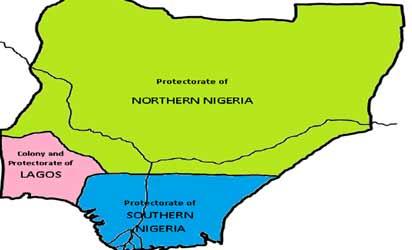
Map of Nigeria
It is happy news that the New Year 2014 has brought its freshness into an atmosphere contaminated by the foul saga of letter-writing that pervaded the last few weeks of last year, 2013.
The hope is that 100 years of amalgamation of Northern and Southern Provinces will rekindle hope in a new and stronger United States of Nigeria.At the time when arrangements are on for a useful National Dialogue and when politicians are re-sketching their plans to capture power in 2015, it is necessary to re-examine the real strategy for economic reconstruction and political stability.
The strategy is not new to readers of this column; it has been discussed several times.It may not be too late to start to sort out our priorities from the confusion of the past. First, action should be taken to strengthen the import substitution industry, so as to ensure its survival against foreign competition and also for it to be able to produce enough for home demand and for export.
The measures required are prevention of smuggling, substantial reduction or complete eradication of import duties on plants, machinery, spare parts and raw materials which cannot be produced at home.
A complimentary policy is that which will stimulate demand for the locally produced goods. Since the lower income groups are more likely to prefer these goods, it would be better to put more money in their pockets by a moderate increase in salaries and wages or substantial reductions in personal income tax and purchase tax (vat).
The other group, with high propensity to consume home goods is the old-age pensioners who need substantial increase and regularity of payment of their pensions. The third group embraces those unemployed graduates (after the National Youth Service) who need a form of income to sustain their current level of demand. They should be supported by stipends until they are employed.
The next development strategy is the orientation of the domestic industry towards foreign markets. The local beer and malt drinks, textiles, plastic goods and oil and lubricants are common in the West African region either through smuggling or under unorganized trade structures. While serious efforts are needed to provide favorable conditions for growth, stringent measures should ensure that domestic industry responds to the policy of employment generation and the demands of tax payments (as and when due).
The old giant stores of old were a sad reminder of lost opportunities through uncoordinated fiscal policy and foreign exchange management. The old giant stores disappeared because of difficulties in procurement and the cost of foreign exchange. Those stores were good avenues for employment of high, middle and lower grades of Nigerians up to the 1970s.
The promise of economic diversification is not new to Nigeria except that it has remained a mere executive theory or parliamentary jargons during annual budget sessions. A concrete policy is needed which should be faithfully executed. What is needed is strong determination by a strong leader who will reverse the trend of selling not only crude oil abroad, but also other oil-based locally manufactured products. Nigeria should be an exporter of refined products and not an importer, as it is being observed now.
In the area of economic diversification, some are suggesting the intensification of the electronics sub-sector. Because of its requirements of high technology and capital, direct foreign investment would be appropriate, necessary and rewarding. The advantage of direct foreign investment is that it releases domestic savings for other productive uses.
However, care should be taken that profits remitted home in respect of foreign investment do not quickly outstrip the annual rate of fresh capital investment as to adversely affect the balance of payments position.
As initially pointed out, the problems with Nigeria and its economy has nothing to do with suitable plans but principally, the inability to prioritize, and when the country is lucky to select some good plans, the unwillingness to pursue or operate them to successful ends becomes a major problem.
Another problem is the pernicious characteristics of every government (whether federal, state or local) to award multi-billion contracts, especially to foreign firms for road construction. Roads are left until they become death-traps, public buildings are poorly maintained and other forms of infrastructures are left decayed until the time is ripe for juicy contracts.
The Road Maintenance Authority would always award contracts for road repairs to several companies instead of directly organizing the road maintenance gangs (like the daily paid workers of old) who would look after the roads permanently and thereby, afford employment opportunity for thousands of unemployed youths who now constitute a menace on the highways.
If the Nigerian economy is to improve, it would be necessary to have full or near full capacity utilization in the industrial sector, to ensure increase in techniques and equipment (plant and machinery) to raise productivity; to have technical education, training on the job and communication in simple way and provision of simple implements to raise agricultural outputs in the rural areas.
This should be complemented by substantial investments in good roads, reliable railways, power stations and irrigation systems in the arid areas of the North.
However, rapid expansion of the economy is possible under a visionary leader who would make sure that the country‘s macro-economic policy produces overall stability.
Such a leader needs a clear perception of what it takes to have full employment, stable foreign exchange and non-volatile price movements in the economy. In the race to a modern and economically viable state, political and economic analysts have expressed some serious doubts on the suitability of the present structure of the state and local governments in the country.
Disclaimer
Comments expressed here do not reflect the opinions of Vanguard newspapers or any employee thereof.