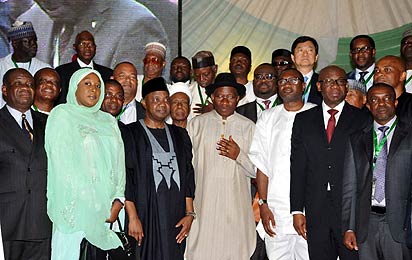
File: Jonathan, Sambo and new PHCN owners
This year marks the third in the series of an annual event christened PRACTICAL NIGERIAN CONTENT, a concept of the CWC Group of London. The oil & gas event, made its debut at Port Harcourt in 2011. The following year, it moved to Yenogoa, which has become its permanent venue. SWEETCRUDE’s Ubong Nelson requested the group, inform its readers, what prompted the promotion of the event.
Why did CWC Group create this event, 3 years ago?
CWC has been involved in the development of oil and gas events in Nigeria for over 10 years. The Practical Nigerian Content Forum event was developed 3 years ago in response to the enactment of the NOGIC Act, the ground breaking legislation that has helped to increase Nigerian participation across the Nigerian oil and gas industry.
Practical Nigerian Content focuses on addressing the challenges and sharing the successes of Nigerian Content implementation, helping to create opportunities for Nigerian companies seeking to participate in, or grow their presence in the Nigerian oil and gas industry. Practical Nigerian Content is produced by NCI, CWC’s Nigerian events production company, Levmora Services, and in partnership with the Nigerian Content Development and Monitoring Board and the Bayelsa State Government.
Are there potentials, is the local content quest train, riding progressively?
There is huge potential for Nigerian stakeholders created by the NOGIC Act. The Act demands greater participation by indigenous companies, and as a result international oil companies and service providers are seeking local partners to fulfill vital contracts, and employing greater numbers of Nigerians, rather than relying on international expertise.
We have seen some evidence of this over the last couple of years with Nigerian-made pipes being used by one IOC, a commitment by others to do the same, and international service providers subcontracting an increasing amount of work to Nigerian companies. Over 85% of contracts are now being fulfilled by Nigerian companies, which is fantastic but, there is still work that can be done to improve things further; Nigerian Content is not just about numbers but about the amount of capital that is kept within Nigeria, a Nigerian company winning a contract is one thing, but it doesn’t achieve as much if the work is then sub-contracted to a company outside Nigeria.
This happens a lot because of the weak manufacturing base at present. But we are aware the NCDMB is doing a lot to stimulate equipment components manufacturing, particularly through the establishment of oil and gas industrial parks.
It’s important to note that Nigerian Content is not a way of removing international companies from the industry, they provide vital international experience that will continue to drive the Nigerian oil and gas industry forward. Instead, these companies must be encouraged to establish operational bases in Nigeria and ensure work, such as the manufacturing of equipment, is done in country, decreasing capital flight.
Arising from No.2 above, what are the challenges presently?
There are a number of challenges that remain in achieving the targets set out by the Nigerian Content Act. Nigeria must work to develop its critical infrastructure, particularly a reliable, cost effective power supply which will enable the growth of the Nigerian manufacturing industry and thereby developing an in-country supply chain, allowing critical components to be manufactured in Nigeria and not brought in from overseas.
Human capacity is also a challenge, the number of Nigerians that must be trained in a wide range of skills is an incredible task and requires the active participation of all stakeholders, government bodies and commercial companies alike, as well as a total commitment to education at all levels. There are Nigerians with the necessary experience across the globe and the repatriation of knowledge is an important tool in increasing local content.
Another challenge is finance. The oil and gas industry is very capital intensive; companies must have access to huge amounts of funding just to enter the industry so that they can purchase necessary equipment and also to cover their operating costs – doing business in Nigeria is somewhat expensive. Gaining access to finance in Nigeria is a challenge and interest rates are sometimes high, the Nigerian Content Development Fund will go some way in helping with this problem but more needs to be done to enable small and medium sized businesses to enter into, and grow their presence in the industry. Indeed, these issues and more will be covered at the Practical Nigerian Content Forum next month.
Finally, how can we better the output, going forward?
Nigeria is moving in a very positive direction and with focus and commitment to the continued development of Nigerian Content; it will play an ever increasing role in growing not just the Nigerian oil and gas industry but other industry sectors, driving the development of commerce and industry and growing Nigeria’s economy. Forums like Practical Nigerian Content provide an excellent contribution to the development of Nigerian Content, encouraging discussion around key topics and providing a platform for industry stakeholders to meet and develop lasting business relationships.
Disclaimer
Comments expressed here do not reflect the opinions of Vanguard newspapers or any employee thereof.