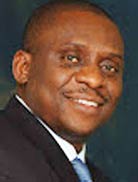
Ayo Shote
KUNLE KALEJAYE
In this interview, the Vice President and Managing Director of Baker Hughes, Mr. Ayo Shote, identified funding and technological deployment as the bane of marginal field operations in Nigeria. Excerpts:
What role do indigenous operators play in the Nigeria petroleum industry?The indigenous operators are becoming more important in Nigeria and because they inherited some of these marginal fields from International Oil Companies, IOCs. In Baker Hughes, we feel that they might not have some of the in-house expertise that they need to actually get some of these fields back to production and profitability.
So, as an oil and gas service company, we want to pass on what we know to these marginal field operators. We have different products, which we have been doing in the past, but we also offer an integrated solution to these operators.
We want a situation where we will sit down with them and they tell us what they want to achieve in a particular field and two years down the line, they will say: “this is what I want to see.” At this point, we want to work with them from the planning stage to the production stage and actualise what they want.
How important is Brownfield Rejuvenation to Marginal Field Operators?
Brownfield Rejuvenation is very important to Nigeria, it is important to them, (Marginal Field Operators) and we have at different levels the required expertise to help them actualise what they are looking for, and we want to present it to them on a single platform and that is our stated goal in this event.

Ayo Shote
Do you see yourself achieving these objectives?
It is obviously going to be difficult but, it is not impossible. There will be several obstacles. Our contracting environment in Nigeria is one, where you do not have a bundle service solution.
The world is rapidly changing, innovation is part of the world, and change is part of the world. Things would change in the future and in Baker Hughes, we believe in customer market where we will be able to show our customers that we have the technical-know-how and the ability to do these jobs.
As we engage them in discussion on a day to day basis, we will begin to build a model that they want to see. We want to have different models for different customers. The question is: Are we talking to them at that level? That is to say a situation whereby we will have different models for different customers.
Our focus now is shifting from a single product line approach to talking to our customers about Baker Hughes’ integrated solutions and the various benefits of bundled services. We are still talking to them on a single product line level not at the different model for different customers level. And there are lots of economic scales that we can achieve with when we talk to them about different products at the same time. So that is what we are looking at right now.
What challenges do you see facing Marginal field operators?
At different levels, there are different challenges, finance is one. Technology is not exactly an issue because, when you look at the oil and gas service companies in Nigeria, we have different technologies.
So if you want to talk about technologies, I will say maybe the challenge facing the marginal field operators is the inability to recognise the exact technology that they need at a specific time. A key aspect of our integrated solutions approach involves identifying and tailoring the most suitable technology to be deployed to meet a specific need.
Production is an issue. The fact that we call these fields ‘Marginal’ it means that to the IOCs the production level of these fields is marginal to them. To the IOCs, those fields are marginal when you look at their budget then, you will discover that it is not economical to them.
But, by the time you go to small operators, they want to get the oil out of the field fast so that they can start having cash flow. But how will they achieve that? Coupled with the fact that government has a law that says “when you have a field for a particular number of years, you have to grow it otherwise government will collect it back.”
That is when we come in and ask them: What do you have? What are your problems? How can we assist you? What are the things that you are lacking? This is what we have? Then we will tell them, ‘this is how much it is going to cost you. Let us sit down and talk about how it is going to happen.
In your own expectation, how do you think government could come into this?
Right now, I do not see 100 per cent how government could come, they have done enough already. I know that marginal field operators have close relationship with government and I think, at this time, government has done enough.
They have made the fields available to the operators. But government should assist them to have access to funds. They can make funds available to them by allowing more financial institutions to come into Nigeria and I think it is now left to us as service provider and Independent producing companies to sit down and discuss. Let’s discuss how we can increase production thereby increasing more revenue for government.
What is your advice for marginal field operators despite the difficulty they face?
They should keep at it. It is a difficult environment for them. I have been interacting with them and I know what their issues are and do you know what? I think there is light at the end of the tunnel. Let’s not forget that internationally, Nigeria is the focus. Different organisations in different industries are looking at the Nigeria experiment, if it is going to succeed and if it does, then I’m sure it is going to be applied in other areas.
Disclaimer
Comments expressed here do not reflect the opinions of Vanguard newspapers or any employee thereof.