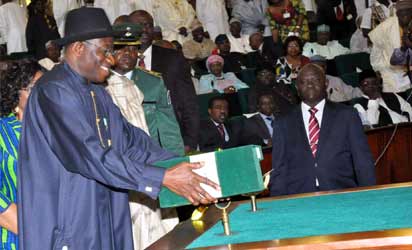
File photo: PRESIDENT GOODLUCK JONATHAN LAYING THE 2013 BUDGET PROPOSAL BEFORE THE JOINT SESSION OF THE NATIONAL ASSEMBLY IN ABUJA ON WEDNESDAY (10/10/12). STATE HOUSE PHOTO
By Babajide Komolafe, Michael Eboh, Godwin Oritse, Rosemary Onuoha & Nkiruka Nnorom
Experts have expressed concern that the budget 2013 proposed by the Federal Government would lead to tight money supply next year and thus undermine credit to the economy, job creation and growth.
On Wednesday, President Goodluck Jonathan presented a budget of N4.9 trillion for the 2013 fiscal year. This represented five per cent increase when compared to N 4.697 trillion budgeted for 2012 fiscal year.
“Inflation is likely to rise unless the Central Bank of Nigeria (CBN) maintains a tight monetary stance,” says the Ecobank Research team in a comment on the budget.
According to Razi Khan, Regional Head of Research, Africa, for Standard Chartered Bank; “The increase in spending is relatively small, only five per cent. In real terms, this, of course, means that spending does not increase. Provided this budget is actually adhered to, this should imply minimal pressure on money supply, with little need for the CBN to tighten further.
“However, what has not been disclosed is the broader plan on fuel subsidy – will it be maintained, diminished, or removed? Whatever happens on this front could also be meaningful for the inflation outlook, and therefore, for monetary policy.”
Since 2011, the CBN has increasingly tightened money supply in a bid to hold down inflation. Among other things, the apex bank increased the Monetary Policy Rate (MPR), six times from 6.0 per cent to 12 per cent; it also reduced banks’ ability to lend money by increasing the Cash Reserve Requirement (CRR) from 4.0 per cent to 12 per cent.
These measures, according to Mr. Goodie Ibru, President, Lagos Chamber of Commerce and Industry (LCCI), has made it difficult and expensive for the private sector to access credit. He said unfortunately the budget presented by the President is silent on the monetary policy implications of the N4.9 trillion.
He said; “The budget speech has no monetary policy content. It would have been useful for the President to highlight the thrust of monetary policy as this is critical to the realisation of inclusive growth and fiscal consolidation. This is even more so at a time when businesses are facing severe challenges with regard to access and cost of credit. The banking system currently has zero tolerance for risk and this is stifling private sector growth and the capacity of entrepreneurs to create jobs.
Collateral demands for loans are as high as 200 per cent. This is a negation of the objective of inclusive growth and a real threat to financial intermediation. Additionally, the government is progressively crowding out the private sector in the credit market. These are fundamental issues that need to be addressed to stimulate growth and create jobs.”
On his part, Managing Director/Chief Executive, Financial Derivative Company Limited, Mr. Bismark Rewane, said that the budget has little prospect for economic transformation. He said the spending proposed by the Federal Government is not adequate to address the problem of high unemployment confronting the nation. He said; “The budget is a tool of economic management, and you have to ask yourself what is the state of the economy?
“First and foremost, Nigeria is witnessing from 2010 till today, a slight decline in our rate of growth, from 7.1 per cent to about 6.85 per cent last quarter. The projection this year is for 6.5 per cent growth as against last year when we had seven per cent projection. Our expectations have been lowered to meet the reality of the world.
“In that case, when an economy is facing a slow down or a recession, what you do is to actually spend more; we call it counter-cyclical expenditure strategy. If you look, Nigeria is increasing its expenditure by five per cent; Ghana is increasing its expenditure by 22 per cent; South Africa by nine per cent, so this is a bit conservative. If you are facing an unemployment rate of about 23.9 per cent nationwide, you really have to be more aggressive in spending and targeting it at areas where there is a multiplier effect and linkages. One does not see that very clearly, even though it is embedded in the budget.

PRESIDENT GOODLUCK JONATHAN LAYING THE 2013 BUDGET PROPOSAL BEFORE THE JOINT SESSION OF THE NATIONAL ASSEMBLY IN ABUJA ON WEDNESDAY (10/10/12). STATE HOUSE PHOTO
“This is a budget of prudence and consolidation; but it does not address the issue of trying to use the budget as a catalyst for growth. Maintaining equilibrium between the external and internal sectors of the economy is also one of the objectives, in doing that, using the exchange rate assumption of N160 from N155 last year, assumes that there are some risks that have to be mitigated. Those risks, if the price of oil is to decline or the production of oil is to be disrupted, there is enough head room and shock absorber and cushioning in the budget to take care of those risks.
“But if you are too risk averse, you really cannot be that aggressive in stimulating growth. The fundamental problem the Nigeria economy is facing today is growth. You need to actually stimulate growth and expend a significant amount of money on infrastructure.
“The shift in terms of increase in capital expenditure relative to recurrent expenditure is good but the total amount spent is not enough to actually jumpstart the economy from a slow down at a time, by this particular period in the nation’s economy.
“We do not want anybody to go away having lofty ideas that this budget is going to transform the economy. The Federal Government is only about 45 per cent or 48 per cent of the economy, there are states’ budgets, the aggregate position is different; it is good to assume that the budget bears some of the risks, it is also prudent enough not to raise the expectation beyond what the ordinary man should face.”
The inadequacy of the budget 2013 to address unemployment was also pointed out by the Chief Executive Officer, Lambeth Trust & Investment Company, Mr. David Imafidon Adonri. He noted that since most of the security equipment are imported, the huge amount of money allocated to security might not benefit the economy in terms of job creation. “That Security takes the lion share is not surprising. Government requires huge resources to contain the emerging security challenges in the country. Unfortunately, the productive economy may not benefit directly from the huge expenditure on security since all equipment for maintenance of security is imported,” he said.
He also frowned at the silence of the President on the implementation of the 2012 budget. He said; “While presenting the 2013 national budget, the audited financial statement for 2012 ought to be simultaneously released. That will enable the public assess actual performance against budget.
“The 2013 budget does not appear expansionary and the deficit content appears to have narrowed. These are positive signals that could engender macroeconomic stability. The financial market will be a major beneficiary when indicators are positive. The benchmark for crude oil has not materially deviated from that of 2012. We hope that the global oil market will remain strong to support the targeted revenue.
“As long as fuel subsidy remains, recurrent expenditure will continue to overshadow capital expenditure. This is shameful for a nation with so much infrastructural deficit to overcome.
Director of Maxifund Investments, Mazi Okechukwu Unegbu, noted that there are a few positive developments noticeable in the 2013 budget as presented by President Goodluck Jonathan.
The first positive development, according to Unegbu, is the fact that for the first time, the budget was presented in October. “It is a positive development that the 2013 budget was presented in October 2012 against the norm where budgets were presented long into that year which it was meant for.
Another positive side to the budget, he noted, is that the government decided to recognise the importance of education by awarding that sector a rather huge budgetary allocation.
He said; “Education got a very large chunk of the budget which has never been done before. It shows that there is hope for the education of our children if implementation of the budget is pursued to the letter.”
He also commended the frank talk between the President and members of the National Assembly, saying that the move is a good omen.
He noted the effort by the government to empower women, saying this is also commendable because women are better money managers than men. “When women borrow money, they ensure that they pay back because they don’t like being in debt. It is the women that ensure that their children are sent to school. The men don’t really bother about those things.”
Unegbu, however, said that implementation is a major factor that could affect the budget. According to him, Nigeria has never recorded 75 per cent budget implementation. He said; “We have some positive developments in this budget but what we have to ensure is that implementation is carried out to the letter.”
According to Unegbu, there should be a rejuvenated intention on the part of the Federal Government to fully implement the budget if the people are to take them seriously. He said government should create the enabling environment for businesses to thrive so that employment opportunities can be created.
“For the economy to thrive, the high unemployment rate in the country must be reduced by more than 50 per cent. There should be a conscious and concise effort by government to create the enabling environment for businesses to thrive.”
Managing Director, H. J. Trust and Investment, Mr Harison Owoh, observed that the prices of crude oil fixed at $75 per barrel as against $80 per barrel proposed by the National Assembly would generate a lot of rancor between the lawmakers and Presidency.
He said that the projected growth rate of the gross domestic product, GDP, by 6.5 per cent as against 6.85 per cent projected in the previous year might not be feasible considering the increase in the level of unemployment rate, decaying infrastructure, ethical challenges and other climatic changes.
Owoh stated that the flood problem witnessed in the country this year would still have negative impact on the nation‘s economy next year.
He said that N74.26 billion allocated to power sector would be enough for the country to build more power stations, noting, however, that the major challenge was that the government would only utilise money for the maintenance of the power sector.
Owoh said that the failure of the Federal Government to use funds allocated to the power sector in the past resulted in epileptic electricity supply being experienced in the country.
Mr. Eddie Osarenkhoe, TFS Finance Limited & former President, Finance Houses Association of Nigeria (FHAN), also commended the decline in the share of recurrent expenditure, focus and efforts to encourage women entrepreneurs. He said; “I observed that there is decline in the share of the recurrent expenditure. This is good for the economy as there would be more money for capital projects.
I also observed the attempt to focus more on women, by creating a grant to encourage women in business, just like it’s been done in some developing economies. This is also good for development. However, we will have to see full details of the budget before we do profound analysis.”
Shittu Olayiwola, President, Association of Nigerian Licensed Customs Agents (ANCLA) commended the incentives given to the aviation industry but said similar incentives should be extended to the maritime industry so as to open up the waterways and enhance the Cabotage regime.
Similarly, Dr. Zeb Ikokide, President of the Freight Forwarders Institute of Nigeria, commended the incentives on the Completely Knocked Down (CKD) for the agric sector. He, however, advised that this should be well monitored so as to ensure that jobs that are internally generated are upheld.
Managing Director of Merciful International, Mr. Vincent Ikekeregu, also emphasized the need for monitoring of implementation of the incentives saying, “Whatever incentives the government is giving to improve the economy will amount to nothing if measures are not put in place to monitor and evaluate the entire project.”
Disclaimer
Comments expressed here do not reflect the opinions of Vanguard newspapers or any employee thereof.