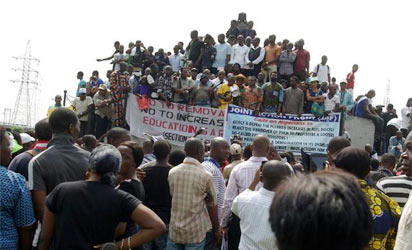
Fuel Subsidy protest
Oscarline ONWUEMENYI
ast Tuesday’s sacking of the Group Managing Director, Nigerian National Petroleum Corporation, NNPC, Mr. Austen Oniwon, and three other top management executives may be the first knell in what would likely be a sweeping reform in the nation’s oil and gas industry.
This came in the wake of reports by the House of Representative Ad hoc Committee on Fuel Subsidy management, which indicted several agencies and companies in maladministration of the fuel subsidy regime.
Federal Government, it would also appear, has finally heeded the recommendations of the Committee and calls from several activists demanding that the NNPC be overhauled, if transparency and efficiency is to be enthroned in the industry.
Asking Oniwon and three of his executives including Mr. Michael Arokodare; Mr. Philip Chukwu; and Mr. Billy Agha, former Group Executive Directors for Finance and Accounts, Refineries & Petrochemicals, and Engineering & Technology, respectively, to proceed on immediate retirement, activists say, might be a good move but it does not solve the entire problem in the industry.

Fuel Subsidy protest
In the wake of the removal of subsidy on January 1, and the resultant protests that rocked the entire country, concerned stakeholders demanded that government agencies including the NNPC be probed for illegal dealings and other corrupt activities.
The leader of the Save Nigeria Group (SNG), Mr. Tunde Bakare, led the charge accusing the Corporation of “monumental corruption.” According to him, “The subsidy probe is a golden opportunity to clean the Augean stable, which the nation’s oil and gas industry has become. The monumental corruption in NNPC stinks to high heavens. As at today, nobody in Nigeria, with the exception of a few NNPC officials, knows how much we make from the oil sector.”
Also, in a recent interview with Sweetcrude in Abuja, the former Chairman of the National Working Group of the Nigerian Extractive Industries Transparency Initiative, NEITI, Prof. Asisi Asobie, charged government not to ignore the Committee’s report, particularly critical issues such as the mismanagement of the subsidy process by officials of the NNPC.
Asobie noted that, “If you read the report you will find out that some of the things contained therein, especially the critical issue of people getting paid for not supplying petroleum products.
“Another critical issue raised by the report is that the NNPC was paying subsidy to itself, which is very irresponsible and illegal. There is no law empowering the Corporation to do so, in fact, the constitution says the opposite. So, there are critical issues that were identified by the report that are still very relevant and nobody should rubbish the entire report merely because somebody has allegedly undermined his own integrity and disappointed Nigerians.”
According to Asobie, “Government owes it as a duty to Nigerians to ensure that the several critical points highlighted by the report are taken apart and implemented diligently. Issues to do with the fiscal regime, subsidy management where people were paid huge sums for products not delivered, and the NNPC issue, these should be addressed and redressed so that people who have been found culpable will be punished accordingly. That is the only way to inspire investor confidence in the sector,” he added.
Meanwhile, a coalition of non-governmental organisations under the name, End Impunity Now, EIN Campaign, has petitioned the Economic and Financial Crimes Commission, EFCC, to prosecute Oniwon and the three members of his executive.
The group, which organised a protest rally in front of the NNPC Headquarters in Abuja, noted that given the levels of corruption that have been exposed by the Committee’s report on the subsidy management, it is simply not good enough to dismiss one or two persons and sweep the rest under the carpet.
In a statement from the coalition, signed by its spokesman, Mr. Jaye Gaskiya, and made available to our correspondent in Abuja, the group also demanded for the resignation of the Minister of Petroleum Resources, Mrs. Diezani Alison-Madueke, and the Minister of Finance and Coordinating Minister for the Economy, Mrs. Ngozi Okonjo-Iweala, over their roles in the subsidy scandal.
Disclaimer
Comments expressed here do not reflect the opinions of Vanguard newspapers or any employee thereof.