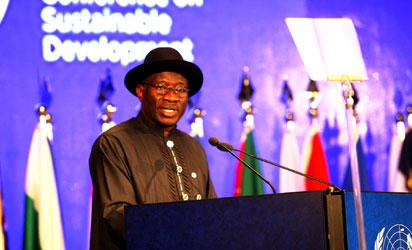
President Goodluck Jonathan addressing Rio+20 Earth Summit Thursday in Rio De Jenario, Brazil.
By Ochereome Nnanna
AS I sat down to write this article, President Goodluck Jonathan was in Brazil for the Rio+20 Earth Summit. He left on Tuesday, June 19, 2012, and presidential spokesman, Dr. Reuben Abati, issued a statement saying he would return on Friday, June 22.
This trip sparked off another barrage of criticisms from concerned Nigerians and the two most vocal opposition parties, the Action Congress of Nigeria, ACN, and the Congress for Progressive Change, CPC, which accused him of insensitivity against the background of escalating violence across northern Nigeria.
Sources indicated that the President’s entourage boasted the largest number of delegates compared with other attending countries. It reportedly consisted of 116 people, made up of 25 personal assistants, 18 aides, two members of the National Assembly, two governors, five ministers and 63 technical officers drawn mainly from the bureaucracy.
In addition, the wife of the President, Dame Patience Jonathan, who accompanied her husband, was reported to be on her way to Annapolis, Maryland, to attend the First Ladies’ “Youth Infusion” Summit organised by the United Nations Educational, Social and Cultural Organisation, UNESCO. She was said to have travelled with a 36-person delegation made up of 18 aides, four wives of governors and 14 “friends and associates”.
The source did not make it clear whether the First Lady’s delegation was part of the 116 presidential crowd or a separate group. Dr. Abati only indicated that the President was accompanied by the First Lady, the Governor of Bayelsa State, Hon. Seriake Dickson; his Katsina State counterpart, Alhaji Shehu Shema; two members of the National Assembly, Senator Benedict Ayade and Hon. Eziuche Ubani of the House of Reps. Others were: the Ministers of the Environment, Mrs Hadiza Ibrahim Mailafia; Water Resources, Mrs Sarah Reng Ochekpe; Trade and Investment, Dr Olusegun Aganga; and Niger Delta, Elder Godsday Orubebe.
Firestorm of criticisms
The firestorm of criticisms came because this “junket” was embarked upon barely two days after the terror campaign of Islamist insurgents in the north entered a new phase which all genuine patriots have hoped and prayed against. For the first time since the terror attacks started directly and specifically targeted Christians in church on Sundays, the Kaduna and Zaria bombings provoked reprisal attacks by Christian youth. This, in turn, brought irate Muslim youth who came out shooting.
The exchanges defied the 24-hour curfew imposed on Kaduna, as killings continued. Also in Damaturu, Yobe State, security officials engaged gunmen in protracted street battles that reportedly claimed the lives of 34 Islamists while two soldiers and four policemen lost their lives defending the territorial integrity of the nation. All told, the presidential foreign trip took place in a week when over 80 Nigerians (by official admission) lost their lives.
There was so much fear in the land that, perhaps, the terrorist were now getting what they bargained for: keep attacking Christian in their places of worship, provoke reprisals and counter-reprisals, divide the ranks of patriotic Christians and Muslims committed to peace and national unity and rally Muslims to their side in their demonic search for an Islamic republic within Nigeria, just as the Salafist Tuareg insurgents have succeeded in doing in Mali.
The apprehension was so pervasive that the House of Representatives decided to invite the President to a closed session of the House to explain exactly the steps he has been taking in curbing the security menace facing our country.
Many of them even expressed their readiness to give him the go-ahead to declare a full-fledged state of emergency in flashpoint states such as Borno, Yobe, Bauchi, Plateau, Kaduna and Kano. Many were confounded by the fact that this mood of the nation did not seem to permeate into the Presidency. Rather than responding to the invitation of the House, the President boarded a presidential jet with an over-bloated entourage of officials and flew out to Rio.
The Minister of Information, Mr. Labaran Maku, mounted a heated defence of the President, saying he can “rule” from any part of the world. He had said the same thing when former President Umaru Yar’Adua was dying in a Saudi Hospital, always giving the impression that the President would “soon” return to his duty post. According to Maku, the Vice President, Namadi Sambo, had been given full presidential powers to deal with any situation and that Jonathan was in touch with Sambo on an hourly basis.
I would like to examine three main issues arising from this controversy: the presidential entourage, the trip at this time and Maku’s assertion that the President can rule from any part of the world.
In the first place, it will be a welcome development if the allegation that the Nigerian delegation to the Earth Summit in Rio was the largest -116-strong – is proved to be untrue. The Presidency has a way of denying each time this sort of allegation is made. If it was true, what logic informs this continued culture of squandermania which this regime seems unwilling to give up, despite the bold promise by the President to henceforth travel light after the January riots over the removal of petrol subsidy? Is large delegation a reflection of population? If so, why did China and India not come with even more delegates? If our wealth is the criterion, why did the USA, China, Japan and Germany not go with more delegates than ours?
How far has our commitment to a greener planet gone in making us to drive down the amount of toxic gas flared in the Niger Delta? Today, Nigeria is still the second biggest gas flarer behind the world biggest gas giant, Russia. One is left to conclude that the disease of wasteful patronage for which the Jonathan administration is notorious, was at play here, even as Finance Minister and Coordinating Minister of the Economy, Dr Ngozi Okonjo-Iweala, keeps warning of a possible recession threat to the economy. This administration is simply unable to keep to its own terms of austerity measures.
Coming to the second issue, I am on the same page with those who think that the President attending the Rio Summit was imprudent. As I noted above, the new stage of the terror attacks is the most dangerous so far. The ability of Boko Haram to push Christians to the extreme measure of embarking on reprisal attacks, thus prompting counter reprisals from their Muslim opposites gives everybody reason to fear. The President should have stayed home to take charge of measures to prevent an escalation. He should have sent his Vice President or even Minister of the Environment to read his address in Rio, with a token delegation. The First Lady should have cancelled her attendance of the Maryland carnival, or asked the Nigerian Embassy in the US to fill in for her.
The new stage of insecurity is capable of precipitating military intervention, especially in the face of perceived insensitivity on the part of the nation’s number one citizen, if care is not taken. Similar perceived insensitivity by the Alhaji Tafawa Balewa regime in January 1966 when he hosted a Commonwealth ministers’ summit in Lagos while the Western Region was engulfed in the “Operation wetie” strife triggered the first military coup. The coup plotters, who had been conspiring for six months, got infuriated and struck.
People who read history allow it to teach them useful lesson. Those who do not read history, if they are wise, allow those who read to teach them the useful lesson. Emperor Nero Claudius Caesar Augustus Germanicus was fabled to have mounted a stage play the fiddle and sing a song entitled: “The Sack of Ilium” while a mystery fire was destroying three of Rome’s districts and severely damaged seven more. He came down from the stage and lost his kingdom – and his life.
National security
In nearby Mali, the armed forces led by Captain Ahmadu Sanogo, only in March this year, returned from the war front to remove President Toumani Tuore from power for failing to provide the armed forces with the requirements to defend Mali. When the army sense that the civilian regime is no longer able to control threats to national security they often get tempted to seize power, particularly if a president is frivolously away in the face of such threats.
Maku’s contention that the President can rule from any part of the world is simply idiotic. Of course he can! But when a president leaves his country in a moment of disaster, mourning or severe security threat it smacks of abandonment. It says he does not care for the plights of families whose loved ones have been slain or maimed by enemies of the state; those the president was elected (and swore) to protect. A responsible father would not leave his house to attend a town union meeting when two of his children are fighting with knives, on the ground that the mother is available and he can always call home by phone!
Government’s number one duty is to protect the lives and property of citizens and preserve the nation. When these are threatened, everything waits. It is only this kind of threat that forces a president to ask for emergency powers, suspending democratic niceties temporarily. Jonathan must not compound his perceived “weakness” with additional perception of “insensitivity”!
Disclaimer
Comments expressed here do not reflect the opinions of Vanguard newspapers or any employee thereof.