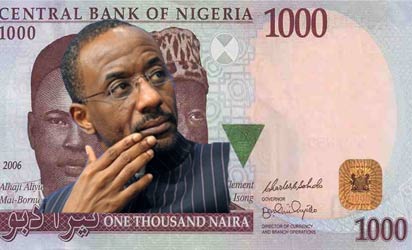
CBN Governor, Sanusi
By Adisa Adeleye
AT this moment when the topic of ‘corruption‘ is on the lips of many Nigerians, it will be unethical for the columnists of widely read newspapers not to add a thought, however negative, to the topic of the day. The word corruption, is not new to Nigerians because it is a part of their culture and getting rich by immoral means or sourcing money by all means is an accepted norm in the country‘s daily existence.
If some people refuse to comment on corruption, it is not that they support graft but because taking bribe or demanding bribe has become an accepted way of life. It has become a case of taking the normal food or perhaps, going hungry. Thus, corruption has become a normal diet for the survival of human body in this country. Perhaps for economic exercise, and not rational thinking, it could be argued that corruption is a baby of inflation and also, a defence against inflation.
If it is assumed that any income above a legitimate earning is a form of corruption, then it stands to reason that any income channeled towards the filling of a depleted income is normal. If inflation is regarded as a process of rising prices that leaves a stated amount of money at a given time, buying less quantity of goods during a period, it stands to rational thinking that people would like to maintain their status quo by getting additional income to offset the increase in prices.
It could be argued that in order to maintain the pattern of expenditure and its level, some people would dip into their savings or would resort to borrowing. Where these options are not available, the logical step would be to extract the necessary funds from any source.
In an inflationary situation, workers in a strong trade union organization could fight back to defend their level of expenditure or standard of living by successful agitation to increase their wages, which producers are ready to pay from their increasing profits.
Thus, if inflation is not properly controlled and it develops into hyper-inflation, the economic structure of the country becomes weakened and the dependability of the country‘s currency becomes suspect. A country whose economy is prone to inflationary tendencies would probably harbour more corrupt officials and workers whose incomes need addition to maintain their standard of living or level of expenditure.
As an excursion into theoretical exercise, inflation and increase in corruption in this country could be attributed to the effect of the Structural Adjustment Policy (SAP) of the former Military President, General Ibrahim Babangida. Like the armored tank officer he was in the army, the former President led a frontal attack on the national currency, the naira, and it has never been the same till today. The era of devaluation started from about N8 to $1 to the present position of about N158 to $1.
As I have noted before, Devaluation (lowering the value) of the Naira has been rated as one of the main factors affecting the competitiveness of Nigerian products at home and abroad. Nigeria, being an import dependent country has to pay more for its raw materials, spare parts and machinery. The high cost of imported inputs added to increasing local cost of productions (because of poor infrastructure) tend to affect upwards, the prices of locally produced goods.
In Nigeria, it looks as if devaluation has followed a different pattern of rational economic course. First, the policy of devaluation hinges on the widely held perception that our currency was grossly overvalued and has led to subsidy on undesirable imports. Secondly, devaluation has become a good measure of increasing government revenue instead of import license or tax. Under this pretext any argument against devaluation, even if specious, becomes merely academic.
The present nature or structure of the nation‘s industry is such that devaluation is adding to the cost of production through the rising cost of imported inputs and local materials which have alternative uses. The implication is that home produced goods cost more than their imported counterparts, a situation which affects the demand for such products in the home and foreign markets.
It might be necessary to remind our policy makers that a policy of devaluation in an undeveloped economy would tend to cause inflation, lower capacity utilization in the few existing manufacturing plants and ultimately, lead to widespread unemployment in the industrial sector, and create general poverty.
In a country where the cost of basic commodity of life is ever rising (Inflation), where distribution pattern of available goods is inefficient, the prospect of deep corruption to make ends meet cannot be completely eliminated from the system, and in a situation where imported commodities are beyond the reach of many Nigerians, the resort to corrupt practices to be able to enjoy good things of life may be a welcome preposition.
What I have been trying to do in this article is to prove the direct connection between devaluation which is making the cost of imported essential and luxury goods prohibitive and which has an indirect negative impact on domestically produced commodities, as a major cause of corruption. It stands to reason that a sincere attack or remedy against corruption should have a direct impact on the root cause of corruption.
It would be necessary to examine other methods of stimulating the economy without stifling or retarding the industrial expansion and employment. It should be realized that some highly industrialized countries, especially Japan became great without being self sufficient in raw materials. They developed on thriving export of manufactured goods in a competitive world market.
There should be an atmosphere where it is possible to bring in capital equipment, spare parts and essential raw materials cheaply under a system of favourable exchange rates. To support domestic manufacturing industry in such a situation, frivolous demands (as exist today) for foreign exchange should be curbed.
The implication is that the industrial sector would be favored, agricultural sector would be encouraged and new entrepreneurship would emerge under a policy of easy borrowing and infrastructural development. My view is that Democracy in a country so naturally endowed like Nigeria should mean Prosperity and not abject poverty. This is the task for the executive and the legislature.
Fortunately, most of them are well paid. Massive investment in real economic infrastructures would increase national income, stimulate effective demands for goods and ensure industrial expansion and general prosperity. In such an environment, corruption would be minimized, if not totally eliminated. Sms only 07059197616
Disclaimer
Comments expressed here do not reflect the opinions of Vanguard newspapers or any employee thereof.