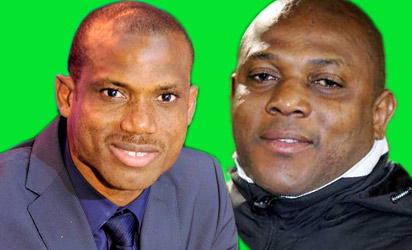
Oliseh and Keshi
Nigerians have almost stopped bemoaning the crises that have bedevilled their football, but what is numbing is the cascading from its Olympian heights in a free for all fashion – on the pitch, on the board, and in rankings by FIFA. It is this free fall that has left most pundits and global admirers dazed on what has become the lots of Nigerian football.
The feeling of being a Nigerian in a foreign land no longer conjures or evokes the admiration it once did, when every national in any dilemma anywhere around the world, proudly claimed to be either Rashidi Yekini’s or Jay-Jay Okocha’s brother, and got away from the situation.
Such identity served as a launch-pad to instant freedom and possible fame however temporary. Ask the Tunisians, the Americans, the Brazilians, or even the Argentines, they will all be unanimous in their verdict that Nigerian football was once a major threat to their global dominance.
That was when dedicated and committed professionals and technocrats with the interest of the nation at heart were in charge. The only thing that mattered then was the nation, Nigeria in spite of the fact that we were politically a pariah nation owing to the upheaval that attended the inconclusive June 12, 1993 presidential election. In those desperate times, Nigeria used football to burnish its foreign diplomacy as nations secretly courted our football out of sheer admiration while loathing the political actors.

*Oliseh and Keshi
In quick successions, the Super Eagles won the Africa Cup of Nations in far away Tunisia in 1994; had a scintillating performance at the World Cup hosted by the United States of America the same year and also voted one of the most entertaining teams in the world.
In the 1996 Atlanta Olympic Games, the Dream Team won gold medal in football. The feat announced the arrival of Nigeria to a global audience and made her a worthy representative of the African continent at soccer events. The magical soccer artistry, determination and discipline exhibited by our wards and their handlers led by Clemens Westerhof and Bonfere Jo made them household names across the world.
Then, every African became a Nigerian and accolades came in droves even from unexpected quarters just as our players gained bountifully from their new super star status, attracting big clubs from far and near. Most Football analysts from all over the world, China, Brazil, England, America, Turkey, South Africa etc made the nation’s football house a Mecca of some sort, as they flocked in to key into the miracle that had become Nigeria’s football. It was also then that pictures of our players adorned covers of soccer magazines globally, just as they were subtly understudying how we made progress overnight almost unnoticed and without a warning.
Those were the days of Air Commodore Samson Emeka Omeruah, who is now late. His board was an assemblage of determined Nigerians who were ever ready to sacrifice their all in order to place Nigeria in its rightful place in the comity of soccer playing nations.
Their activities were fully complemented with an energetic secretariat of sound technocrats led by Alhaji Sani Ahmed Toro, who was the chief executive officer. With his team of dedicated officials who were out to serve the nation, no minute of the day was ever wasted just as anyone who was called up at any time for an urgent assignment, either within or outside the nation, never hesitated.
Those were also the days Decree 101 held sway as the enabling law; under it, the power to administer our football domiciled with the chief executive officer (the secretary general), who was equally the go-between the government and the board.
Although, there were little crises of interests here and there, but it pales into insignificance when compared with the multifarious litigations littering our courtrooms. It is now easier to seek interpretation of the courts over minor issues that would have been resolved in the boardroom through administrative proceedings.
Then, top teams were prepared to shell out any amount of money to have the Super Eagles as guests any day and the stadia earmarked for such events where certainly guaranteed full capacity. No wonder, most FIFA licensed agents swooned on the Super Eagles.
These are like fairy tales now; we have dropped from one of the best 10 to the miserable 57th in the world and could not qualify to play at the 2012 Africa Cup of Nations, won by Zambia, a team that envied us just some years ago.
We now have to sweat and resort to fasting and prayer to confront ‘little’ nations like Lesotho, Rwanda, Guinea, Ethiopia, Niger, Chad etc. We no longer get mentioned when modern African football giants are counted.
The natural question on every lip is, how did we get it wrong? Considering the large population of youths in Nigeria, does it mean that we can’t get eleven talented players to wear the jersey of Nigeria and put up a winning performance?
Has corruption, nepotism and avarice equally eaten deep into the fabric of the nation’s football administration? These are all questions begging for answers. There are other assumptions running riots in the hearts of most followers of the game in the country such as, could it be that since fame and soccer-dollars invaded our football, players are no longer committed; could it be that national team coaches now favour their cronies with call-ups with the intention of getting kickbacks.
Is it now a case of what I can get rather than what I can give? But the point remains that there is a board that should supervise their activities or does the same scourge affect them too? Until all issues that have fuelled our consistent decline are critically analysed and credible solutions proffered, the nation may continue to wallow in the wilderness.
However, one issue that has stood out like a sore thumb is the selfish alteration of the enabling law, (Decree 101 of 2004 as amended) and its replacement with a Statute without following the due process. This arose out of the selfish quest to manage the nation’s football and resources that go with it at all cost, thus, infusing all manner of superlatives to further confuse gullible Nigerians to always fear and believe that FIFA will likely ban the nation if they are resisted.
By alteration of the enabling law, (Decree 101 of 2004 as amended), soccer-loving Nigerians were told that FIFA no longer deals with “Associations” but “Federations”, hence the drive to assume the toga of Nigeria Football Federation, forgetting that the world is a global village.
Nigerians however forgot to ask the proponents of the change what happened to South Africa Football Association, SAFA that copied their law and administrative pattern from Nigeria when they joined the continental body in the early 90s.
The pain is that most nations that wove the tenets of their administration from Nigeria are now operating poles ahead, while ours remains a huge joke.
The unimpeachable truth about the doctoring of the enabling law was just to encourage power grab, and enthrone a system where there will be no accountability to anyone in particular – false-autonomy. Government funds sports one hundred percent, yet the arrowheads wanted less of government in the overall administration of the game, thereby creating a cult that will continue to promote and perpetrate illegality.
Rather than the position of the chief executive officer residing with office of the secretary general, the office of the chairman which ordinarily should have been on a part-time basis now assumes the position of a full-time chief executive. This has not only negated the vision of the founding fathers of our football, but has also scared away sponsorship of the game and the philanthropy it once enjoyed.
Also, instead of attracting large hearts of the game to head the board, it is rather attracting people who feed on the game. Ask Alhaji Yusuf Ali, former Managing Director of Unipetrol, late Chief Nathaniel Idowu, philanthropist par excellence, Mr Anonymous in Lagos, otherwise known as Sola and a host of others who spent their money in the 90s but did not want public recognition.
The problem today is that we have too many hungry and greedy people that are desperate to feed from the game; they see their coming on the board an entrance into an exclusive club rather than the all-inclusive Nigerian project. Out of desperation they have closed the democratic space in order to shut out others from a touch at the national cake. The unending litigations crippling our football speak volume of the unseen motif.
•Mr. Mgbolu, a former image maker of the NFA wrote in from Abuja.
•To be continued
Disclaimer
Comments expressed here do not reflect the opinions of Vanguard newspapers or any employee thereof.