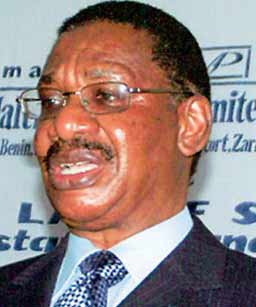
Itse Sagay
By BARTHOLOMEW MADUKWE
Professor Itsejuwa Esanjumi Sagay (SAN) is a notable constitutional lawyer and a pro-democracy activist. He studied law at the then University of Ife (now Obafemi Awolowo University) and graduated in 1965.
As the best student in his LL.B exams, Prof Sagay was awarded national scholarship to Cambridge University. In 1970, he returned to Nigeria with a Ph.D in International Law of the University, and picked up a teaching appointment at his alma mata.
Between 1982 and 1996, Prof Sagay taught at the University of Benin. He became a Professor of Law in 1979 and was conferred with the rank of Senior Advocate of Nigeria in 1998. An author of several books, Prof Sagay is an authority on constitutional matters. In this interview, he spoke on the renewed calls for Sovereign National Confference, Constitution amendment and the Supreme Court judgment on tenure elongation, especially as it affects Kogi state. Excerpts.
Against the backdrop of persistent calls for convocation of a Sovereign National Conference, the National Assembly has said that it remains the only platform on which National Conference can be discussed, and not the move by some prominent Nigerians towards the same purpose, saying the country does need such conference. What is your take on this?
I think those calling for National Conference are legally and politically right and justified. The National Assembly is wrong, because the National Assembly is established to make laws for this country. And also, when necessary, to participate in the amendment of the constitution. I say participate because all the 36 states Houses of Assembly are also involved in it, as far as the constitution is concern.
What those calling for a National Conference are saying is that a totally new constitution should be established based on a dialogue of all the nationalities in this country, at which they will iron out a total new basis for co-existence. So, the process is a fundamental political process that goes beyond amendment of an existing constitution, which in fact is being abandoned.
What do you think may have been the argument that might have given birth to this clarion calls for a Sovereign National Conference?

Itse Sagay
What those who argue for a Sovereign National Conference are saying is that this constitution is a military constitution, which was made by decree 34 of 1999. What they are also saying is that nobody was consulted by the military, just a few selected people got together and then the military took whatever it is they had recommended, put the finishing touches and issued it and falsely proclaimed that it was a decision made by some Nigerians for Nigerians. That is false, it is a unitary constitution.
How do you react to the move by some prominent Nigerians towards the conveyance of a sovereign national conference?
What we have now is a unitary constitution passed in federal tones, and that is what those calling for Sovereign National Conference want to correct. What they want to do is to meet, discuss and establish a new constitution which will recognize the federal and multi-national character of Nigeria. It will be based on an agreement by them, validated by referendum and will therefore be a true reflection on the basis by which Nigerians want to co-exist, that is it.
Don’t you think the Sovereign National Conference is connected to many undertones, which may include amending the constitution at a time the country have issues of insecurity to battle with?
Those calling for a National Conference are not even talking of amending the constitution, they are talking of wholesale jettison, going from aboard and starting from the scratch to establish a new thing. I do not see how a security situation has to do with a group of people meeting to fashion out a new basis of co-existence.
Infact, it will enhance security in the sense that those who are agitating and creating insecurity, because they feel that there cultural and political interest are being sub-shield in a unitary government need a voice, which will enable them to have some autonomy, so that they can operate with some freedom without a constrained and the suffocating presence of this unitary constitution.
And how would it enhance security in the country?
It will enhance security because everybody will be freer and there will be autonomy in every national and every ethnic nationality and there will be better resources for the federating units. And the centre would be a weaker place and nobody will feel oppressed by the centre, which is the case now.
In fact, the way I see it, the National Assembly is absolutely insincere because all they are thinking of is their four years tenure which they think will be disturbed by a rival body, that is not true at all. And that is not going to be a rival body, but they think it will be a rival body.
So their total control of federal power and their capacity to share our resources among themselves, they feel, will be disturbed. So, because of their narrow selfish interest of two or three years, they are ready to sacrifice the future of this country. It is as simple as that.
Let us look at the Kogi state issue within the context of the Supreme Court judgment; the Federal High Court in Abuja has declined to order the removal of Capt Idris Wada as governor of the state. What is your position on that?
Well, the Kogi state issue is a complicated issue. I don’t want to be very definite on it until I see all the court processes. My original reaction is that everything done, and I still say that because that is still the law, everything done before judgment of the 27th of January is validated because the effect of a judgment nullifying election or nullifying elongation, the effect is from the date of that judgment, it is not retroactive. Therefore, anything done before then is validated.
And on that basis, my feeling was that the position of any person elected or nominated and validated, the person could take office or contest, depending on whether the person is nominated or elected. If he is elected, the person can take up office immediately.
If the person is nominated to contest, he will represent his party in an election that is to be held soon after. That is the position I see as the position of law. But I don’t want to be too categorical, I want to see the decision of the Supreme Court. I want to see what the Supreme court said, I have not read it yet.
Disclaimer
Comments expressed here do not reflect the opinions of Vanguard newspapers or any employee thereof.