By Ochereome Nnanna
WHEN a friend contacted me to join a few other columnists in Abuja for an encounter with Governor Kashim Shettima of Borno State, I saw it as a real opportunity to get behind the iron curtain of the politics of far North East Nigeria, core theatre of the Boko Haram Islamist insurgency.
Beyond what you and I read in the newspapers, not much else is known by me about the socio-political conditions that could produce people so aggrieved that they go on a killing spree.
Murdering both strangers and their own kinsmen, targeting both Christians and their fellow Muslims, grounding the economy of their home states and making demands that could only come from deranged minds – such as asking President Goodluck Jonathan to convert to Islam as their condition for peace, as well as fighting to enthrone an Islamic system in which Western Education will be outlawed!
The last time I visited Borno and Yobe States was twenty one years ago. I was there as a young reporter to cover military President Ibrahim Babangida’s rather comprehensive official visit during which he toured virtually every major settlement.
It was a bird’s-eye view of a visit, not enough to let me into the reason why so many questions are waiting and no answers seem forthcoming. For instance, the ancient Kanem-Bornu Empire of about ten centuries ago had the singular privilege of establishing the first university in this part of Africa (though it was an Islamic university). The first university (also an Islamic one) in West Africa was established in Timbuktu during the Old Mali Empire ahead of Kanem-Borno.
Poorest socio-economic zone
But today, the entire North East Zone is the poorest socio-economically and the most bedevilled with illiteracy than the rest of the country. I wanted to listen to the man suffering from the direct pinch of the Boko Haram shoes he is forced to wear as the governor of Borno living in the lion’s den, Maiduguri.
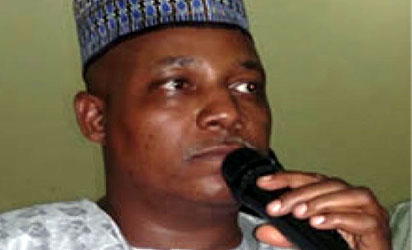
Shettima turned out to be a very brilliant, easygoing, friendly and witty young man. He became the candidate of the All Nigerian People’s Party (ANPP) when Nmodu Fanami Gubio, the candidate earlier imposed by the outgoing Governor Nmodu Sheriff (Gubio was actually his younger brother) was gunned to death by Boko Haram.
When Shettima addressed the gathering he chose to stand up, saying jokingly that he was “intimidated” by the newspaper tigers that surrounded him. His surmise of the causative factors of the Boko Haram insurgency – and others before it such as the Maitatsine riots of 1980, was that over a period of thirty years the ruling establishment abandoned the common people.
Graudllay, the poorest of the poor from Maiduguri and all corners of the Muslim North (and even neighbouring countries) found themselves living in certain slums of the town. Nobody bothered about their education and health, and nobody cared how they made their living. Even the few that were able to acquire some Western education increasingly failed to get jobs or decent means of livelihood.
This was the ready-made situation that the late leader of Boko Haram Islamic sect, Mohammed Yusuf, capitalised on. He started organising the youth, procuring motorcycles for them for their transport business, helping them set up small businesses, assisting them to get married at little cost and generally creating what one of the journalists in the gathering correctly described as “an alternative society”.
At the same time he fed them with radical Islamic messages. Apparently, the group became convinced that the current ruling class would never on their own turn a new leaf for the better.
Trap of destitution
They started dreaming of setting up an Islamic system based on strict Shariah and the exclusion of Western education as the panacea for escaping the trap of destitution. They started putting up belligerent attitudes to issues of law and order and when the law enforcement agencies went after them they fought back. And when their leader was arrested and killed in police custody they regrouped with local and foreign assistance and transformed into the cancer that now troubles the nation.
Shettima said all he needs is to be given an opportunity to prove that leadership under our constitutional democracy can be humane and people-oriented. He disclosed that his predecessor, former Governor Sheriff, left the sum of N52 billion for him to start work with.
He is determined to add another N20 billion to that amount and start an ambitious job creation scheme which, he hopes, will persuade majority of the sect’s adherents to abandon their quixotic quest and return to normal life. He intends to pump much of the funds into massive agricultural schemes focusing on the farm settlement system to transform his state into a major agricultural hotbed of the nation.
The governor expressed optimism that many operatives of the Boko Haram sect are tired of their murderous venture and would like to drop their weapons but for the factvthat they are afraid of their so-called commanders. This, according to him, is why he thinks the use of dialogue (and not just army operations) could help.
There are those who do not believe, however, that the Boko Haram challenge is as simple as this. The Al Qaeda connection, which links Boko Haram to the worldwide network of Islamists seeking to create a new Islamic world order (a factor that makes them seem implacable and when they speak they talk in unrealistic terms) is something Governor Shettima’s package does not seem to take along. Would Boko Haram even allow him to work to attract their members back to society?
Some of us still believe that Boko Haram’s backbone must be broken with military force first. We can dialogue with them only after defeating them militarily. We must not allow miscreants and anarchists to go away with the impression that Nigeria can be threatened at will and Nigerians can be killed and displaced while the lawbreakers escape with a tap on the wrist.
After the big stick, the carrot can follow but only for the genuinely penitent ones. The dialogue that will follow will be about rehabilitation, reconstruction and reconciliation.
Reconstruction and rehabilitation
That way, no ethnic or religious bigot high on hashish will just get up and start killing people. They will be deterred by the fate which Maitatsine and Boko Haram suffered.
“Nnanna, you’re on your own!”
During the question and answer session, I told Governor Kashim Shettima my view that former Governor Sheriff was one of the problems that led to the rise of Boko Haram. He even made one of their financiers his Commissioner for Religious Affairs before they fell out.
He spoke like a religious and ethnic bigot. He (just like other politicians from other parts of the country) armed the youth and use them for his political ends. Their killing of his brother who he picked to succeed him, to me, was just another case of a Frankenstein Monster turning on its master.
The governor, when he addressed the issue, surprised me with his answer. He described Sheriff as a “great” leader. In fact, he went as far as likening his exploits to the achievements of Dr. Michael Okpara in former Eastern Region and Chief Obafemi Awolowo in the former Western Region! As he said this, all his officials nodded in unison. Even after the event, I still nosed around to know what developmental programmes Sheriff brought to his people that accounts for such a bombastic comparison.
Awo governed the richest of the three regions and scored so many firsts, including the award of free education to his people. Okpara ran the most qualitative educational system and by 1964 took the Eastern Region economy from the poorest to rank as the fastest industrialising economy in the Third World.
Many will tell you that effective development stopped in the West and East when Awo and Okpara and their political movements were no longer in charge.
But in the case of Sheriff, he governed his people for eight years only to step down and be forced to go on his knees and beg the militants his regime brought to haunt his people and Nigerians at large.
Northern journalists
After the meeting, one of Northern journalists jokingly said to me:
“Ah, Nnanna, you are on your own o!” (for calling Sheriff a failed leader).
Another columnist from the North put in:
“It was a good thing that he (Nnanna) spoke his mind”.
And another added:
“It was also good the way the governor answered”.
Sheriff’s strongest point was that he was a genuine grassroots politician who could travel any distance by road to keep a political appointment. It is not easy for a predecessor to be well spoken of by his successors. His successor said he left N52 billion in till, while in most cases the story you hear is that the predecessor left huge debts and salary/pension arrears. Nothing else to indicated that he added value to governance and uplifted the standard of living among his people.
I went away with the impression that Governor Shettima did not want to speak ill of the man who obviously helped put him where he is today.Though he praises Sheriff to high heavens and dresses him with a “giant’s robe upon a dwarfish thief” as Shakespeare would say in Macbeth he does not sound like a man who will travel the road taken by Nmodu Sheriff.
Disclaimer
Comments expressed here do not reflect the opinions of Vanguard newspapers or any employee thereof.