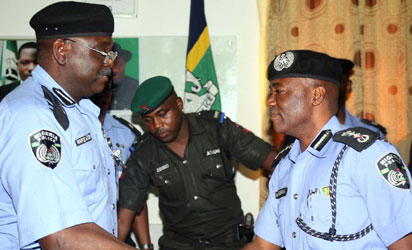
HAND OVER— Former Inspector General of Police, Hafiz Ringim (left) with his successor, Mohammed Dikko Abubakar during the handing over ceremony at the Force Headquarters, Abuja yesterday. Photo: Gbemiga Olamikan.
Intrigues that nailed former IGP
By John Bulus
For the Nigerian Police Force, an era has ended just as another begins. The sack of Mr. Hafiz Ringim, the former Inspector General of Police, IGP, last Wednesday by President Goodluck Jonathan marked the end of a journey that began in September 2010.
Taking over the office from Ogbonna Onovo, Ringim’s tenure was characterized by events that endangered national security, virulently threatening not only the peace but also the cohesive existence of the country. There were the post- elections crises that swept across the northern region of the country which snuffed lives out of many citizens, including several corps members.
Then came the mother of all attacks against the Nigerian state, the governments and her citizens by the dreaded Islamic sect, Boko Haram.

HAND OVER— Former Inspector General of Police, Hafiz Ringim (left) with his successor, Mohammed Dikko Abubakar during the handing over ceremony at the Force Headquarters, Abuja yesterday. Photo: Gbemiga Olamikan.
The sect has killed, maimed, bombed, destroyed and caused untold hardship to the people. In all their clandestine activities, the police have shown inefficiency, sometimes, complacency in the midst of terror. Consequently, its leadership has been accused of connivance with the sect against the government.
Perhaps, the last straw that broke the camel’s back was the controversial escape of Boko Haram’s kingpin, gun runner and mastermind of Christmas Day bombing of St. Theresa’s Catholic Church in Madalla, Niger State, Kabiru Umar alias Sokoto in the hands of a police team under the watch of both Zaraki Biu, a Commissioner of Police and the ex_IGP himself, Ringim on their way to the suspect’s house at Abaji, a suburb of Abuja, the nation’s capital for a search.
While Biu was confined under House arrest for such high negligence, Ringim was threatened by the Federal Government to produce Sokoto within 24 hours or risk a sack. Till today, Sokoto is still at large. So, the federal Government made good its threat and fired Ringim. With this, what would have become 35 years of a meritorious service of an intelligent cop came to an abrupt end. Ringim who would have been due for retirement in March, 2012 was unceremoniously relieved of his duty last Wednesday.
Cautious welcome for new IGP
Meanwhile, that Mr. Mohammed Dikko Abubarkar has since assumed office as the new police helmsman is not news. What may be news to most people is that some persons have refused to be drawn into the euphoria that greeted his appointment by the President. As far as some people are concerned, Abubarkar has a case to answer. He is said to lacks the moral standing to continue being in service as a cop much less deserving an appointment to the exalted and sensitive office of the Inspector General of Police. This is heavily premised on the reports submitted by a committee set up by Plateau state government in 2001 headed by a respectable jurist, retired Justice Nikki Tobi to investigate Jos killings.
The Committee found Abubakar who was the then Commissioner of Police in the State, culpable. It was said that he aided and abated the killings of most Christians by their Muslim brothers in the state and as result should be sacked.
The report reads in parts: “Religious fanatics should not be posted to head state police commands. The commission recommends that for his ignoble role during the September 2001 crises, which resulted in the loss of lives, the former Commissioner of Police, Plateau State Command, Alhaji M.D. Abubakar, be advised to retire from the Nigeria Police Force and in the event of his refusal to do so, he should be dismissed from the service. The government should forward the recommendation to the Police Service Commission for consideration and necessary action.”
In the same line of thought, some other indigenes of the state which included a member of the House of Representatives from Jos-South/Jos-East constituency, Honourable Bitrus Kaze expressed his regrets: “It is amazing to me that at a time when Nigeria is witnessing a spate of terrorism, a man who has been indicted by the Justice Nikki Tobi Commission of Inquiry into the September 2001 crises in Jos, and recommended for dismissal from the police force by the commission, is the one found fit to lead the Nigerian Police. It is disheartening that those who have mentored terrorism in Nigeria are being asked to lead the police against the same terrorism. I cannot imagine it; I am shocked beyond words.”
Also, the Special Assistant to Governor David Jang, Mr. Clinton Garuba, faulted the appointment of Abubarkar, picking holes on his moral consciousness, adding that persons with suspicions hanging on their neck at this auspicious time of the nation should not be entrusted with sensitive positions such as the IGP.
He said: “At a time when the President himself has acknowledged that the Boko Haram sect has infiltrated his government, it is only logical that he appoints someone with a proven integrity and track record of performance to head the Nigerian Police, which is in a seeming position of helplessness due to bad leadership. We therefore call on the Senate, in the interest of Nigerians, not to confirm his appointment.”
Indeed, in the face of the contemporary security situation in the country in the northern region, it could be said that Abubakar’s appoinment is surprising as his last command, Zone 12 Bauchi, made of Yobe, Borno and Buachi states has been the most troubled spot. But some sources say that his appointment might be strategic.
Though Abubakar’s appointment has met with some condemnations, there are also others who say it means well for the nation. They hail the federal government for removing Ringim.
A fiery lawyer and human right activist, Mr. Femi Falana, in a statement said, “In spite of intensive pressure mounted on the presidency to retain Mr. Hafiz Ringim as the IGP, the Federal Government has eventually removed him from office in the national interest. The government deserves commendation for plucking up the courage to sack the police boss. The ex_IGP should however be made to account for the two leading Boko Haram suspects who escaped or were released by him and Mr. Zakari Biu.”
Falana further said: “The new IGP should see his appointment as a challenge to redeem the battered image of the police. Check points that have become extortion centres should be dismantled as beggars in police uniform on the highways are prone to compromise national security. The Nigeria Police Force should be repositioned to combat the menace of terrorism, armed robbery and other violent crimes. To do this effectively, Abubakar will have to restore the confidence of the Nigerian people in the police.”
Alhaji Yerima Shetima, National President of Arewa Youth Consultative Forum (AYCF) said, “The sack of Ringim is a welcome development. It is what Jonathan should have done earlier before now. It was obvious that the man he had at the helms of affairs in security was loose, never in charge of the network. It is either he was loose or was sabotaging the government, because he had a case where two prime suspects on a case bothering on the Nigerian security were found and they escaped under his nose. I am of the view that Jonathan would dismiss him and bring him to book so he will be dealt with decisively so that others will learn.”
On the new IGP, he said, “He is somebody I know vey well; I knew he is very good and dedicated to the job. He is a committed officer who knows Nigeria very much having served at various places in the country, where he didn’t fail Nigerians. So I believe that giving him this opportunity he will do better as a very intelligent young man. I think all he needs to do the job is the support of all Nigerians, and he will do well. No country is without challenges. So we need someone like him who will work with other Nigerians to control crime.”
Yerima is one of those who believed that the Niki Tobi report was meant to indict Abubarkar: “The truth of the matter is that the committee you are talking about was set up by a state government and not federal, and if state government forms a committee and discovers that they are not finding what they want with the committee politically, it can do anything to make sure someone is indicted for whatever they want to achieve. I think this was the case in Jos when they said that panel indicted him. Like I said, I know him. He has served in various parts of Nigeria and he is not tribalistic as some say. I know him very well.”
Former national and founding member of the All Progressive Grand Alliance, APGA, Chief Chekwa Okorie, in the same vein submitted, “First of all, the president and commander-in-Chief of Nigeria has the prerogative to make changes at all levels of our security system. I have also seen the profile of the new Inspector General of Police. Going by what I have seen, it is rich enough, but that also is not enough.
My suggestion therefore is that now that the president has taken this initiative of reforming the police force, the police must be extensively reorganized because Nigeria is too large for us to have a central command to oversea security challenges in a country like Nigeria. We must have a system where a DPO must be sanctioned properly for a security failure in his area of command, and not wait until the thing has escalated to a state, regional or national issue and consume part of the country before action is taken. I asked for reorganization of police.”
Also, in some other quarters, the new IGP is seen as a very intelligent cop with exceptional finesse and expertise in the art of curbing and combating crimes. It is said he exudes the brilliances and technical competences that qualified him for the job, and that contrary to his allegedly suspicious roles in the tribal killings in Jos that may have tarnished his integrity and service, he would use his links to rid the country of vices.
Ex NSA Gusau’s role
But much as it has come to the public domain Abubakar possesses the prerequisites for the job. It has not been known how he got the job. Saturday Vanguard’s investigation reveals that the appointment came at the instance of the former National Security Adviser, General Aliyu Gusau. Contrary to the belief that the retired General had a face-off with President Jonathan at the wake of the Presidential elections last year, Gusau still enjoys access to Mr. President. A Villa source which preferred anonymity told Saturday Vanguard that Gusau was spotted at the Villa last week where he was believed to have had a meeting with the president on the issue. Interestingly, the new IGP is his kinsman from Gusau town in Zamfara State. Some persons believed that Gusua must have been instrumental to the eventual appointment of Abubakar.
Apparently, the appointment of the new IGP surely heralds another new beginning by the Police Force. But much as he is expected to clean up the system and ultimately rid the country of insecurity, some analysts are of the opinion that Abubakar should exercise caution, bearing in mind the fate that has befallen his predecessors, moreso, at this time the nation is seen by many to be at the brink of disintegration chiefly due to the menace of Boko Haram.
It could be recalled that since the days of former Inspector General of Police, Mr. Tafa Balogun who was disgraced out of office in 2003, those that occupied the office prior to now have not left office completely devoid of one controversy or another. Like Ringim, they have either been forced to resign, sent on compulsory retirement or disgraced out of office.
Until his appointment on Wednesday, Abubarkar was the Assistant Inspector General of Police, AIG, in charge of Zone 2, Bauchi State. Born in Gusau, Zamfara State, on 5 May 1958, he enlisted as a Cadet Officer in the Nigeria Police Force on 31 July 1979.
From 1991 to 1993, he read for and obtained an Advanced Diploma in Public Administration from Sokoto State Polytechnic, Sokoto. From 1995 to 1997, he again pursued and obtained a Diploma in Criminal Justice Administration from the University of Lagos, Lagos. While on that course, he also obtained a Diploma in Disaster Management and Control from Israel in 1996.
For his professional training, Abubakar undertook several courses in Nigeria and abroad. These include: General Detective and Security Course with the Metropolitan Police, West Hendon, England (1982); Police Mobile Training in Malaysia (1983), Police Mobile Training at Gwoza, Borno State, Nigeria (1983), General Security and Intelligence Course at the Police Academy, Cairo, Egypt (1986), Basic Intelligence Course at Military Intelligence School, Badagry, Nigeria (1987); General Security and Anti-Terrorism Course with the Federal Bureau of Investigations (FBI) in the United States (1988_89); and the International Security Course 9 at University of Surrey, England (1991).
He attended the Intermediate Command Course at the Police Staff College, Jos, Nigeria (1991); Senior Command Course at the Police Staff College, Jos, Nigeria (1995); General Security and Intelligence Course with the Israel Defence Force, Isreal (1996); Disater Management Course at Haifa, Israel (1996); Senior Executive Course (SEC) 27 at the National Institute for Policy and Strategic Studies (NIPSS), in Kuru, near Jos, Nigeria (2005).
Since joining the Nigeria Police Force, Abubakar has held several appointments and positions. He was Assistant Commissioner of Police, State Criminal Investigation Department (SCID), Sokoto Police Command (1991 – 1993); Assistant Commissioner of Police, Federal Operations, Force Headquarters, Lagos (1993); Assistant Commissioner of Police, Murtala Mohammed International Airport Police Command (1993-1995); Deputy Commissioner of Police in charge of Airport Police Command, Lagos (1995_1998) and Deputy Commissioner of Police, Administration (and second in Command), Lagos State Police Command, Ikeja (1998_2000).
Abubakar has held command as Commissioner of Police in Plateau, Abia, Kwara, Kano and Lagos States. He was also Commissioner of Police, Airport Police Command, Murtala Mohammed International Airport, Lagos. In 2008, he was made AIG and posted to Zone 2 Command Headquarters, Lagos, comprising Lagos and Ogun States. He was also AIG Zone 5, Benin, comprising Edo, Delta and Bayelsa States. He was later posted to Zone 6, comprising Cross River, Akwa Ibom, Rivers and Ebonyi States. He was since Nov 15 2011, AIG in charge of Zone 12.
He is a member of International Association of Chiefs of Police, (IACP), member International Association of Black Police Officers, Fellow of the International Institute of Professional Security (FIIPS), Fellow of the Chartered Institute of Economics (FCE), Fellow of the Chartered Institute of Local Government and Public Administration of Nigeria.
Disclaimer
Comments expressed here do not reflect the opinions of Vanguard newspapers or any employee thereof.