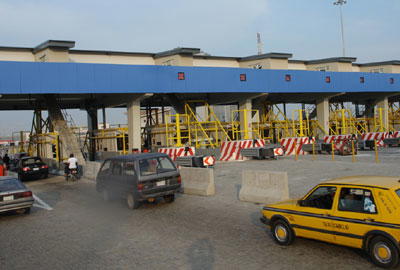
Lekki-Epe Tollgate… cause of disagreement
By Pini Jason
ONE of the most profound statements I have come across in recent time is that we cannot become what we want to be by remaining what we are! Every time I reflect on this maxim, I end up asking myself whether in truth, we Nigerians really want to make progress and become the developed country that we want to be.
I ask myself if we have the guts it takes to become what we want to be. These questions become even more relevant whenever I look at the way we conduct our national life.
Not a new idea: Last week, I was watching the Minister of Works, Mr. Mike Oziegbe Onolememen, on TV justifying the return of tollgates on Federal highways.
Anybody new in Nigeria who listened to him would think that the Minister was introducing tollgates as a new idea in the country; you could even swear that the Minister has just invented tollgates! But he was “educating” us about what was part of our lives way back in the seventies, till Gen. Olusegun Obasanjo became President in 1999 and thereafter rolled the tanks on the tollgates.
When the tollgates were conceived, the rationale was to raise funds for the maintenance of the roads. The tollgates also served as markers and stopovers for travellers. You could stop there, ease yourself, take cold drink and allow your vehicle a few minutes to cool down.
There is no doubt that accounting and managing the money collected, like everything Nigerian, became problematic. The tollgates were handed out as political patronage. However, one can say that collection of tolls was stopped and the toll plazas crudely destroyed without thinking the matter through. We could have stopped collecting tolls without destroying the plazas. What we would have done now would have been simply to upgrade the plazas. But we have too much money and our problem has always been how best to foolishly spend it! Moreover, demolishing the plazas meant contract for the boys. Building new ones now will also be contracts for the boys!
Imbroglio over driving licence and plate number
It is very difficult to decipher how we arrive at what is the appropriate time to do certain things. Take the ensuing imbroglio between the National Assembly and the Federal Road Safety Corps, FRSC, over the new driving licence and vehicle plate numbers, for example. The issue for me is not whether the FRSC has the right to issue the licence and plate numbers.
The issue is WHEN did the National Assembly become aware of the scheme? The FRSC has been issuing these documents since Olu Agunloye’s era. What has suddenly changed now? I ask these questions because it was public knowledge that the FRSC was introducing new drivers’ licence and vehicle plate numbers. The National Assembly could not have been unaware when President Jonathan launched the scheme. Why has the National Assembly suddenly woken up to question the scheme?
One is not questioning the right of the National Assembly to exercise its oversight functions, but it is unedifying when such function is carried out in a manner that could be seen as perfunctory. Assuming the FRSC has no constitutional rights whatsoever to issue the new licence and plate numbers, is it not a dereliction of duty for the National Assembly not to have stopped the illegality in time and saved the nation the money spent on the scheme? If you remember that the FRSC was once merged with the Nigeria Police, and later to be de-merged (just like removing and re-introducing the tollgates) you are excused if you question whether it is sentiment or rigour that goes into our policy formulation and execution. These policy flip-flops have proved the bane of our economy.
Policy flips-flops
During Gen Ibrahim Babangida’s era as President, there was this policy that export of cocoa beans would no longer be allowed. Only the export of cocoa butter would be allowed in order to add value to our export products. Great policy! After all, we wanted to diversify our export away from crude oil only. Many industrialists jumped into the new venture of cocoa processing.
A place called Ile-Oluji became synonymous with cocoa processing. Industries re-tooled and spent huge sums on new moulds. Banks gave loans to industries to take advantage of the new boom. Then, what happened? Before factories could test run their new moulds, the policy was reversed without a bat of the eyelid!
Not only did investors lose money on what became a misadventure, several banks and many of the emerging nought-nine-nought bankers got into trouble. This project sank a particular new generation bank and their promoters were dragged to NDIC and subsequently detained. There were litigations over takeover of companies under receivership. In short, many people were ruined!
In like manner, there was so much noise about local production of wheat and sorghum for the use of our breweries. Again everybody dived into wheat and sorghum production and marketing. I was so proud of the wheat revolution that I took the Boston, USA-based Christian Science Monitor TV network to a wheat farm in Kaduna to feature in a documentary we were doing on Nigeria in 1990. Breweries re-tooled and set up plants for sorghum malting. Sorghum beer did not smell well, but we, the patriotic drinkers, did not mind. Clever brewers were cautious about Nigeria’s policy inconsistency and introduced entirely new sorghum-based brands to protect their leading brands. They were right. You may ask: where is the sorghum policy today?
Last week, a national newspaper published the photograph of the Secretary to the Government of the Federation, Senator Anyim Pius Anyim, hugging a loaf of bread, made of cassava flour, distributed to members of the Federal Executive Council last Wednesday by the Minister of Agriculture, Dr. Adesina Akinwunmi. The Minister seems to have stumbled on the novel idea of Nigeria consuming what she produces instead of having gluttonous appetite for imported goods. Great! But why did this same Federal Government remove the restriction on the importation of toothpicks and furniture thus throwing the local industries into precarious positions?
Why is the government still encouraging importation of textile goods at the same time it is throwing over N500 billion of tax payers’ money into reviving our textile industry? Why does the same Federal Government insist on importing refined petrol instead of fixing our refineries while quarreling over removal of subsidy? Why is the same government giving waivers to monopolists to import rice while we spend money on FADAMA rice? Now radio-active calcium has been found in rice in Japan! Such rice may be on its way to our market!
In any case, Minister Akinwunmi’s cassava revolution is as old as the Nigerian state. My grandmother’s main economic lifeline was cassava. Only yesterday President Obasanjo was on cassava crusade as if it is was a new discovery. Everybody became a cassava farmer. As usual, with everybody producing cassava, there soon was a glut. The cassava revolution died even before Obasanjo left office!
I am not running down the idea of relying on our God-given resources. We should survive on them. That is why God gave them to us in the first place. For example, 40 percent of fuel used by South Africa is Sasol refined from coal in Sasolburg, South Africa. But what have we done with our own coal, one of the best in the world? Nothing, except play bad politics with it!
Inconsistency of vision
Some people attribute our problem to policy execution. Other say the problem lies in policy formulation, that once the formulation is wrong, the execution becomes difficult. But it seems another aspect of the problem is the inability to sustain even that we have decided to do. There is an inconsistency of vision and haste in thinking through our problems.
Take the clear case of the appointment of Dr. Ngozi Okonjo-Iweala, the Minister of Finance. When she first came to serve Nigeria, there was no doubt about her abilities. And quickly, she restored international confidence in a country that was a pariah. But midway she was frustrated out, in my view, because of the desire for free access to the treasury for the imminent elections.
But imagine that she had been managing our economy since then, is it not possible that we would have bitten some of the hard bullets of reforms and come out of our economic quagmire? Just a thought!
When you take one step forward and four steps backward, you are definitely heading only one direction—backwards.
Disclaimer
Comments expressed here do not reflect the opinions of Vanguard newspapers or any employee thereof.