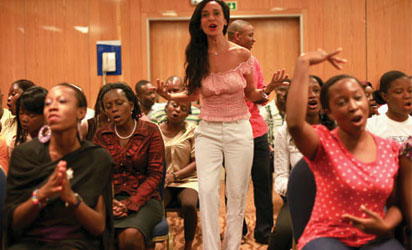
Maria Cecilia Toledo de Schmillen, the glamorous opera singer wife of a former German Ambassador to Nigeria on stage
By Donu Kogbra
MARIA Cecilia Toledo de Schmillen, the glamorous opera singer wife of a former German Ambassador to Nigeria, established AMEMUSO (the Abuja Metropolitan Music Society) and AMEMUSITO (a subsidiary for youngsters) while she and her husband, Joachim, were based in the Federal Capital.
They were transferred to the German Embassy in Peru earlier on this year, but Maria-Cecilia continues to take an active interest in mentoring and entertaining Nigerian classical music-lovers, whether they be students or audiences. She is trying to raise millions of naira to construct a stylish, 800-capacity Performing Arts Centre and Music School and is in Abuja, at the moment, preparing for a concert and competition that will take place this coming Sunday 27, at the Hilton Hotel (start time: 7.30pm. Ticket price: N5000 for two people).
The theme will celebrate Abuja as a “Unity City”. The orchestra will be flown in from Germany. Talented Nigerian singers will be joined by skilled performers from other countries. Members of the audience will be given the opportunity to vote for their favourite acts. And I would strongly advise any Vanguard reader who can make it to show up because I’ve attended Maria Cecilia’s extravaganzas before and have found them to be fantastically uplifting. And it’s not as if one gets a chance to participate in this kind of world-class cultural event every day.

Maria Cecilia Toledo de Schmillen, the glamorous opera singer wife of a former German Ambassador to Nigeria on stage
I’m sure that some of you will want to know more about this foreign lady who has embraced Nigeria so warmly and invested so much energy in broadening the scope of our creative landscape. So here are a few details about her:
Maria Cecilia was born in Chile to a portrait painter mother and naval admiral father. She initially studied law and literature at the University of Santiago but changed direction when she met Ricardo Kistler, who ran the best choir in Chile and took her under his wing when he found out that she had a wonderful voice.
Maria Cecilia eventually left Chile to study in Austria, where she met another influential mentor – Placido Domingo, one of the 20th century’s opera greats – who provided her with training and helped her get a scholarship. She has subsequently enjoyed a successful career that has taken her to top concert venues all over the globe. And she now combines her role as an ambassador’s wife with her interest in encouraging musically-gifted Nigerian children to fulfil their potential as singers or instrumentalists.
Maria Cecilia has received considerable appreciation in certain quarters and she proudly displays the congratulatory message she received from Dr. Goodluck Jonathan in 2009, when he was still Vice-President. Jonathan was apparently so impressed by her efforts that he agreed to become an AMEMUSO Patron.
But it isn’t always easy to persuade people to believe that what she is doing is worthwhile. Some onlookers have expressed the view that European classical music is an “alien” art form that has no place in Africa, while others feel that an expensive Performing Arts Centre/School is a luxury we can do without at a time when Nigeria has so many social, economic and infrastructural problems.
Maria Cecilia’s response to such criticisms is that she regards all aspects of human development as important, respects traditional Nigerian music and has gone out of her way to include indigenous songs in the concerts she hosts. Anyone who wishes to know more about this project – or to donate time, ideas or money – should check out the AMEMUSO website: www.amemuso.com
Nigerian influence spreads!
MY sister lives in the UK and I thought she was mischeviously exaggerating when she told me that Nigerians have become so dominant in certain parts of London that their non-Nigerian neighbours can now speak Nigerian languages.
And then I went to Peckham during a recent visit to London; and what I saw and heard with my own eyes and ears proved that my sister had not been kidding me!
Peckham is a fascinating multi-cultural melting pot in which mostly poor White, Asian and Black African and Caribbean people live side by side. And I like the place because, even though it is ugly and over-crowded, it is full of ethnic grocery stores; and if there is one aspect of Nigeria of which I am unconditionally fond, it is the food.
I absolutely love Nigerian delicacies like fried snails, egusi soup and ugba (with shaki, stockfish and garden eggs!). So it figures that I would have an affectionate attitude towards any district that can provide me with such items when I am abroad. Especially in the middle of a horribly cold English winter.
Anyway, off I trotted to Peckham the other day, shivering as the icy wind tormented me and dreaming of the hot, blood-warming dried fish peppersoup that I intended to prepare when I had purchased the necessary ingredients.
My first port of call was a Nigerian-owned shop; and while I was queuing up to pay for my goods, a Chinese girl entered the establishment, bobbed a deferential Yoruba-style curtsey to the Yoruba Madame who owns the joint and said: “Ekale Ma”. And I nearly fell off my perch!
I had a similar experience in another shop where I overheard a Pakistani butcher speaking almost fluent Igbo to one of his customers. And I’m told that it is increasingly common nowadays for non-Nigerians to use Nigerian phrases and slang – “ah-ah!”, for example – even when they are talking to each other.
Nollywood movies – which are immensely popular in certain non-Nigerian enclaves – have also played a part in spreading Nigerian influence to distant lands. I guess this is what is known as cultural imperialism?!
Disclaimer
Comments expressed here do not reflect the opinions of Vanguard newspapers or any employee thereof.